

More news on this day
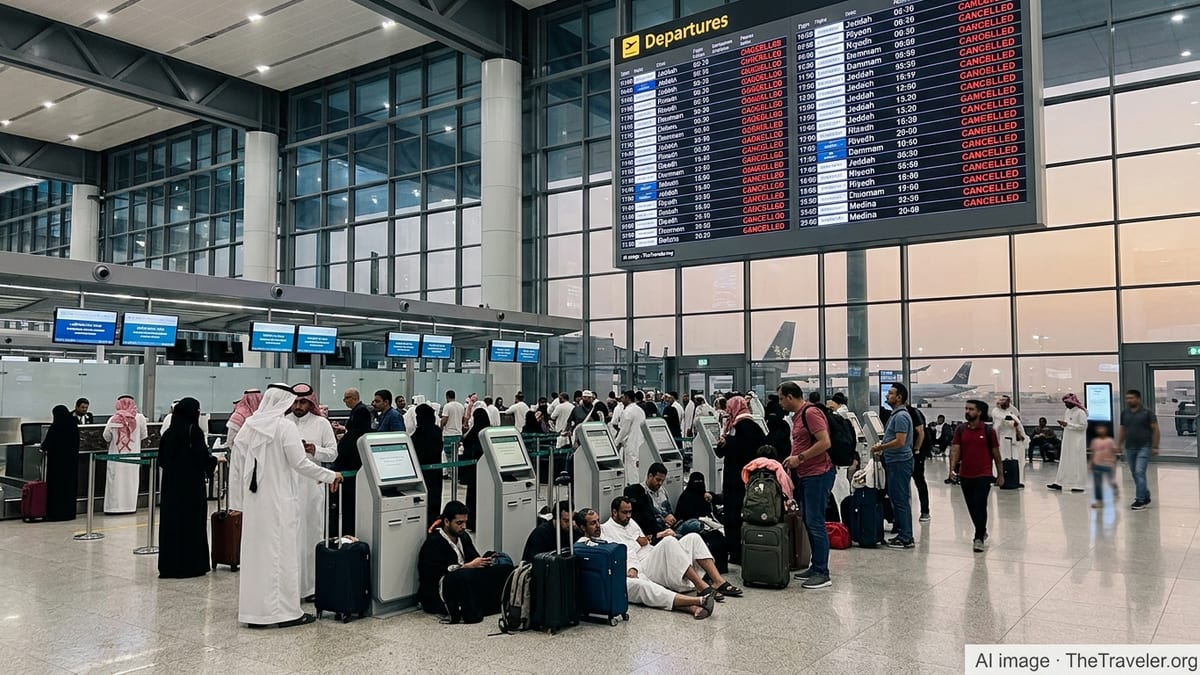
Saudi Arabia is facing another bout of air travel disruption as more than 60 flights serving Jeddah, Riyadh, Dammam, Medina and other key routes are cancelled or rerouted, with Gulf Air, Qatar Airways, KLM and several other major carriers adjusting schedules in response to evolving regional security risks and airspace restrictions across the Gulf.
Get the latest news straight to your inbox!
Regional Tensions Keep Pressure on Saudi Airspace
Recent regional tensions linked to the wider conflict involving Iran and Gulf states continue to ripple through commercial aviation, with Saudi Arabia once again positioned at the centre of shifting air corridors. Publicly available assessments of the Middle East airspace picture in March 2026 describe a patchwork of closures, restrictions and temporary operating corridors as airlines seek to balance safety, insurance considerations and operational viability.
Analysts tracking aviation patterns in the region note that Saudi airports have remained technically open, but are operating under tighter routing constraints, especially on paths that would normally cross Iranian, Iraqi or adjacent contested airspace. These constraints have led carriers to either extend flight times through lengthy detours or, in many cases this week, cancel services altogether when rerouting is no longer commercially or operationally feasible.
The result is a new wave of schedule changes affecting both point to point traffic into Saudi Arabia and connecting itineraries that rely on Gulf hubs. Passengers have reported last minute cancellations, aircraft downgrades and fragmented journeys as airlines continually recalculate their exposure to volatile airspace and updated safety guidance.
Jeddah, Riyadh, Dammam and Medina See Clustered Cancellations
Data compiled from airport schedules and airline bulletins indicates that the latest disruptions are heavily concentrated on Saudi Arabia’s busiest gateways: Jeddah’s King Abdulaziz International Airport, Riyadh’s King Khalid International Airport, Dammam’s King Fahd International Airport and Prince Mohammad bin Abdulaziz International Airport in Medina. These airports handle a mix of business traffic, labour flows, religious travel and long haul connections, magnifying the impact of any cutbacks.
Reports summarising March flight operations in the wider Middle East show double digit cancellation rates on certain cross border city pairs involving Saudi Arabia, particularly where services intersect with Israel, Qatar or other states caught in the current security crisis. Within that broader pattern, more than 60 individual flights linked to Saudi routes have been removed from schedules or zeroed out for upcoming days, including multiple frequencies in and out of Jeddah, Riyadh and Dammam.
Medina, a key gateway for religious travellers, has also seen targeted cancellations and temporary suspensions on selected international services. Some airlines have opted to consolidate religious traffic onto fewer departures rather than maintain thinner point to point links, a strategy that reduces exposure while still preserving limited capacity for essential journeys.
Gulf Air, Qatar Airways, KLM and Other Carriers Adjust Operations
Among the airlines most visibly reshaping their Saudi schedules, Gulf Air has trimmed services across several Gulf and Levant destinations as part of a broader recalibration of flights in and out of the region. Publicly available travel briefings describe Bahrain’s flag carrier cancelling or suspending rotations on routes where diversions around high risk airspace significantly erode efficiency, a pattern that has included selected flights touching Dammam and Riyadh.
Qatar Airways, already operating under a constrained framework following repeated missile and drone activity around Qatar, has continued to publish rolling “limited schedule” updates. Passengers and travel agents report that some itineraries linking Saudi cities with Doha for onward long haul connections have been cancelled at short notice, even when flights initially appeared as scheduled. The carrier’s advisories emphasise that only a subset of services are operating and that normal commercial flying remains curtailed while air navigation capacity is restricted.
European carriers have also taken a cautious stance. Operational documents circulated in mid March highlight that KLM, for example, is avoiding Iranian, Iraqi and Israeli airspace and adjusting several Gulf routes accordingly. While the airline has been planning growth in Saudi Arabia over the longer term, its near term schedule shows selected cancellations and rerouted services affecting links that touch Riyadh and Dammam, reflecting the complexity of navigating the current airspace configuration.
Other regional and European airlines, including Turkish and various low cost operators, are similarly pruning networks around higher risk corridors. Some have suspended flights to cities such as Dammam for defined periods, effectively reducing the number of one stop options available to travellers heading to or from secondary Saudi markets.
Passengers Confront Delays, Detours and Limited Alternatives
For travellers, the renewed disruption is translating into a familiar mixture of uncertainty and logistical headaches. Publicly shared passenger experiences indicate that many only learn of cancellations within 24 to 72 hours of departure, as airlines wait for the latest guidance before finalising whether a given flight can operate along an acceptable route. This just in time decision making can leave passengers scrambling to find alternatives across already constrained networks.
Rebooking has also become more complicated. Some Gulf carriers previously offered relatively flexible rerouting via partner or third party airlines, but recent policy updates circulated to trade partners suggest tighter rules and a greater emphasis on rebooking onto the same airline’s own metal where possible. Travellers attempting to switch from disrupted Gulf itineraries onto European or Asian competitors are finding availability limited, particularly during peak travel days around weekends and religious observances.
Where flights do operate, journey times can be significantly longer due to detours around sensitive airspace. This has knock on effects for connections, with some passengers missing onward long haul departures and being forced into overnight stays or multi day delays. Travel planners note that even seemingly straightforward regional hops into Saudi Arabia now carry a higher risk of disruption than usual, prompting many to build in additional buffer time or seek routings via more stable hubs.
What Travellers Need to Know Before Flying to Saudi Arabia
With conditions shifting rapidly, travel specialists advise treating any itinerary involving Jeddah, Riyadh, Dammam or Medina in the coming weeks as subject to change. Public information from risk consultancies and aviation trackers underscores that while Saudi airports remain open, airlines are erring on the side of caution when evaluating routes that intersect with contested airspace or depend on tight scheduling around restricted corridors.
Passengers are encouraged, based on widely shared guidance, to monitor their booking directly through the airline’s manage my trip tools and to check flight status repeatedly in the 72 hours leading up to departure. Many carriers have activated special commercial policies that allow at least one free date change or refund for affected flights, but the exact terms vary and may be restricted to travel within set date ranges.
Travel industry observers also stress the importance of having flexible accommodation and ground transport arrangements, especially for time sensitive trips tied to business meetings, religious travel or medical appointments. Given the possibility of last minute changes, itineraries that build in flexibility on both ends of the journey are likely to prove more resilient.
While there is cautious optimism in some aviation briefings that schedules could stabilise if regional tensions ease, there is no firm timeline for a full return to normal operations. For now, Saudi Arabia’s main international gateways remain open yet vulnerable to the wider security picture, leaving airlines and passengers to navigate a continuously shifting landscape of routes, detours and cancellations.