

More news on this day
Hundreds of travellers were left stranded across Europe this weekend as a new wave of disruption saw more than 1,200 flights delayed and nearly 140 cancelled, hitting major hubs in the United Kingdom, the Netherlands and Germany and rippling through airports from Munich to Zurich.
Delays and Cancellations Mount Across Key European Hubs
The latest round of disruption peaked between Thursday and Saturday, 5 to 7 March, with data from flight compensation specialists and regional aviation trackers indicating at least 1,201 delays and 138 cancellations across Europe’s main markets. Those figures build on already elevated disruption levels earlier in the week, compounding pressure on carriers and airport operations.
Services in and out of the United Kingdom, Germany, the Netherlands, France, Spain and Italy were among the worst hit, with knock-on effects spreading well beyond Europe to North America, the Middle East and Asia. London Heathrow and Gatwick, Amsterdam Schiphol, Frankfurt, Munich and Zurich all reported tightly stretched operations as arrival delays cascaded into missed departure slots and aircraft and crew found themselves out of position.
Industry analysts say the pattern now emerging is one of rolling disruption, where even modest shocks to the system quickly translate into widespread delays as airlines attempt to run dense schedules with little slack. The result for passengers on the ground is growing uncertainty, longer queues, and a rising risk of unplanned overnight stays as connections are missed and replacement services fill up.
While precise totals are still being updated, aviation data aggregators and passenger-rights firms agree that the past several days mark one of the most disrupted periods of the winter for European air travel, with little sign of an immediate return to normal schedules.
British Airways, Lufthansa and easyJet Among Hardest Hit
Flag carriers and low cost airlines alike have been swept up in the turmoil, but British Airways, Lufthansa and easyJet have borne a significant share of cancellations and extended delays. British Airways has faced repeated schedule adjustments on short-haul services linking Heathrow and Gatwick with continental Europe, as well as on some longer-haul sectors fed by those routes.
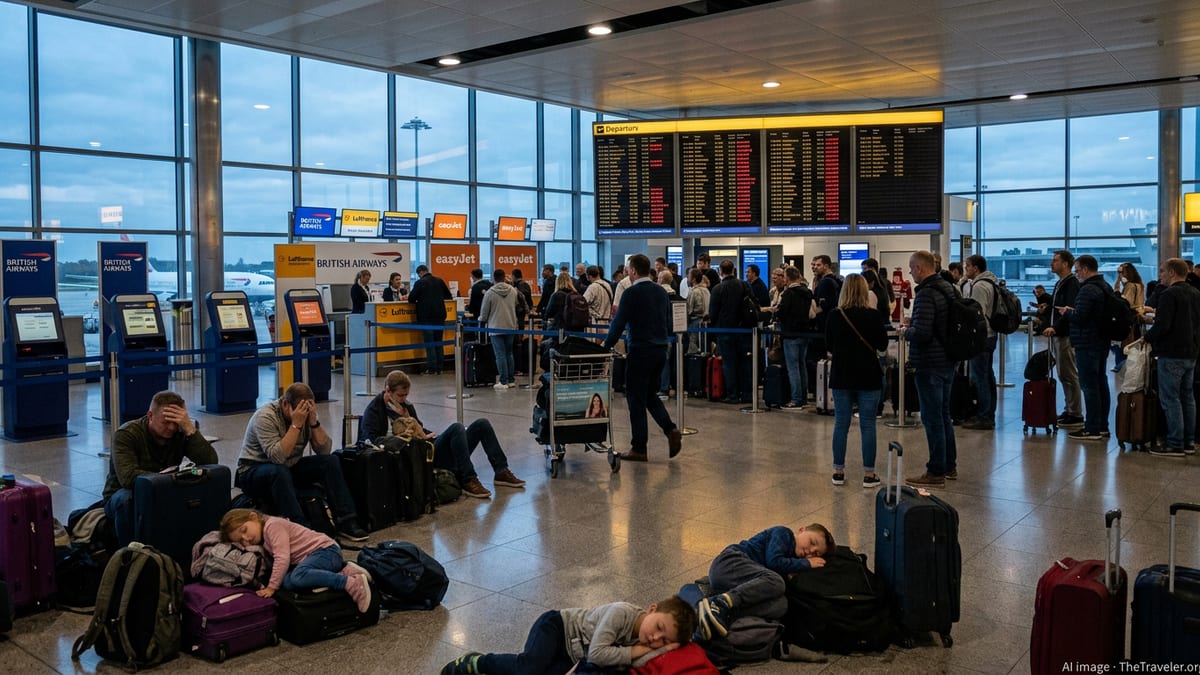
Lufthansa has reported operational challenges at its key German hubs, with Frankfurt and Munich both experiencing waves of delayed departures and several cancellations in recent days. In Munich and Berlin, a cluster of cancellations and lengthy delays left passengers queueing at customer service desks and crowding around departure boards as they searched for alternative options.
easyJet, with its large footprint at Gatwick and across core European leisure markets, has struggled with late-running aircraft arriving from disrupted regions and with congestion at slot-constrained airports. Additional carriers, including KLM, SWISS, Air France, Emirates, Qatar Airways and Delta Air Lines, have also reported cancellations or reroutings tied to the broader network instability.
For airlines, the challenge lies in juggling aircraft rotations and crew duty limits while accommodating stranded customers. With many services now running near capacity, rebooking passengers from a single cancelled flight can require space on multiple later departures, including from different airports and sometimes even different countries.
Munich and Zurich Feel the Strain as Disruption Ripples Outward
Germany’s Munich Airport and Switzerland’s Zurich Airport have emerged as key pressure points in this wave of disruption, both because of their roles as major hubs and because of the broader constraints affecting airlines based there. In Munich, disrupted Lufthansa and partner operations have created bottlenecks for travellers headed to destinations across Europe, North America and the Middle East.
Zurich has also seen compounding pressure as SWISS and other carriers adapt schedules in response to both European operational challenges and ongoing suspensions of services to parts of the Middle East. The result has been a patchwork of cancellations and reroutings that can strand transfer passengers mid-journey when one leg of a multi-stop itinerary is disrupted.
Scenes at both airports on Friday and Saturday featured long lines at ticket counters, crowded seating areas and passengers bedding down on terminal floors as hotel capacity around the airports tightened. Travellers reported waiting hours to speak with airline staff, and in some cases being advised to seek rail alternatives for regional journeys within Europe.
Secondary hubs and regional airports from Manchester and Edinburgh to Berlin and Geneva have felt the knock-on impact as well, with late-arriving aircraft triggering curfew concerns and forcing some services to be cancelled outright when they exceeded local operating limits.
Middle East Conflict and Winter Weather Add to Operational Pressures
The timing of the latest European disruption coincides with airspace restrictions and suspensions affecting parts of the Middle East, which have forced multiple carriers, including Lufthansa Group and SWISS, to halt or reroute services to Dubai, Abu Dhabi, Tel Aviv and other cities. These changes have diverted aircraft away from their usual patterns, reduced network flexibility and created additional complexity for scheduling teams.
At the same time, lingering winter weather issues and staffing constraints in air traffic control and ground operations have added a further layer of risk. Even when local conditions at an airport are stable, an arriving flight can already be significantly delayed due to earlier congestion or rerouting elsewhere, putting pressure on turnaround times and departure slots.
Aviation experts note that modern European airline networks, while efficient in good conditions, are especially vulnerable when multiple stressors coincide. Tight aircraft utilisation, congested airspace, and limited spare crews mean there is little capacity to absorb shocks, so relatively localized issues can quickly escalate into continent-wide problems.
For travellers, the result is a sense that disruption is no longer confined to major weather events or rare crises, but has become an increasingly common feature of long-distance journeys involving multiple connections.
Passengers Face Long Queues, Limited Information and Complex Rights
Across affected airports, stranded travellers have described hours-long waits at customer service points, difficulty getting through to airline call centres, and limited real-time information on new departure times. Many have turned to social media and third-party flight-tracking apps to piece together what is happening to their flights.
Under European passenger protection rules, customers caught up in cancellations and long delays on eligible flights are generally entitled to care such as meals and accommodation, and in some cases financial compensation, unless airlines can demonstrate that extraordinary circumstances were to blame. However, applying these rules in practice can be complicated when multiple factors, from weather to airspace closures, overlap.
Consumer advocates are urging travellers to keep all receipts for meals, transport and accommodation, to document communications with airlines, and to submit formal claims rather than relying solely on on-the-spot assurances. They also recommend checking the precise conditions of each booking, particularly where journeys involve multiple airlines on a single ticket or a mix of EU and non-EU carriers.
With flight loads already high, experts warn that recovery from this latest wave of disruption may take several days, even if no further shocks emerge. Travellers with imminent departures are being advised to monitor flight status closely, allow extra time at the airport, and consider alternative routings where feasible.