

More news on this day
Travelers moving through Turkey and the wider region are facing another bout of disruption as Gulf Air, Qatar Airways, Flydubai and other carriers cancel additional services, squeezing capacity on routes between Istanbul and key Gulf hubs while winter weather continues to unsettle U.S. connections between Marquette and Detroit.
Get the latest news straight to your inbox!
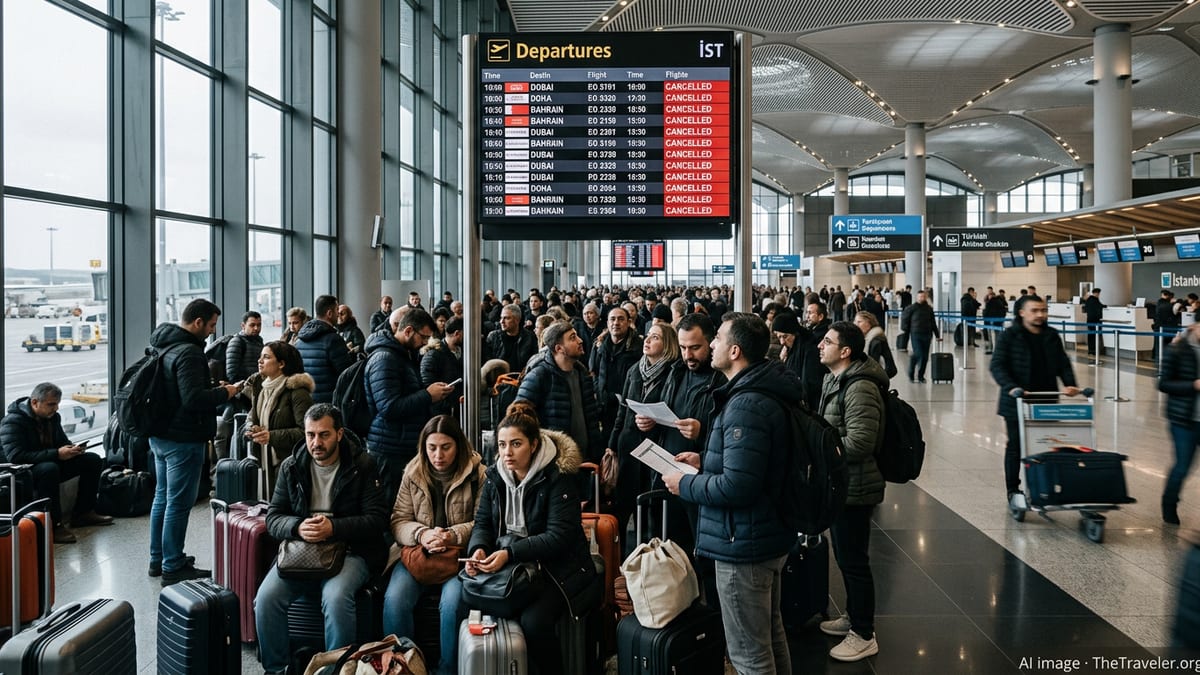
Latest Cancellations Hit Istanbul–Gulf Connections
Publicly available flight-status data and regional media coverage indicate that nearly a dozen additional services linking Istanbul with Bahrain, Doha and Dubai have been withdrawn or trimmed in recent days, building on a pattern of rolling disruption that began in late February. Gulf Air, Qatar Airways and Flydubai appear among the carriers most affected, with schedules repeatedly adjusted as operational and airspace constraints ripple across the network.
On the Istanbul–Doha corridor, Qatar Airways has already been operating a reduced timetable following restrictions on Qatari airspace and tightly controlled capacity at Hamad International Airport. Updated guidance for ticketed passengers through late March points to continued suspensions and retimings, leaving many Istanbul-origin travellers dependent on scarce seats via alternative hubs such as Istanbul Airport’s extensive European and Asian connections.
Flights between Istanbul and Bahrain have also come under pressure. Regional business outlets report that services to Bahrain International Airport have been repeatedly thinned across several carriers as Gulf-based airlines prioritize core trunk routes and essential links under constrained conditions. For Gulf Air, which relies heavily on east–west connecting traffic, any reduction in Istanbul feed further complicates its broader schedule.
Istanbul–Dubai services, including those operated by Flydubai, remain comparatively more frequent but have not been immune to cancellations. Adjusted rotations and aircraft swaps have been reported as carriers try to match capacity with sudden changes in demand and route viability, producing a patchwork of last-minute changes that are proving difficult for passengers to anticipate.
Qatar Airways Rerouting and Policy Changes Prolong Uncertainty
Qatar Airways remains at the center of the regional upheaval. A series of publicly posted advisories for travel agents and passengers in March highlight an extended window for no-fee changes and refunds for certain tickets, reflecting the airline’s expectation of continued instability at least through the end of the month. The carrier has also been operating what it describes as limited services in and out of Doha while it works around airspace and security constraints.
At the same time, reports shared by affected travelers show a growing reliance on rerouting via Istanbul when direct Doha connections are not available. Passengers originally ticketed on itineraries such as Frankfurt–Doha–Singapore or Barcelona–Doha–Clark have described being moved onto routings that connect through Istanbul on partner or third-party airlines, illustrating how Turkey’s main hub is absorbing spillover demand from disrupted Gulf operations.
The rerouting process, however, is far from seamless. Travel forums and consumer reports describe long waits to reach call centers, repeated rebookings onto later Qatar Airways flights that are themselves vulnerable to cancellation, and confusion over the exact conditions under which tickets can be refunded or endorsed to other carriers. This uncertainty is particularly acute for those transiting Istanbul en route to Asia or Africa, where alternative options can quickly sell out.
For Istanbul Airport, now one of the world’s busiest international hubs, the volatility introduces additional complexity to an already dense bank of connections. Ground operations must accommodate late-notice aircraft changes and fluctuating passenger flows, even as travelers seek clarity at check-in desks about whether onward sectors to Doha will depart as planned.
Flydubai and Gulf Air Adjust Networks as Gulf Tensions Linger
Flydubai and Gulf Air have both been adjusting their broader networks in response to the evolving security and airspace picture across the Gulf. Coverage from regional newspapers in early March noted that carriers serving Bahrain and the United Arab Emirates trimmed or consolidated some services as military activity and related restrictions reshaped preferred flight corridors. For point-to-point markets such as Istanbul–Dubai and Istanbul–Bahrain, that has translated into thinner schedules and occasional day-of-departure cancellations.
For Flydubai, the Istanbul link forms part of a wider web of medium-haul routes that channel traffic into Dubai’s role as a connecting hub. When rotations are cut or timings are shifted, knock-on effects can be felt across onward connections to South Asia and East Africa, particularly on itineraries that rely on tight transfers. Passengers originating in Turkey report being re-accommodated on later services or, in some cases, moved to other carriers out of Istanbul when Dubai-bound flights are withdrawn.
Gulf Air’s position is similarly delicate. The Bahrain-based airline has been working to maintain a core schedule amid heightened regional tensions, but reductions affecting flights to and from Turkey have been noted in online timetables and local press. Business travelers who depend on the Istanbul–Bahrain route for access to corporate and financial centers in Manama face limited alternatives when services are thinned, often needing to connect via other Gulf hubs at less convenient times.
Collectively, these adjustments have narrowed the range of same-day travel options between Istanbul and Gulf capitals, creating a more fragile network in which a single aircraft swap or airspace closure can cascade into multiple cancellations.
North American Weather Adds Pressure on Marquette–Detroit Corridor
Compounding the disruption in the transcontinental journey chain, the Upper Midwest of the United States has been contending with severe late-winter weather that has heavily affected the short but vital route between Marquette and Detroit. A powerful March storm system produced blizzard conditions and ice across parts of Michigan, forcing airlines to cancel waves of regional flights that feed larger hubs.
Official meteorological summaries show that the storm brought record or near-record snowfall to sections of Michigan’s Upper Peninsula, including areas served by Sawyer International Airport near Marquette. As visibility dropped and crosswinds intensified, airlines preemptively cancelled or consolidated multiple rotations to Detroit, disrupting links for passengers attempting to connect onward to national and international services.
This localised disruption has global implications. Travelers returning from Istanbul or Gulf cities to U.S. destinations via Detroit depend on reliable regional connections to complete their journeys. When the Marquette–Detroit leg is cancelled, passengers can find themselves stranded far from home despite having successfully navigated the more complex international segments of their trip.
With winter weather systems still possible well into March, regional carriers operating the Marquette–Detroit route are likely to continue taking a cautious approach, prioritising safety over schedule reliability when conditions deteriorate.
What Travelers Can Expect in the Coming Days
Based on current schedules and airline advisories, the near-term outlook for routes linking Istanbul with Bahrain, Doha and Dubai, as well as regional flights between Marquette and Detroit, remains unsettled. Airlines are making frequent short-notice changes as they respond to a combination of security considerations, airspace restrictions, crew and aircraft availability, and adverse weather.
For passengers, this means itineraries that rely on tight connections between these points carry increased risk of disruption. Those with upcoming travel that includes Istanbul–Gulf sectors or a Marquette–Detroit feeder segment may face schedule changes even after online tools show flights as confirmed, as carriers continue to fine-tune operations closer to departure.
Consumer advocates and frequent-flyer communities are broadly advising travellers to monitor their bookings closely, ensure contact details are updated in airline profiles, and consider building in longer connection times where possible. While flexible rebooking and refund policies introduced by airlines such as Qatar Airways provide some protection, seat availability on alternative routings through Istanbul and other hubs can quickly become constrained when a new wave of cancellations occurs.
With regional tensions and late-season storms still in play, the network connecting Istanbul, Gulf capitals and U.S. Midwest gateways is likely to remain fragile, and further short-notice cancellations cannot be ruled out in the days ahead.