

More news on this day
New York City moved to a near standstill this week as officials enforced a sweeping travel ban and closed public schools while a historic blizzard pummeled the northeastern United States, dumping several feet of snow, crippling transit and triggering states of emergency from New Jersey to Massachusetts.
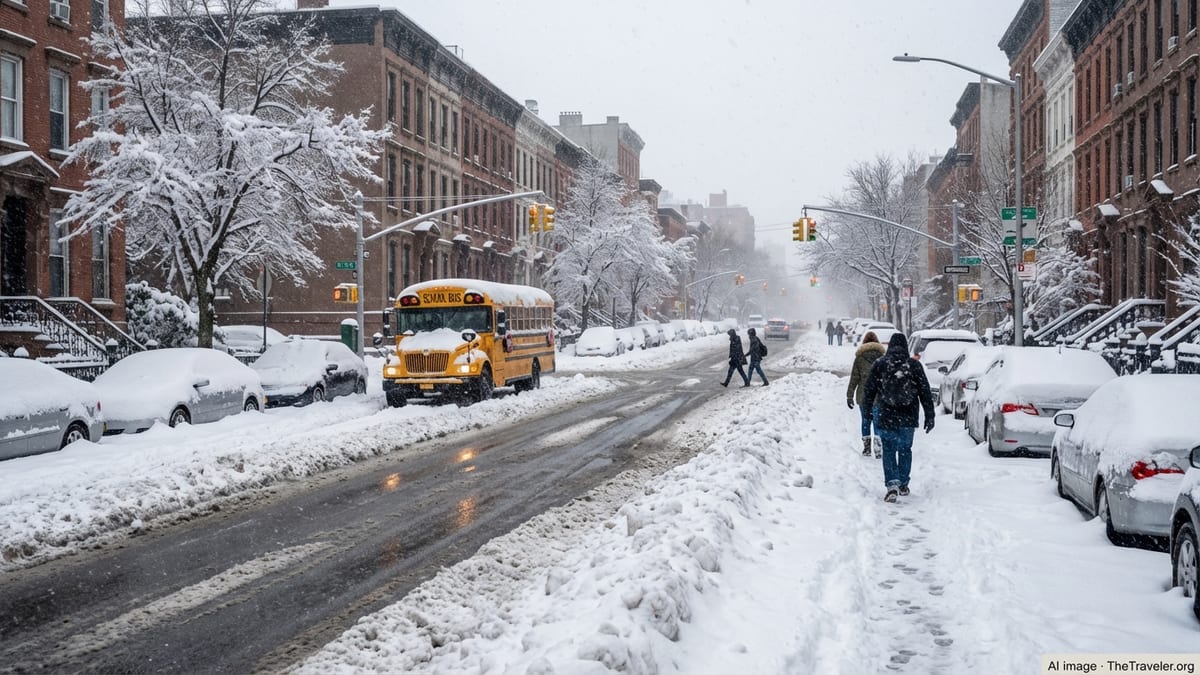
Emergency Orders Bring New York to a Halt
New York City officials declared a local state of emergency as the blizzard intensified late Sunday into Monday, ordering a rare citywide travel ban that effectively emptied one of the world’s busiest urban road networks. The restrictions, which began at 9 p.m. on February 22, barred most private vehicles from streets, bridges and tunnels so plows and emergency crews could work without obstruction.
Mayor Zohran Mamdani urged residents to stay indoors and avoid all nonessential movement as forecasters warned of blizzard conditions and rapid snowfall rates. The order followed similar emergency declarations and highway restrictions across New York State and neighboring New Jersey, Rhode Island and Massachusetts, where officials reported whiteout visibility and hurricane force wind gusts along the coast.
By Monday morning, snow totals across the New York metropolitan area ranged from roughly 16 to nearly 24 inches, with higher localized amounts on Long Island and parts of Staten Island. The heavy, wind driven snow quickly overwhelmed secondary streets, while visibility on major arteries such as the Long Island Expressway and New Jersey Turnpike deteriorated to near zero at the storm’s peak.
City agencies mobilized in force, with the New York City Department of Sanitation deploying more than 2,000 plows and hundreds of salt spreaders. The Metropolitan Transportation Authority curtailed or suspended some above ground services and ran de icing trains to keep critical rail corridors open, even as officials warned that ongoing snow removal and drifting would hamper travel long after the formal ban expired.
Schools Close as Region Rekindles the Classic Snow Day
As the storm’s trajectory became clear, New York City announced all public schools would close on Monday, February 23, marking the city’s first full traditional snow day since before the pandemic era. Officials emphasized that there would be no remote instruction and that all after school programs were canceled, a notable reversal from recent years when districts often shifted classes online instead of shutting down entirely.
The closure affected the nation’s largest school system, with more than one million students suddenly homebound as snow piled up outside. Facilities that double as warming centers and emergency shelters remained open, but most campuses were dark while operations teams concentrated on digging out entrances, clearing roofs and checking heating and backup power systems.
While many families welcomed the unexpected break, the decision set off a logistical chain reaction across the region. Suburban districts on Long Island and in northern New Jersey also canceled classes, with some extending closures into Tuesday due to impassable local roads. Philadelphia pivoted to virtual instruction, underscoring how differently districts across the Northeast now balance safety concerns and instructional time when severe weather strikes.
By Tuesday, New York City signaled a rapid return to normal by confirming schools would reopen for in person learning on February 24. The announcement drew pushback from some local officials and the teachers union, who argued that buried sidewalks and narrowed streets would make the morning commute hazardous, particularly for children who walk or rely on yellow buses navigating tight residential blocks.
Travel Chaos Across the Northeastern Corridor
The blizzard’s impact rippled far beyond city streets and classrooms, paralyzing one of the world’s busiest air and rail corridors. Airlines canceled more than 5,000 flights on Monday alone, with near total shutdowns at New York’s John F. Kennedy and LaGuardia airports, Newark Liberty in New Jersey and Boston Logan in Massachusetts. Carriers preemptively scrubbed schedules to avoid aircraft and crew being stranded in whiteout conditions.
Amtrak scaled back service along the Northeast Corridor, suspending or truncating multiple routes between Washington, New York and Boston as heavy snow and high winds battered overhead wires and trackside infrastructure. Regional rail lines around New York operated on emergency timetables, warning passengers to expect delays, cancellations and crowded trains on the few services that continued to run.
On the ground, highway travel was equally fraught. States from New York to Rhode Island implemented partial or full bans on commercial trucks during the height of the storm in an effort to prevent jackknifed tractor trailers from blocking key arteries. Even where roads technically remained open, police and transportation officials pleaded with drivers to stay off the pavement, noting that stranded vehicles could slow emergency responses and snow clearing operations.
The resulting transportation gridlock stranded travelers across the region. Airports filled with passengers sleeping on benches or lining up to rebook itineraries, while bus companies and rideshare operators suspended service in many hard hit zones. Delivery platforms paused operations in New York City and other major hubs, further underscoring how completely the storm had stalled routine movement.
Power Outages, Coastal Damage and a Long Cleanup Ahead
Beyond transportation, the blizzard delivered a punishing blow to the region’s infrastructure. Strong winds paired with heavy, wet snow toppled trees and power lines, cutting electricity to hundreds of thousands of homes and businesses from coastal New Jersey through Cape Cod. Utility crews, themselves battling deep drifts and closed roads, warned it could take days to fully restore service in some of the hardest hit communities.
Along the shoreline, forecasters reported significant coastal flooding and beach erosion, particularly across parts of Long Island, Rhode Island and southeastern Massachusetts. High winds drove pounding surf into already vulnerable dunes and seawalls, a reminder of the growing vulnerability of low lying coastal areas as severe winter storms intersect with rising sea levels.
Inside New York City, officials opened additional shelter beds and warming sites to protect unsheltered residents from life threatening wind chills. Hospitals activated emergency staffing plans while urging non urgent patients to postpone visits until conditions improved. Local businesses weighed the cost of prolonged closures against the risks of employees commuting through snow choked streets.
With forecasters tracking the possibility of another winter system later in the week, emergency managers across the Northeast warned that the current storm’s impact could be compounded if cleanup proves slower than expected. Crews must clear not only major avenues and transit hubs but also residential side streets, intersections and pedestrian crossings, the last links in a mobility chain that remains fragile even as the blizzard’s fiercest winds subside.
Questions Over Preparedness and the Future of Winter Travel
As skies brightened and residents began to dig out, officials and transportation experts quickly turned to questions of preparedness and resilience. The storm, already being referred to by some meteorologists as one of the most intense Northeast blizzards in recent years, exposed how rapidly modern travel networks can seize up when snow, wind and freezing temperatures converge over dense population centers.
In New York, debates flared over the timing of the travel ban and school closures, with some arguing that earlier, more aggressive moves could have reduced the number of stranded commuters and abandoned vehicles. Others countered that the sweeping restrictions, including the city’s decision to bring back an old fashioned snow day, showed a willingness to prioritize safety over economic disruption in the face of increasingly volatile winter weather.
Transportation planners noted that the blizzard underscored the importance of investing in more agile snow removal fleets, hardier rail and airport infrastructure, and clearer communication with travelers during fast evolving storms. They also pointed to the growing role of remote work and virtual learning as tools that can reduce pressure on physical networks when roads and rails become too dangerous.
For now, New York and its Northeastern neighbors are focused on the immediate task of clearing snow, restoring power and reopening schools and transport hubs. Yet the images of empty highways, silent runways and children building snowmen on what would have been a regular school day have already reignited a broader conversation about how America’s busiest corridor can adapt to the kind of historic blizzards that meteorologists say may become less frequent but more intense as the climate continues to change.