

More news on this day
New York is moving to unlock a key slice of Brooklyn land for roughly 300 new homes near one of the borough’s busiest transit hubs, in a step that aligns with Governor Kathy Hochul’s wider campaign to steer more housing growth to rail- and subway-rich neighborhoods across the state.
Get the latest news straight to your inbox!
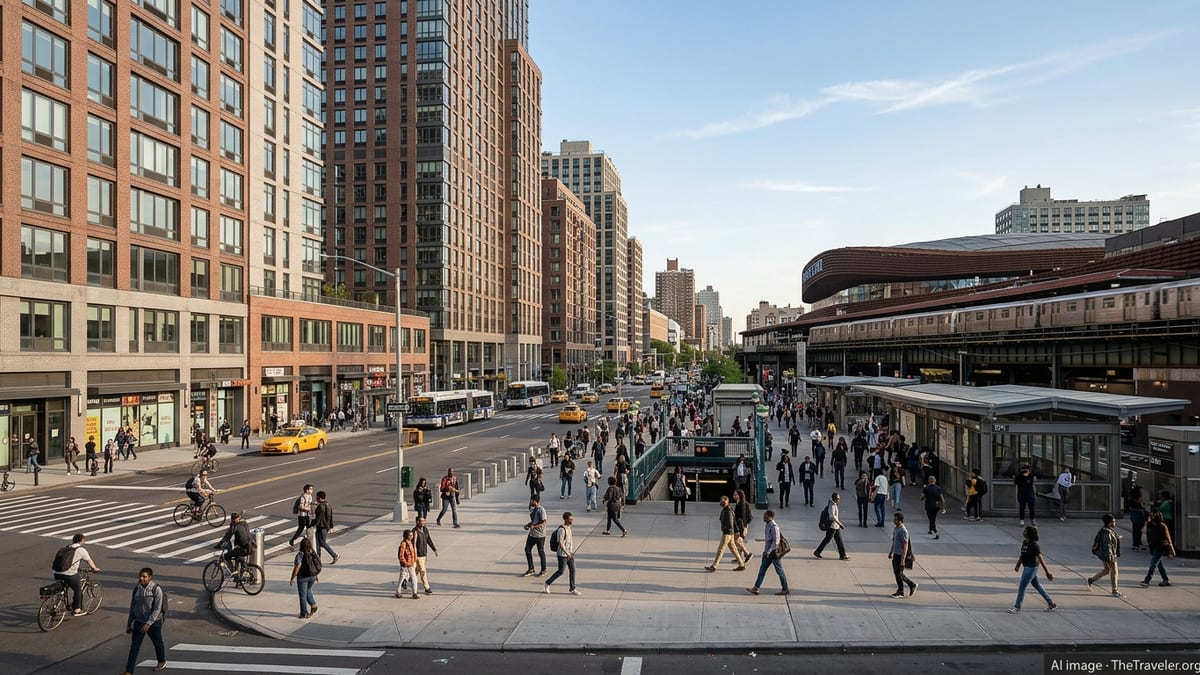
Strategic Brooklyn Site Opened for New Housing
Publicly available planning documents and recent local coverage indicate that state authorities and development partners are preparing to convert underused land near the Atlantic Avenue–Barclays Center transit complex into a mixed-income residential project of about 300 homes. The site, long dominated by rail infrastructure and low-rise commercial uses, has been flagged in city and state planning materials as a priority area for new housing because of its exceptional transit access and proximity to jobs in Downtown Brooklyn.
The move to unlock this land fits into a broader pattern of repurposing parcels near major stations that were previously viewed as too complex or infrastructure-heavy to support substantial residential construction. Nearby developments such as the Pacific Park project and the Alloy Block have already demonstrated that building housing above or alongside rail facilities can transform what were once gaps in the urban fabric into dense residential districts.
The planned Brooklyn homes are expected to include a significant share of income-restricted units, in line with recent mixed-income projects being advanced in neighborhoods from Gowanus to East New York. Housing and planning materials describe the goal as not only increasing the total number of apartments, but also ensuring that households with a range of incomes can live near high-frequency transit.
While exact design details and timelines for the 300-home project are still emerging through public review channels, the decision to free the land for residential use is seen by urban planners as a critical early step. It signals that the state is prepared to use its control over strategically located sites to address New York’s chronic housing shortage.
Hochul’s Broader Housing Push Around Transit
The Brooklyn initiative aligns with Governor Hochul’s multi-year effort to channel more development into neighborhoods served by robust rail and subway networks. Recent state announcements have highlighted transit-oriented housing plans at Metro-North and Long Island Rail Road stations outside the city, as well as support for dense, mixed-use projects in New York City boroughs where demand for homes far outstrips supply.
According to publicly available statements and policy documents, the administration’s housing agenda emphasizes two priorities: producing new homes at scale and locating as many of them as possible in places where residents can rely on public transportation instead of cars. Advocates argue that this approach can simultaneously relieve pressure on rents, reduce traffic, and cut emissions by shortening or eliminating car commutes.
New York City’s “City of Yes for Housing Opportunity” zoning overhaul, advanced in partnership with the state, has also focused on relegalizing smaller apartment buildings near transit corridors and creating new incentives for affordable units around stations and major bus routes. Downtown Brooklyn and surrounding neighborhoods have figured prominently in these discussions because they already function as regional employment centers and transit crossroads.
In that context, unlocking a parcel near one of Brooklyn’s busiest transit hubs for 300 additional homes is a relatively modest move in numerical terms, but it reflects a policy shift toward treating rail-adjacent land as a core resource for housing production. Observers note that if similar interventions are replicated at other major nodes, the cumulative effect could be thousands of additional apartments over the coming decade.
Transit Hub Location Offers Connectivity and Urban Amenities
The chosen Brooklyn site sits within walking distance of the Atlantic Avenue–Barclays Center subway and Long Island Rail Road complex, one of the largest and most connected stations in New York City. The hub links multiple subway lines with regional rail, placing residents within a short ride of Midtown and Lower Manhattan, as well as job clusters in Downtown Brooklyn and beyond.
Planning documents and neighborhood studies describe this part of Brooklyn as a textbook example of a place where additional housing can leverage existing infrastructure. Streets around the hub already support a dense mix of offices, schools, cultural venues, and retail, making daily errands possible on foot and expanding options for car-free living.
By targeting rail-adjacent land for new housing, the project also aims to correct earlier patterns of development that left swaths of low-intensity uses and surface lots in locations with some of the city’s best transit access. Over time, urban design advocates have called for filling in these gaps with active ground floors, improved public spaces, and mid- to high-rise housing that better matches the surrounding demand.
For travelers and residents alike, reinvesting in the area around a major transit hub can enhance the experience of arriving in Brooklyn. Instead of passing vacant or underused parcels, visitors could encounter a more continuous streetscape of homes, shops, and neighborhood services that extend the vitality of Downtown Brooklyn into adjacent blocks.
Balancing Density, Affordability, and Neighborhood Concerns
As with many recent housing initiatives in New York, the Brooklyn project is expected to navigate a complex mix of expectations from community groups, housing advocates, and local businesses. Neighborhood planning processes in nearby districts have highlighted long-standing concerns about displacement, building heights, and the need for public investments in parks, schools, and streetscape improvements to accompany new apartments.
Reports from previous rezonings, including the Atlantic Avenue Mixed Use Plan adopted in 2025, show that adding thousands of homes in central Brooklyn has typically been paired with commitments to affordable housing targets and infrastructure funding. Observers anticipate that any 300-home project near the transit hub will be evaluated through a similar lens, with close attention to how many units are reserved at below-market rents and how the development integrates with surrounding streets.
Housing experts point to recent mixed-use complexes elsewhere in Brooklyn as reference points for balancing density and community benefits. Projects in Gowanus, East New York, and along the waterfront have combined large-scale residential construction with public open space, environmental improvements, or community facilities, though the specific trade-offs in each case have varied.
For local residents, the transformation of rail-adjacent land into a new residential building brings both opportunities and questions. Additional households can support more services and neighborhood amenities, but they can also intensify debates about congestion, school capacity, and changing commercial patterns. The outcome will likely depend on how the project’s final design, affordability levels, and public-realm investments are shaped during the review process.
Implications for Travelers and the Future of Brooklyn Growth
For visitors, locating new housing near a key transit hub helps reinforce Brooklyn’s identity as a borough that can be explored without a car. More residents living steps from multiple subway lines and regional rail can sustain a richer mix of street-level businesses, from cafes and markets to cultural venues that draw both locals and tourists.
Travel and urban planning observers note that globally, major cities are rethinking how land around transit stations is used, often shifting from low-rise or industrial functions to high-density, mixed-income districts. The Brooklyn initiative fits squarely within that trend, highlighting how infrastructure built decades ago can anchor a new generation of compact, walkable neighborhoods.
In the longer term, the 300 homes near the transit hub may be seen as one piece of a larger recalibration of Brooklyn’s growth. As state and city leaders continue to call for more housing close to jobs and trains, additional rail- and subway-adjacent sites could follow a similar path, gradually stitching together a network of dense, transit-oriented districts across the borough.
For now, the decision to unlock a strategically located Brooklyn parcel for residential use signals that the state’s housing agenda is increasingly focused on pairing new homes with high-capacity transit. If the project proceeds as envisioned, it will offer a concrete example of how policy ambitions around affordability, sustainability, and mobility can converge in one of New York’s most dynamic urban centers.