

More news on this day
Air New Zealand is reinforcing passport checks on its Auckland–Nadi route after a traveller boarded a flight to Fiji without her passport, triggering a same-day return and renewed scrutiny of airline and border controls between the two Pacific neighbours.
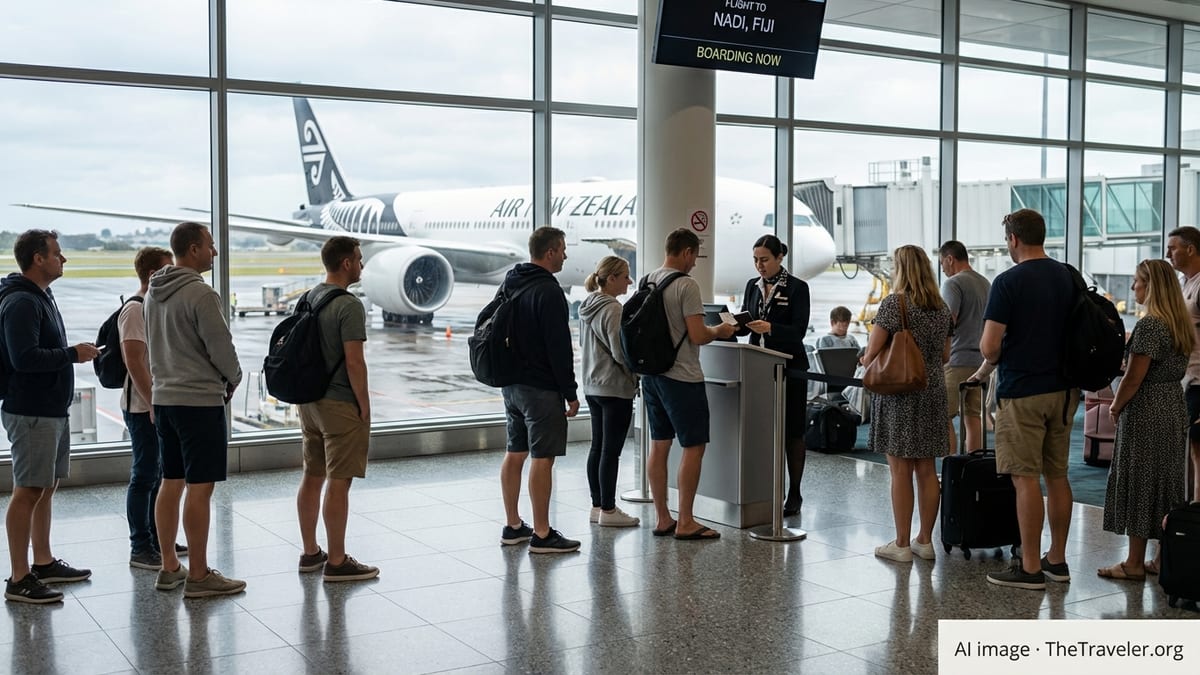
Boarding Oversight Triggers Review on Key Pacific Route
The incident, which occurred on an Air New Zealand service from Auckland to Nadi, saw a woman complete check-in and boarding in Auckland only to discover on arrival in Fiji that she did not have her passport. Fijian border officials refused her entry, and she was placed back on the same aircraft for an immediate return to New Zealand. The episode has raised questions about how multiple layers of airport checks failed to detect the missing document.
According to reporting in New Zealand, the trip had been planned as a short break with friends. The group believed all formalities had been completed correctly in Auckland, only realising the mistake when the traveller was unable to clear immigration in Nadi. While the group later accepted responsibility for misplacing the passport, they expressed surprise that no final document check was performed at the aircraft door before departure.
The case has drawn particular attention because the Auckland–Nadi route is among the busiest links between New Zealand and the Pacific islands, carrying a mix of leisure travellers, seasonal workers and family visitors. Any perceived weakness in document verification on such a corridor quickly becomes a wider concern for authorities on both sides of the border.
The traveller’s unexpected turnaround has become a cautionary tale shared widely on social and mainstream media, underlining how a single lapse can upend a trip and place scrutiny on airline practices that are usually taken for granted by the public.
Air New Zealand Moves to Tighten Passport Checks
In response, Air New Zealand has launched an internal review and confirmed it will strengthen passport checks at the gate on flights to Fiji and other short-haul international destinations. The airline said its standard procedure already requires staff to sight and verify passports during check-in and before boarding, but acknowledged that additional steps will now be reinforced to minimise the risk of a similar event.
Air New Zealand’s General Manager of Airports, Kate Boyer, has described the situation as distressing and disruptive for the passengers involved, while maintaining that established procedures were followed on the day. The airline insists that passengers remain responsible for retaining their documents once they have been verified, a principle that underpins international airline operations around the world.
Nonetheless, teams across the network have been instructed to refresh their focus on document handling at boarding, particularly on routes where travel feels more like a domestic hop than an international flight. For carriers operating in a geographically tight but heavily interconnected region such as the South Pacific, complacency is a risk airlines and regulators are keen to counter.
Operationally, the airline’s review is expected to lead to more consistent physical checks at the gate, closer alignment between digital systems and manual processes, and clearer briefings for staff on how to respond when passengers present without passports or fail to produce required visas. These adjustments may add marginal time at boarding but are viewed as a necessary trade-off for certainty.
Shared Responsibilities Under New Zealand Border Rules
The episode has also highlighted the legal and operational framework that governs who can board flights to and from New Zealand. Immigration New Zealand obliges airlines to transmit passenger and travel document data before departure through an advance passenger processing system, enabling officials to confirm visa status and identify red flags before a plane leaves the ground. Airlines that fail to meet these obligations can face penalties.
Under guidance to carriers, New Zealand authorities stress that airlines must both provide data to the border system and comply with directives about who may or may not be allowed to travel. Airlines must also ensure they sight valid travel documents where required. At the same time, border agencies emphasise that travellers themselves are expected to carry the correct passport and documentation and keep them secure at all times.
International departures generally involve several checkpoints: airline check-in, security screening, outbound passport control where applicable, and gate boarding. Each stage is designed to filter out problems before they reach the aircraft door. When a case slips through, as in the Auckland–Nadi incident, it prompts a re-examination of how these layers interact and whether human error, system gaps or both played a part.
Industry officials point out that the growth of e-visas and electronic travel authorities across the region has increased reliance on digital systems that verify eligibility in the background. While this speeds up processing for millions of travellers, it can also give a false sense of security if physical document checks become less rigorous than intended.
Fiji Immigration on Alert Amid Rising Document Risks
From Fiji’s perspective, the incident reinforces the importance of firm document controls at Nadi International Airport, the country’s main tourism gateway. Immigration officers there are the last line of defence against travellers arriving without proof of identity or with incorrect visa status, and have the power to deny entry and order carriers to return passengers on the next available flight.
In recent months, Fijian authorities have also been grappling with a separate but related risk: the rise of fraudulent online platforms posing as official visa providers. Fiji’s Immigration Ministry has issued high-priority warnings about fake websites harvesting passport details, photos and payment information from unwitting travellers applying for electronic visas and permits.
Officials in Suva have characterised such sites as a serious threat to public safety and national security, urging travellers to scrutinise online services carefully and to use only authentic government channels when applying for travel documents. The timing of these warnings has sharpened the focus on the integrity of both digital and physical checks for visitors heading to Fiji.
For border agencies, a case where a traveller arrives in Nadi without a passport underscores how vulnerabilities can emerge at every step of the journey, from initial online applications to document checks at departure and finally inspection on arrival. When one stage fails, others must catch the problem; if several align, the result can be a disruptive and expensive turnaround.
Impact on Travellers Between New Zealand and Fiji
For passengers on the busy corridor between New Zealand and Fiji, the immediate impact of Air New Zealand’s tightening of passport checks is likely to be felt in longer boarding times and a more visibly strict approach from gate staff. Travellers may be asked to present passports more than once and to confirm that they hold any required visas, even if they have already used self-service kiosks or digital boarding passes.
Travel agents and tour operators are advising customers to treat flights to Fiji in the same way as long-haul international services, despite the relatively short flight time and holiday atmosphere. That means checking passport validity well in advance, confirming visa or electronic travel authority requirements, and keeping documents accessible but secure from the moment they leave home until they return.
The Auckland–Nadi route is particularly popular with family groups and first-time international travellers who may be less familiar with border processes. Industry insiders say this makes clear communication essential, both at the point of sale and at the airport, to avoid assumptions that a driver’s licence or other photo ID might be sufficient to board.
While the incident has alarmed some prospective travellers, it has also reassured others that authorities in Fiji were swift to act when a passenger arrived without proper documentation. For holidaymakers planning trips later in the year, the expectation is that enhanced checks should make a repeat of the event less likely.
Pacific Border Controls Under the Spotlight
The passport oversight on the Auckland–Nadi flight comes at a time when Pacific governments are already fine-tuning border policies in response to changing travel patterns. New Zealand has been expanding the use of its electronic travel authority system and adjusting transit rules for neighbouring countries, while Fiji explores digital solutions to manage visitor flows and combat fraud.
Regional aviation links have grown steadily since pandemic-era restrictions were lifted, restoring tourism revenues but also reviving long-standing concerns about people smuggling, identity theft and the misuse of legitimate travel channels. Officials across the Pacific say that close cooperation between immigration, customs and airline partners is now more important than ever.
Within this context, even a single high-profile case of a traveller boarding without a passport can be seen as a stress test of existing safeguards. It prompts questions about training, staffing levels at peak times and the degree to which airlines rely on automated systems rather than manual checks in the final moments before departure.
Security specialists note that public attention tends to focus on dramatic enforcement operations, such as the interception of travellers without valid visas or the exposure of smuggling rings. Yet comparatively mundane slip-ups, like a forgotten passport, may reveal more about the everyday resilience of border systems, and can drive incremental but important changes in practice.
What Travellers Should Expect and How to Prepare
Looking ahead, travellers flying between New Zealand and Fiji can expect a more visibly cautious approach at check-in and boarding. Air New Zealand’s own guidance already stresses that it is illegal to board an international flight without a passport and that passengers must carry any necessary visas or health documentation required by destination countries.
Passengers using self-service kiosks at Auckland Airport should be prepared to scan machine-readable passports and may find that staff conduct additional spot checks or re-verify documents at the bag drop and gate. Those connecting from domestic New Zealand flights are being reminded that they must still produce passports for the onward international sector, even if they have already cleared initial airport security.
Travel experts recommend building extra time into pre-flight routines, especially for families and groups travelling together. Verifying that each person physically holds their passport before leaving home, at check-in and again at the gate can help avoid last-minute panic. Keeping documents in a dedicated travel wallet or pouch rather than loose in hand luggage may also reduce the risk of items being misplaced amid the rush of security queues and boarding calls.
For travellers concerned by the recent headline, officials on both sides of the Tasman and the Pacific are stressing that such incidents remain rare compared with the volume of daily flights. The latest measures, they argue, are about tightening a small but significant gap, ensuring that the convenience of modern air travel is matched by the reliability of its document checks.