

More news on this day
New Zealand has joined the United Kingdom, Germany, France, Switzerland, Fiji and a widening roster of countries facing unprecedented flight cancellations, as escalating conflict involving Iran, Israel and the United States triggers sweeping airspace closures across the Middle East and forces major airlines to suspend or reroute services.
Get the latest news straight to your inbox!
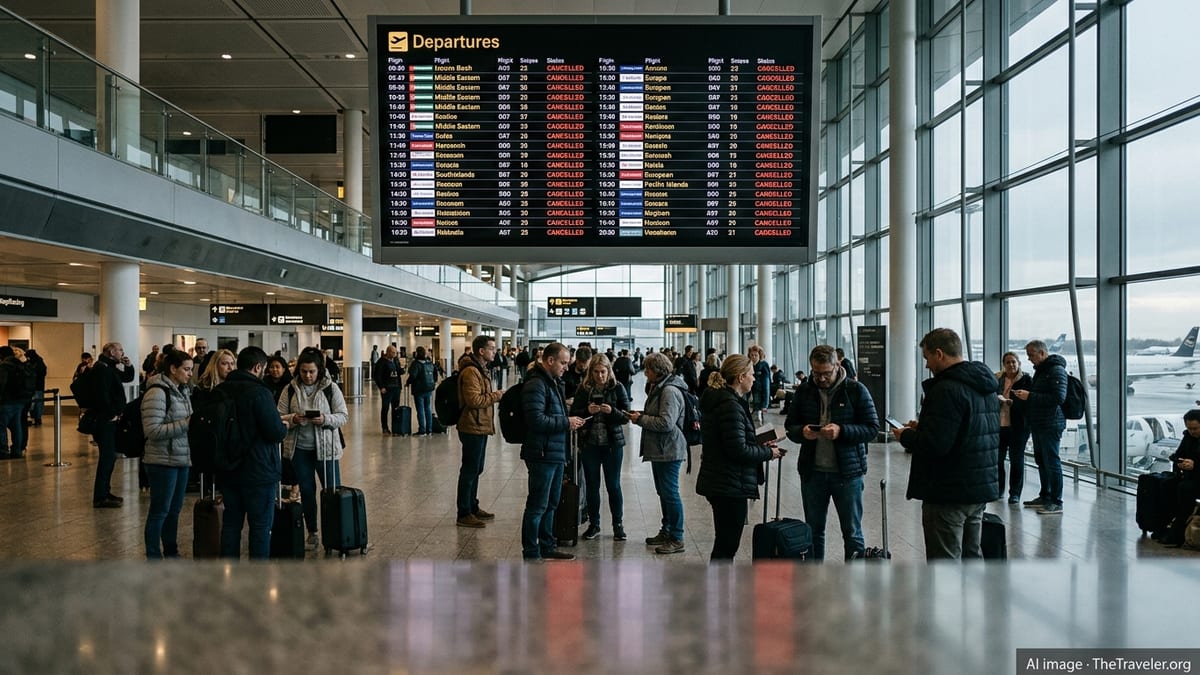
Middle East Conflict Triggers Global Aviation Shockwave
Publicly available information indicates that coordinated strikes on Iran on 28 February 2026 and subsequent retaliation have rapidly evolved into a wider regional crisis, with airspace closed or heavily restricted in key Middle Eastern hubs. Reports on the 2026 Strait of Hormuz crisis describe how the confrontation has spilled across borders, disrupting civilian aviation on an exceptional scale.
According to multiple aviation and government briefings, airspace in countries including the United Arab Emirates, Qatar, Israel, Iran, Iraq and Bahrain has been shut or sharply curtailed for civilian flights. Dubai International Airport, normally one of the world’s busiest long haul hubs, has been forced to suspend operations for extended periods, cutting critical connections between Europe, Asia and the Pacific.
The closures have rippled through global schedules, with airlines cancelling thousands of flights and re‑plotting routes around the affected region. For travellers, especially those dependent on long connections between the Southern Hemisphere and Europe, the result has been a wave of last‑minute disruptions, extended journey times and mounting uncertainty over future bookings.
Industry data and government reporting suggest that tens of thousands of flights have been delayed, cancelled or heavily rerouted since the escalation began, with aviation analysts warning that normal traffic flows through the Gulf could remain constrained for weeks or months depending on the security outlook.
Major European Carriers Suspend Services
A number of Europe’s flagship airlines have responded by suspending or sharply reducing services into the conflict‑adjacent region. Recent airline statements and schedule updates indicate that British Airways, Lufthansa, Air France, KLM and Swiss have all halted flights on some or all routes to destinations such as Tel Aviv, Beirut, Dubai and other Middle Eastern cities.
Travel industry summaries show that Lufthansa Group carriers, including Swiss and Austrian Airlines, have stopped flights to Tel Aviv and several nearby destinations, while also cancelling selected departures to Gulf hubs because of airspace closures. Air France and KLM, facing the same restrictions, have redirected or suspended flights to parts of the region and are advising passengers to monitor schedules closely as the situation evolves.
British Airways has cancelled services to key Middle Eastern destinations on multiple days, aligning its approach with other European and North American carriers that are avoiding overflight of high‑risk areas or are unable to operate because airports remain closed. Monitoring services indicate that some airlines have begun routing Europe–Asia flights via longer northerly or southerly tracks, significantly increasing flight times and fuel burn.
These decisions have had knock‑on effects far from the Middle East. With European long‑haul networks heavily reliant on predictable overflight permissions, airlines have had to thin out wider schedules, reduce frequency on marginal routes and, in some cases, pause ticket sales while they rebuild timetables around the new constraints.
New Zealand Routes Severely Disrupted
New Zealand has emerged as one of the countries most exposed to the turmoil, because a large share of its Europe‑bound passengers typically travel via Gulf mega‑hubs or through other Middle Eastern airspace. A March 2026 advisory from a major travel insurer in New Zealand notes that the closure or restriction of Middle Eastern hubs is already resulting in widespread flight cancellations, missed connections and delays for travellers heading to or from Europe and the United Kingdom.
Public briefings by New Zealand agencies describe how many flights that would ordinarily cross the Middle East must now take substantially longer routes, often skirting both Russian and Ukrainian airspace in addition to the newly restricted Gulf corridors. This combination of constraints has produced an unprecedented reshaping of long haul paths between Australasia and Europe, with some services extended by several hours.
Air New Zealand itself is feeling the strain. Domestic media coverage in mid‑March reports that the airline plans to cancel around 1,100 flights between now and early May, affecting roughly 44,000 passengers. While the carrier has cited several pressures, including higher fuel costs and capacity challenges, the conflict‑driven spike in global jet fuel prices and the disruption of traditional long haul routings are highlighted as key contributing factors.
For New Zealand travellers, the impact is two‑fold. In the near term, those with existing bookings are facing cancellations, diversions or enforced rebookings via alternative hubs, often in Asia or North America. Over the medium term, the economics of ultra‑long haul travel may shift, with higher operating costs potentially feeding through to airfares and route choices, especially on already thin seasonal or leisure‑focused services.
Regional Neighbours from the UK to Fiji Feel the Strain
The fallout is not confined to New Zealand. The United Kingdom, Germany, France and Switzerland, all home to major network carriers, are experiencing extensive disruption as airlines cancel Middle Eastern rotations and reconfigure long haul networks. Airport boards at London Heathrow, Frankfurt, Paris Charles de Gaulle and Zurich have shown clusters of cancellations and significant delays on services linked, directly or indirectly, to the Middle East conflict.
In Europe, passengers travelling to and from Asia, Australasia and parts of Africa are encountering longer journeys, extra stops, or sudden schedule changes. Publicly available aviation data shows that many flights between Europe and India, Southeast Asia and Australia are now avoiding the most sensitive airspace, in some cases flying substantial detours that lengthen flight times by an hour or more.
Smaller and tourism‑dependent countries are also being squeezed. Fiji and other Pacific destinations, which rely heavily on long haul visitors from Europe and North America, are seeing itinerary disruptions as travellers struggle to find viable routings that do not depend on Gulf carriers or Middle Eastern overflight. Travel agents are reporting increased interest in trans‑Pacific and trans‑Asian alternatives, but seats on those routes are limited and often more expensive.
Across this wider network, airlines are attempting to balance safety, regulatory requirements and commercial viability. Some carriers are offering change‑fee waivers or allowing rebooking within defined travel windows, while others are trimming capacity outright to preserve operational resilience during what industry observers describe as one of the most complex rerouting exercises since the early months of the pandemic.
What Travellers Can Expect in the Weeks Ahead
With fighting still active and diplomatic efforts ongoing, there is no clear timeline for when Middle Eastern airspace will fully reopen or when airlines will feel confident restoring previous schedules. Analysts tracking the 2026 Iran war warn that even if hostilities ease, it may take time for regulators, insurers and carriers to reassess risk levels and reintroduce overflights on key corridors.
In the short term, travellers from New Zealand, the United Kingdom, continental Europe and the Pacific can expect continued volatility in long haul schedules. Same‑day cancellations, last‑minute reroutes and extended journey times are likely to remain common, especially for itineraries that previously relied on connections through Dubai, Doha or other Gulf hubs.
Travel industry guidance encourages passengers to build additional flexibility into their plans, including longer connection windows and a readiness to accept alternate routings, sometimes via secondary hubs in Asia or North America. Public advisories also stress the importance of monitoring airline notifications closely and checking travel insurance wording, as many policies treat war and conflict‑related disruptions differently from ordinary operational delays.
For now, the unprecedented wave of cancellations and suspensions by carriers such as British Airways, Lufthansa, Air France, KLM, Swiss and their counterparts underscores how quickly a regional conflict can redraw the global aviation map. For New Zealand and its fellow affected countries, the path back to normal air connectivity will depend not only on developments in the Middle East, but also on how airlines and regulators choose to rebuild the skyways that link the world.