

More news on this day
Travelers moving through Newark Liberty International Airport on April 4, 2026, faced a fresh wave of disruption as flight-tracking data showed 121 delayed departures and arrivals alongside 9 cancellations, underscoring continued strain on one of the nation’s most delay-prone hubs.
Get the latest news straight to your inbox!
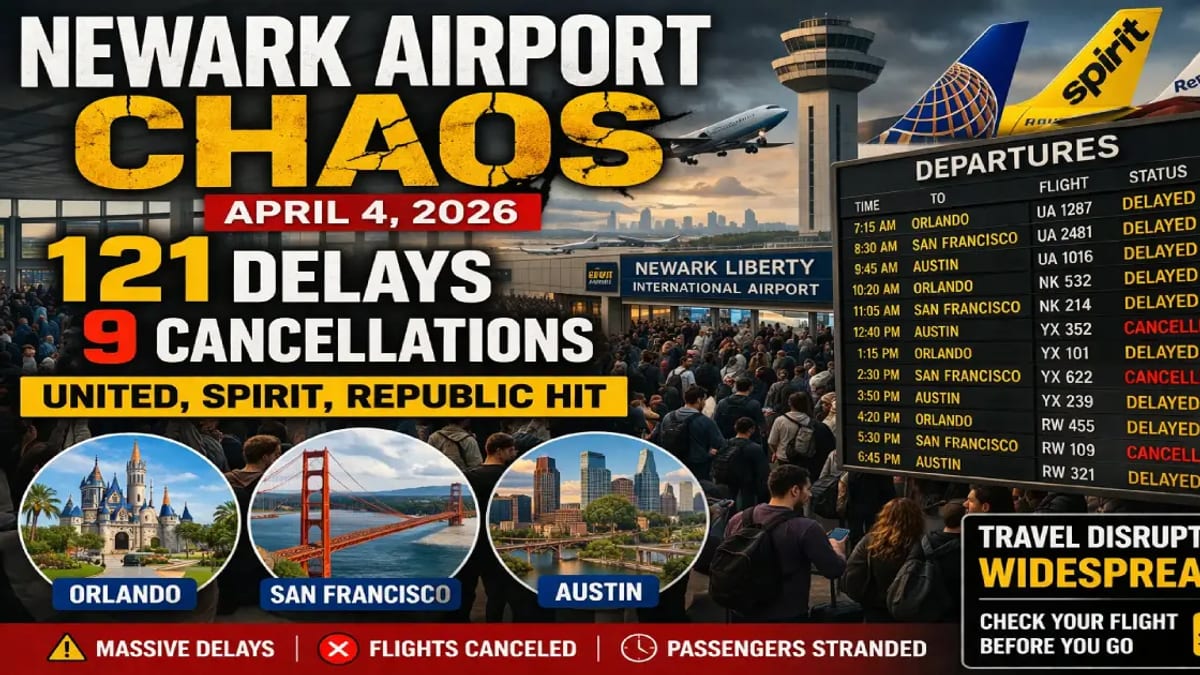
Heavy Disruptions at a Key Northeast Gateway
The April 4 disruption at Newark Liberty unfolded during one of the busiest early spring travel weekends, amplifying the impact of each delayed or canceled flight. Publicly available aviation dashboards and operational tallies for the day point to a pattern of rolling delays that pushed many services well beyond their scheduled departure times, particularly during the afternoon and early evening peaks.
Newark’s 121 delays and 9 cancellations formed one node in a broader web of nationwide disruption. National flight-status aggregations for the same period show several thousand delays across the United States and hundreds of cancellations, with major hubs in the Midwest, Northeast and Southeast all reporting elevated numbers. Within that context, Newark’s role as both a transatlantic gateway and a domestic connecting point meant relatively modest cancellation counts still translated into long queues at customer service desks and cramped gate areas.
Published aviation coverage for early April highlights how airports along the Eastern Seaboard, including Newark, have been particularly vulnerable when low clouds, gusty winds or convective weather interact with already dense schedules. On April 4, Newark again appeared in those national tables as one of the airports where capacity constraints and weather-related spacing requirements converged to limit how many arrivals and departures could be processed in each hour.
For individual travelers, the statistics translated into missed connections, rebooked itineraries and a familiar pattern of creeping departure times on flight-information displays. Even where flights eventually operated, extended ground holds and airborne holding patterns often added an extra layer of uncertainty to already tight itineraries.
Weather, Airspace Bottlenecks and Construction Legacy Issues
Reports on the April 4 disruptions across the U.S. aviation network indicate that unstable spring weather again played a central role, with thunderstorms and low cloud ceilings affecting key corridors from the Mid Atlantic to the Midwest. When such systems move through the New York and New Jersey area, Newark frequently experiences ground-delay programs that require airlines to slow the rate of departures and space out arrivals more widely for safety.
Newark’s susceptibility to these constraints has been a recurring theme in federal and industry analyses. Government documents and planning materials released over the past year describe the airport as consistently among the most delay-prone in the country, citing a combination of dense schedules, complex runway configurations and limited room for further expansion. Construction and rehabilitation work on one of Newark’s primary runways in 2025 also left a legacy of scheduling adjustments that continue to influence how many flights can be slotted into peak hours.
These structural issues mean that even on days when the raw number of cancellations is relatively low, delay totals can spike quickly once weather or upstream congestion intervene. On April 4, airlines operating at Newark appeared to prioritize keeping flights on the board rather than canceling early, a tactic that can reduce network-wide disruption but often results in significant late departures when storms and air-traffic-management initiatives linger longer than expected.
Regional airspace complexity adds another layer of fragility. Newark shares crowded skies with nearby LaGuardia and John F. Kennedy airports, and adjustments to arrival rates at one facility can ripple across the others. With multiple hubs in the Northeast all managing weather and volume challenges during the April 4 window, Newark’s operations effectively became part of a larger, tightly coupled system where minor disruptions in one area quickly propagated to others.
United Hub Pressures and Passenger Experience on the Ground
As the dominant carrier at Newark Liberty, United Airlines once again found its hub at the center of operational pressures. Publicly available airline and airport statistics for early April show United handling a significant share of Newark’s departures, meaning that any capacity reduction or flow restriction at the airport disproportionately affects the airline’s network.
Earlier in the week, coverage of United’s Newark operation highlighted ongoing efforts to improve resilience, including adjustments to schedules and the introduction of new tools to help passengers anticipate bottlenecks such as security wait times. However, the April 4 disruption underlined the limits of carrier-level initiatives when broader constraints related to air traffic control staffing, airspace management and weather converge on the same day.
For passengers, the on-the-ground experience at Newark on April 4 mirrored scenes observed recently at other major hubs where delay counts climbed into triple digits. Travelers encountered long lines at rebooking counters, crowded terminal seating and limited availability of same-day alternatives as airlines worked to accommodate those affected by missed connections or late-arriving aircraft. In some cases, late-evening delays that pushed aircraft and crews up against duty-time limits appear to have tipped marginal flights into outright cancellation.
Reports from earlier disruption episodes at Newark show that such conditions can have knock-on effects for days afterward, as aircraft and crews remain out of position. While April 4’s tally of 9 cancellations is modest compared with past meltdown events, the associated 121 delays at a major hub increase the likelihood of lingering schedule imbalances into the following day, particularly on longer-haul and transatlantic routes.
Part of a Wider Pattern of Spring Travel Strain
Newark’s April 4 disruption did not occur in isolation. Across the country, early April has produced several high-impact travel days, with national delay counts running into the thousands and cancellation totals in the hundreds. Coverage of Boston Logan, Chicago O’Hare, Reagan National and other hubs on adjacent days points to a pattern of recurring strain as airlines operate close to pre-2019 capacity levels amid volatile spring weather.
Analysts noted in recent reports that the national aviation system currently has little operational slack. Aircraft utilization is high, schedules are dense and staffing in key roles, from air traffic control to ground handling, remains tight. Under these conditions, events that once might have produced moderate localized disruption are more likely to result in system-wide ripples, especially during peak travel periods such as Easter and school holidays.
Newark’s experience on April 4 fits this broader narrative. While the airport was not the worst-affected in raw cancellation terms, its combination of high traffic volumes, international connectivity and regional airspace constraints meant that each delay carried outsized consequences. Passengers connecting through Newark from smaller markets or transatlantic origins often had fewer alternative options than travelers using larger multi-hub regions with more redundant routing choices.
Published travel-industry commentary suggests that, for the remainder of the spring and into summer, travelers using Newark and other major hubs may continue to face elevated disruption risk on days when weather, staffing and infrastructure limitations intersect. The April 4 episode serves as another illustration of how quickly conditions at a single hub can deteriorate into what many passengers experience as chaotic, even when formal cancellation totals remain relatively contained.
What Travelers Can Do Ahead of Busy Newark Departures
In light of Newark’s April 4 performance and the wider pattern of early April disruptions, travel planners are again emphasizing a set of practical steps for passengers using the airport in the coming weeks. Publicly available guidance from airlines, airports and travel-management firms consistently recommends building in additional time buffers, especially for tight domestic-to-international connections or evening departures that may be more exposed to the cumulative effect of daytime delays.
Passengers are also encouraged to make use of airline and airport tools that provide live updates on security screening times, gate changes and departure estimates. Recent announcements highlight the rollout of new digital features aimed at Newark travelers, including wait-time indicators that can help passengers decide when to leave for the airport and which terminal checkpoints to use.
For those with flexibility, booking earlier flights in the day, choosing routes with multiple daily frequencies and avoiding very short connection windows can provide an extra margin of safety when delays mount. Travel-insurance products and credit-card benefits that cover missed connections, hotel stays or meal expenses can further mitigate the impact of episodes like the one recorded at Newark on April 4.
While no booking strategy can eliminate the risk of disruption at a complex hub such as Newark Liberty, the pattern of 121 delays and 9 cancellations on April 4, 2026, reinforces the value of informed planning. As the spring travel season accelerates, Newark’s latest bout of chaos will likely factor into how frequent travelers, corporate travel managers and airlines themselves think about scheduling, contingency plans and passenger communication in the months ahead.