

More news on this day
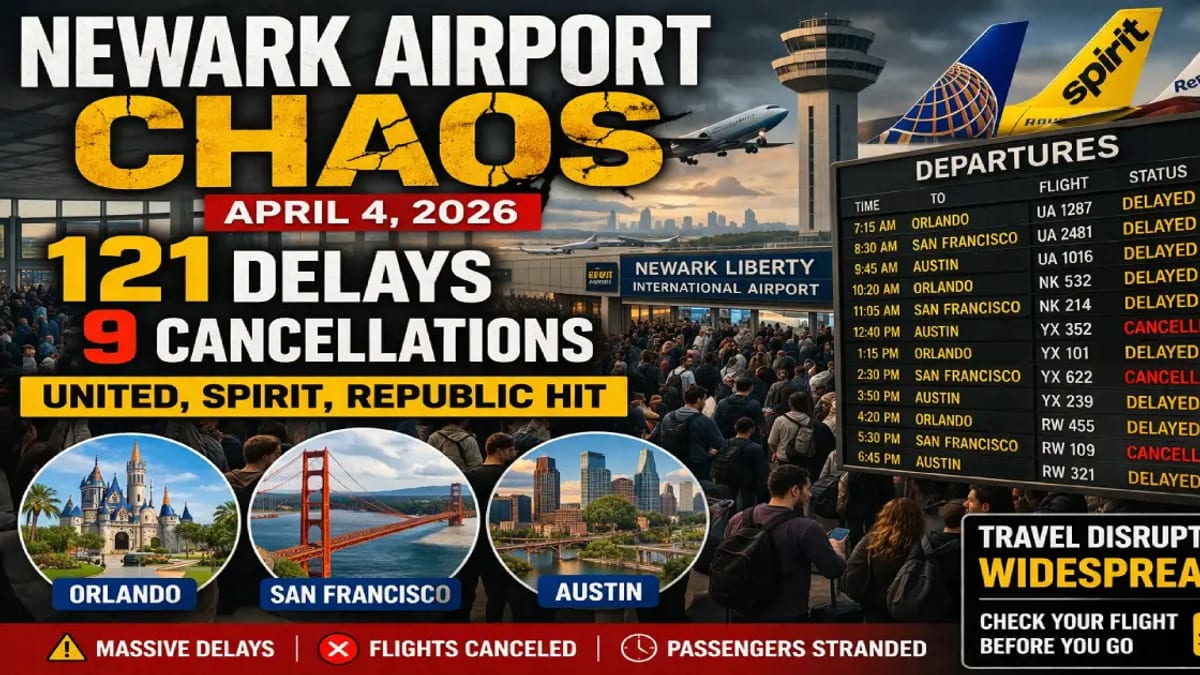
Travelers moving through Newark Liberty International Airport on April 4, 2026, encountered another difficult day of air travel, as publicly available tracking data showed 121 flight delays and nine cancellations, adding fresh disruption to an already strained spring travel season across major U.S. hubs.
Get the latest news straight to your inbox!
Heavy Disruptions Hit a Key Northeast Gateway
The disruptions at Newark on April 4 came as airlines and travelers were already navigating a period of heightened delays across the United States. Aggregated tracking information for the day showed Newark once again near the top tier of congested airports, with 121 delayed operations and nine cancellations affecting both arrivals and departures. These figures placed Newark among the more heavily impacted facilities in a national picture that also featured thousands of delayed flights across the country.
While the numbers at Newark did not approach the most severe meltdowns seen in past years, the scale of the disruption was enough to generate long lines at gates, rolling departure-time changes on departure boards, and missed connections for passengers attempting to route through the busy New Jersey hub. The airport’s role as a primary transatlantic gateway and a major domestic connection point meant even modest schedule shocks were quickly felt across multiple regions.
The timing of the April 4 problems proved particularly challenging for leisure travelers starting spring holiday trips and for business travelers relying on tight schedules in the New York metropolitan area. Many itineraries depended on connections through Newark, leaving relatively little margin when a first leg ran late or a short haul flight was canceled with limited rebooking options available.
Reports from flight-tracking dashboards indicated that most delays at Newark clustered in the late morning and afternoon hours, a pattern consistent with broader nationwide congestion that built as the day progressed. By early evening, many passengers faced knock-on disruptions, with late aircraft arriving out of sequence and crews timing out after extended duty periods.
Weather, Volume and Structural Constraints Combine
The April 4 disruptions did not stem from a single dramatic incident such as a radar outage or complete ground stop. Instead, publicly accessible aviation data pointed to a familiar combination of contributing factors, including low cloud ceilings over the Northeast, wider national congestion and Newark’s long running capacity constraints. Low clouds and reduced visibility were identified as a concern for multiple East Coast hubs, which tends to slow arrival rates and tighten spacing between aircraft.
Newark has been operating under structural constraints for several seasons, with federal documentation describing it as one of the country’s most delay prone airports. Capacity limits linked to air traffic control staffing, older technology and runway configuration have already prompted regulators to formally restrict scheduled operations through 2026, an effort meant to prevent more extreme gridlock during peak periods. Those measures were designed to smooth traffic, but they have not fully eliminated the risk of daily disruption when conditions deteriorate.
Recent federal notices and transportation analyses highlight how ongoing runway work and airspace management challenges around the New York region continue to amplify the impact of even minor operational hiccups. Construction related closures in previous years reduced the number of available runways and forced airlines and controllers to work with tighter margins, a situation that remains relevant as the system adjusts to new patterns and demand levels in 2026.
Industry coverage has also documented how staffing levels at key regional air traffic facilities still lag long term targets. That shortfall can reduce flexibility during weather events or periods of heavy traffic, making it harder to absorb sudden bursts of demand or recover quickly from earlier delays in the day.
Part of a Wider Spring 2026 Disruption Pattern
The turbulence at Newark on April 4 formed part of a broader picture of spring 2026 travel difficulties. Nationally, live data for the day showed several thousand delays across U.S. airports, with particular pressure on Northeast and Mid Atlantic hubs and major leisure markets in Florida and the Midwest. Industry analysis has framed this period as a continuation of a multi year pattern in which staffing constraints, infrastructure projects and volatile weather combine to magnify routine day to day disruptions.
Coverage from travel outlets has noted that some carriers have been hit harder than others during this spring’s disruption cycle, depending on their route networks and reliance on especially congested airports. Newark’s status as a central hub for a major U.S. airline has kept it squarely in focus, as operational hiccups there can quickly cascade through that carrier’s broader domestic and international schedules.
Travel and consumer publications have emphasized that when delays build early in the day, the ripple effects can extend late into the evening, leaving aircraft and crews out of position for subsequent flights. That pattern appeared to be in evidence on April 4 at Newark, where early and mid day delays contributed to compounding evening disruptions even as weather conditions gradually improved.
Recent national data sets reviewed by transportation analysts suggest that system wide on time performance has improved compared with the most severe disruption years earlier in the decade, yet remains vulnerable at certain high density nodes. Newark’s combination of heavy schedule demand, constrained airspace and susceptibility to low ceiling weather means it often features prominently whenever the national system begins to strain.
Impact on Passengers and Practical Takeaways
For passengers traveling through Newark on April 4, the statistics translated into familiar frustrations at the terminals. Many encountered extended waits at gates, rapid fire schedule changes in airline apps and, in some cases, missed connections that required overnight stays or rebooked itineraries through alternative airports. Travelers connecting from smaller regional markets were especially exposed when a single delayed inbound aircraft disrupted a limited set of onward options.
Consumer advocacy and travel advisory coverage in recent days has underscored several practical steps for those planning to use Newark or other congested hubs this spring. Recommendations commonly include building more time into connections, favoring morning departures when possible and monitoring flight status throughout the day, rather than relying solely on original ticketed times. These suggestions reflect patterns observed in delay data, which show disruption risk increasing as the operating day advances.
Some airlines have introduced new tools intended to help travelers navigate this environment. For example, in the New York region, carriers have recently rolled out app based features that provide estimated security wait times and real time updates on airport conditions, with Newark among the hubs where such tools are being tested. While these digital services cannot prevent delays, they may allow passengers to adjust arrival times at the airport and make quicker decisions about meal breaks, lounge visits or gate changes.
Travelers passing through Newark in coming weeks may continue to see a complex operational backdrop, shaped by federal limits on scheduled flying, evolving staffing levels and the unpredictable spring weather typical of the Northeast. The April 4 figures of 121 delays and nine cancellations served as another reminder that even on days without a headline grabbing outage, persistent structural pressures can still turn a routine travel day into a challenging one for many passengers.
Outlook for Newark Through the Rest of 2026
Looking beyond the events of April 4, publicly available regulatory documents indicate that operational limits at Newark are set to remain in place through at least October 2026. The measures, which cap certain hourly arrival and departure rates, are intended to relieve chronic congestion while longer term solutions related to staffing and infrastructure are developed. This framework suggests that airlines will continue to face constraints when planning schedules at the airport.
Transportation policy materials describe Newark as a test case for a more managed approach to high density airports, in which regulators actively balance demand and capacity to protect overall system stability. For travelers, that can translate into fewer scheduled flights than the market might otherwise support, but also a reduced likelihood of extreme gridlock on the most heavily trafficked days.
In the near term, aviation analysts expect that day to day performance at Newark will continue to hinge on a mix of factors, including weather patterns, the pace of technology upgrades at regional air traffic facilities and airlines’ willingness to keep schedules conservative. The events of April 4, with more than a hundred delays and multiple cancellations, suggest that even with formal limits in place, the airport remains sensitive to relatively modest shocks in the broader system.
As the busy summer travel season approaches, passengers planning itineraries through Newark may pay closer attention to time of day, connection length and backup options via other New York area airports. The experience of April 4 will likely serve as one data point among many for travelers and industry watchers assessing how effectively current policies are containing disruption at one of the nation’s most closely watched hubs.