

More news on this day
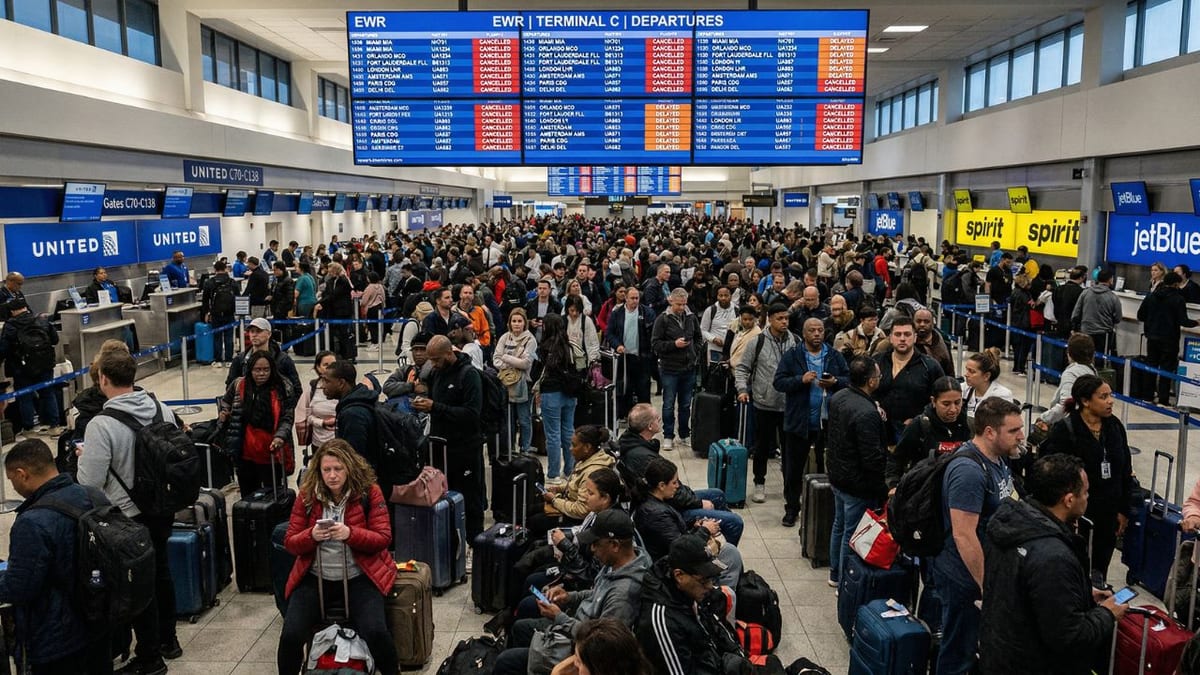
A fresh disruption crisis at Newark Liberty International Airport has triggered 109 flight delays and 9 cancellations, sending shockwaves through busy USA–Europe and Florida routes operated by Spirit, United and JetBlue and stranding passengers across Miami, Orlando, Fort Lauderdale, London, Amsterdam and Paris.
Get the latest news straight to your inbox!
Holiday Crowds and Operational Strain Converge at Newark
The latest turbulence at Newark Liberty unfolded around the early April return travel period, when already stretched operations collided with heavy seasonal demand. Publicly available tracking dashboards for April 5 to April 7 show repeated bottlenecks at the New Jersey hub, with disruptions building over several days rather than stemming from a single incident.
Within that window, one 24-hour stretch saw 109 delayed departures and arrivals and 9 cancellations directly associated with Newark Liberty, according to aggregated flight-status data. While those raw figures are smaller than some historic weather-related meltdowns at the airport, the concentration of delays on peak leisure and transatlantic corridors sharply magnified the impact for travelers.
Reports indicate that the disruption formed part of a broader pattern of strain at Newark, which has recorded some of the longest average arrival delays among major US airports in recent federal statistics. Capacity caps, runway work, earlier air traffic control staffing constraints and residual weather knock-ons have combined to leave operations at the airport especially vulnerable when demand surges.
Consumer-focused flight disruption services describe the early April episode as a bottleneck event, in which relatively modest numbers of outright cancellations masked the severity of delays. With many flights departing well behind schedule but still operating, aircraft and crews arrived late into downstream airports, seeding further disruption across the national and transatlantic network.
Spirit, United and JetBlue Schedules Buckle
The disruption figures were felt most acutely on carriers with dense schedules radiating from Newark. Spirit, United and JetBlue all operate high-frequency services from the airport to Florida and major hubs across the United States and Europe, making them especially exposed when a wave of delays hits the departure bank.
Operational data compiled from airline and airport dashboards for the affected period shows United bearing a significant share of the delayed flights, reflecting its status as the dominant carrier at Newark. JetBlue and Spirit also experienced notable schedule pressure, particularly on leisure-heavy routes to Florida and select transatlantic connections.
Publicly available coverage of the episode indicates that many affected flights were classified as late rather than canceled, but the cascading effect on rotation and crew positioning quickly rippled outward. Aircraft that departed Newark behind schedule often arrived late into other hubs, compressing turnaround windows and forcing airlines to combine services, swap equipment or trim frequencies temporarily.
Consumer advocates note that when carriers opt to preserve as many departures as possible rather than preemptively canceling flights, the immediate cancellation tally can remain modest even as overall punctuality deteriorates dramatically. The Newark crisis followed that pattern, with nine cancellations headline-worthy for individual travelers but the broader story written in missed connections and multi-hour delays.
Florida Gateways Hit: Miami, Orlando and Fort Lauderdale
Nowhere were the downstream effects more visible than on Newark’s busy pipeline of flights to Florida. Miami, Orlando and Fort Lauderdale rely heavily on inbound capacity from the Northeast during school breaks and holiday return weekends, and disruptions at a major feeder hub like Newark can rapidly crowd gates and strain local resources.
Flight status snapshots from the affected days show prolonged knock-on delays from Newark-operated services into all three Florida airports. At Orlando and Fort Lauderdale, where low-cost and hybrid carriers maintain large leisure footprints, late-arriving Newark flights compressed afternoon and evening departure waves, contributing to rolling delays on subsequent rotations.
In Miami, a key international gateway as well as a leisure destination, the combination of Newark-related delays and separate weather and traffic congestion in other parts of the network created an uneven operational picture. Some flights landed close to schedule while others arrived significantly behind, complicating gate assignments and baggage handling and extending the time passengers spent onboard waiting for stands to free up.
Travel disruption trackers highlight that, even when Florida airports themselves are operating normally, their dependency on aircraft and crews sourced from the Northeast can leave them vulnerable to severe timetable slippage. In this case, Newark’s 109 delayed flights and nine cancellations represented a relatively small fraction of the overall US schedule yet were concentrated in markets with limited slack, amplifying the sense of chaos for holiday travelers.
Transatlantic Links to London, Amsterdam and Paris Suffer
The disruption did not stop at US borders. Newark Liberty is a key transatlantic launchpad, and the early April bottleneck quickly spilled into services linking the United States with London, Amsterdam and Paris, among other European destinations. Publicly available route data and airline alerts point to delayed or adjusted services on both nonstop and one-stop itineraries connecting through Newark.
For London-bound passengers, the delays at Newark affected evening departures that typically feed into tight morning arrival slots at Heathrow and Gatwick. When those flights pushed back late, arrival times in the United Kingdom shifted, compressing immigration and baggage peaks and limiting passengers’ options to connect onward to regional European or domestic UK flights.
Amsterdam and Paris services were hit in slightly different ways. Operational summaries show a mix of long departure delays from Newark and schedule adjustments on Europe-originating flights designed to maintain aircraft rotation integrity. In some cases, airlines extended ground time in Europe to recover from earlier misalignments, which then pushed subsequent crossings outside their usual windows and forced travelers to rebook missed connections.
European hub operations are finely tuned around banked waves of arrivals and departures. Even a handful of late Newark flights feeding into those banks can throw off carefully balanced slot timings, particularly at airports already facing their own capacity limitations or seasonal weather challenges. As the Newark disruption played out, travelers reported missed connections and extended layovers across multiple European gateways despite relatively stable local conditions.
Passenger Rights, Compensation Rules and What Comes Next
The Newark crisis has renewed attention on what protections travelers can expect when delays and cancellations cascade across multiple carriers and international borders. Consumer rights organizations point to a patchwork of rules that varies sharply depending on whether a flight is domestic within the United States, operated by a European carrier, or departs from the European Union.
Under US regulations, airlines are generally not required to compensate passengers for delays, although they do have to provide prompt refunds when a flight is canceled and a traveler chooses not to travel. Some major carriers have voluntarily published customer service commitments that include meal vouchers, hotel accommodation or rebooking assistance when disruptions are within the airline’s control, and consumer-facing dashboards encourage passengers to reference these policies when seeking support at airports like Newark.
On routes between Newark and European Union airports such as London, Amsterdam and Paris, European rules can apply in certain circumstances, particularly when the operating carrier is based in the EU or the flight departs from an EU or associated country. In those cases, travelers may be eligible for standardized financial compensation and care obligations when long delays or cancellations are not caused by extraordinary circumstances such as severe weather or air traffic control strikes.
Analysts observing the latest Newark episode suggest that, with federal slot caps and infrastructure constraints likely to persist, the airport will remain one of the most delay-prone major hubs in North America. Industry data from recent months already ranks Newark among the leaders in average arrival delay. Unless airlines, regulators and airport operators can create more operational headroom, similar clusters of 100-plus delays and targeted cancellations may continue to ripple across domestic and transatlantic networks during peak travel periods.