

More news on this day
A landmark turbulence investigation involving a Newark-bound United Airlines flight is sharpening the focus on how fragile the U.S. air travel system has become, with operational limits, storms and staffing shortfalls at Newark Liberty International Airport now rippling through flight schedules nationwide well into 2026.
Get the latest news straight to your inbox!
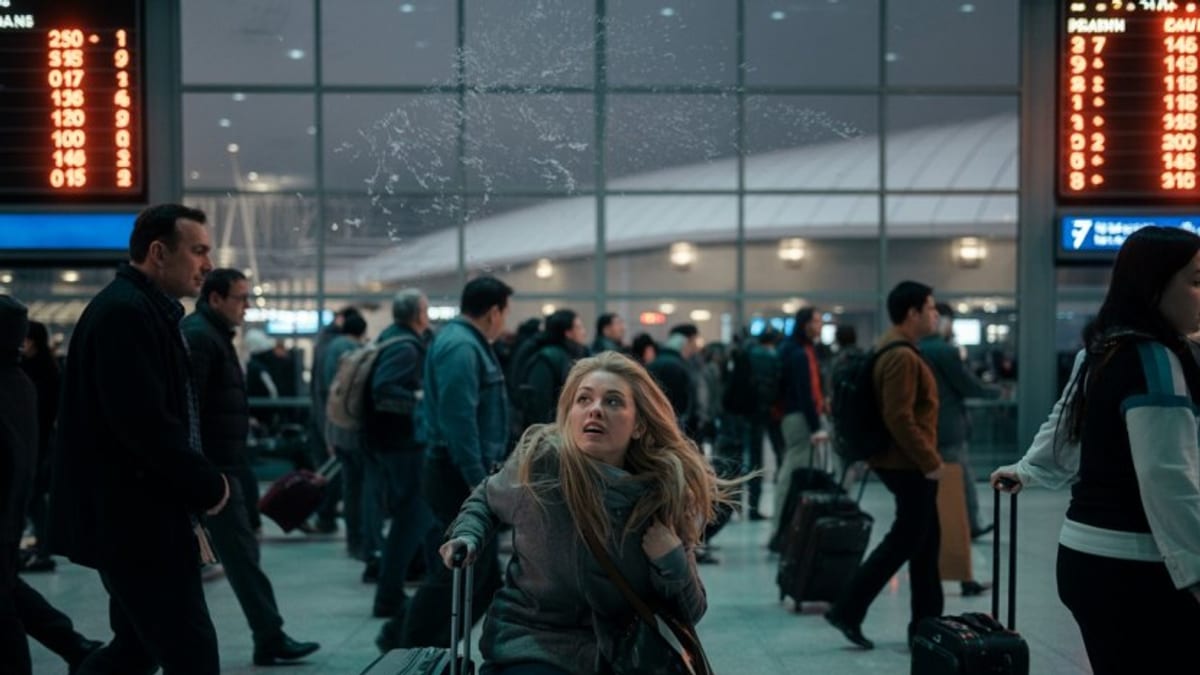
From One Turbulent Descent to a Systemwide Warning
A final report from the National Transportation Safety Board in early 2026 on United Airlines Flight 1890, which encountered severe turbulence while descending into Newark on February 10, 2024, has become a reference point in debates over aviation safety. The widebody jet, arriving from Los Angeles, was struck by an intense, localized disturbance that left three flight attendants with serious injuries, including broken bones and a head injury, even as passengers remained largely unharmed.
According to publicly available investigation documents and subsequent media coverage, the episode was aggravated by a missed opportunity to relay updated turbulence information from air traffic control to the cockpit. The finding has intensified scrutiny of how fast-changing weather data is shared in one of the country’s most congested air corridors, particularly during busy arrival banks into Newark Liberty International Airport.
While the incident itself was confined to a single flight, analysts note that it has fed directly into broader efforts to modernize air traffic procedures, weather forecasting tools and cockpit briefings. Newark’s role as a key gateway for transcontinental and transatlantic traffic means that any procedural gap identified there carries implications for routes across the United States and beyond.
In the two years since the turbulence event, Newark’s operational challenges have repeatedly intersected with safety and reliability concerns, reinforcing the sense that the airport is both a barometer and a driver of wider strain in the U.S. air travel system.
Caps, Congestion and the Long Shadow of 2025 Outages
Newark’s difficulties are not limited to turbulence. A sequence of radar and communications outages in spring 2025, combined with an acute shortage of air traffic controllers, forced regulators and airlines to take unusually aggressive steps to stabilize the schedule. United Airlines, the dominant carrier at Newark, cut dozens of daily flights, while the Federal Aviation Administration introduced temporary caps on arrivals and departures.
Those short-term measures have since evolved into a more structured regime. A final order detailed by aviation trade publications and policy sites limits total movements at Newark to a combined 72 flights per hour through late 2026, with stricter caps in place at certain times to accommodate runway work and staffing constraints. The caps follow earlier, tighter limits introduced while a major runway project was under way and while some controllers were on extended leave following equipment failures.
Publicly available analyses characterize Newark as an airport that has long operated at or above its sustainable capacity, leaving little margin when weather or technology falters. The formal caps are intended to create breathing room, but they also concentrate demand on a smaller set of flights, heightening the impact whenever disruption does occur. Once Newark’s banks of departures and arrivals slip out of sequence, delayed aircraft and crews quickly knock on to other hubs.
Industry-focused research platforms and financial commentary have framed the Newark restrictions as evidence of deeper structural weaknesses in the national air traffic system, including aging radar technology and a slow rollout of modernization programs. The turbulence case has therefore become part of a larger narrative that portrays Newark as a stress test for the country’s ability to handle growing passenger volumes safely and predictably.
Storms, Ground Stops and a Web of Knock-On Delays
The winter of 2025 to 2026 and the early spring travel period have highlighted just how quickly issues at Newark can radiate outward. A major February 2026 blizzard brought more than two feet of snow to the region, with public meteorological records showing hundreds of flight cancellations at Newark in a single day as plows and deicing crews struggled to keep up.
In March 2026, severe weather across the eastern half of the United States again snarled operations, with travel blogs and aviation trackers logging more than a thousand delays in a single day across major hubs. Newark featured prominently in those tallies, both as an origin and connection point, even when its own skies had begun to clear. Aircraft and crews that started the day late in Chicago or Atlanta often arrived late into Newark, forcing onward delays along key transcontinental and transatlantic routes.
Independent monitoring sites that rank airports by on-time performance continue to place Newark near the top of the list for average delay minutes, citing a familiar mix of thunderstorms in summer, snow and ice in winter, and sheer schedule density throughout the year. Recent accounts from travel advocacy outlets describe terminal scenes of rolling gate changes, long security lines and missed connections, even on days without major headline-grabbing storms.
These weather-linked disruptions interact with the structural flight caps to create a complicated puzzle for airlines. When a storm shrinks the number of usable arrival slots or forces temporary ground stops, the smaller, capped schedule gives carriers less flexibility to recover, so misaligned rotations and missed curfews can cascade for days. The result, analysts say, is that seemingly localized weather events are now more likely to evolve into multi-day, multi-airport disruptions.
Passenger Experience and Airline Strategy Through 2026
For travelers, the convergence of turbulence concerns, capacity limits and chronic congestion at Newark is reshaping how trips are planned. Travel advisories from consumer-focused sites increasingly encourage passengers to build longer layovers when connecting through Newark, avoid the airport during peak evening banks where possible, and track not only their own flight but also the inbound aircraft’s origin.
Some airlines have responded by quietly rebalancing their networks. Public schedules show adjustments that move a portion of connecting traffic to other East Coast hubs, spread flights more evenly across the day, or shift marginal routes to nearby airports. United’s own decision in 2025 to trim its Newark schedule, along with later messaging that highlighted operational improvements, reflects an attempt to stabilize performance while preserving the airport’s role as a flagship hub.
Yet Newark remains too important to sideline. It is a primary gateway for northern New Jersey and a critical access point for the broader New York metropolitan region, particularly for travelers heading to or from Europe. Analysts note that, even under the caps, demand for seats remains strong, supported by robust business travel, visiting-friends-and-relatives traffic and a rebound in international tourism.
At the same time, the highly publicized turbulence investigation has sharpened passenger awareness of in-flight safety measures. Travel media increasingly emphasize the importance of keeping seat belts fastened when seated and paying attention to pre-flight briefings, especially on routes that cross the weather-prone jet stream into the Northeast. Turbulence itself remains statistically rare as a cause of serious injury, but the Newark-linked case illustrates how a single lapse in information sharing can have lasting repercussions for procedure and perception.
What Travelers Can Expect Next
Looking ahead to the remainder of 2026, publicly available regulatory filings indicate that Newark’s capped operations will stay in place at least through October, with the possibility of further review depending on controller staffing levels and the performance of upgraded equipment. Any easing of restrictions is expected to be gradual, to avoid a return to the pre-2025 pattern of chronic over-scheduling.
In the meantime, travel experts expect Newark’s ripple effects to persist. Tight scheduling leaves limited slack in the system, so late-afternoon thunderstorms, winter nor’easters or technical slowdowns can quickly reappear in delay statistics at airports as far away as Denver, Houston or Los Angeles. For travelers booked through Newark, a forecast of storms anywhere along the eastern seaboard can be a meaningful early warning sign.
The turbulence investigation from 2024, formally closed but still widely discussed, serves as a reminder that operational resilience is about more than on-time performance. It touches on how information moves between pilots, controllers and dispatchers, how many flights are scheduled into finite runway and airspace capacity, and how prepared airlines and regulators are to adapt when conditions change rapidly.
As airlines, regulators and airports work through these challenges, Newark Liberty International Airport remains at the center of a complex experiment in managing risk, demand and safety in one of the world’s busiest air corridors. For U.S. travelers planning trips through 2026, the lesson from Newark’s recent turbulence is clear: build in extra time, expect occasional surprises and watch this crucial hub as a bellwether for the wider network.