

I had dreamed about the Ngorongoro Crater for years. It existed in my mind as a kind of African myth, a perfect bowl of green packed with wildlife, mist rolling off the rim at dawn, lions posing against a backdrop of rising sun. When I finally made it there, the reality was more complicated. Yes, the crater is extraordinary and, in short bursts, it absolutely lives up to its reputation.
But it is also regimented, expensive, busy and at times strangely rushed. My day in the crater felt both unforgettable and, in parts, uncomfortably crowded. This is my honest account of what it was like to actually go and what I wish I had known in advance.
Getting There: Beautiful Drive, Early Start, Hidden Logistics
My Ngorongoro day started in the dark, leaving Karatu around 5:30 in the morning. The road from Arusha to the Loduare Gate is now tarmac the whole way, and from Karatu it is an easy paved climb to the gate. On paper it is straightforward. In reality, it felt a bit like joining a queue for a very elaborate theme park, only with buffalos and acacias instead of roller coasters.
The gate opens at 6:00. Vehicles bunch up outside, engines idling while drivers deal with paperwork and park fees. Like most visitors, my fees had been handled in advance by the safari operator and charged as part of the package. Even knowing that, it still stung when I later worked out the figures. The conservation fee for the Ngorongoro Conservation Area is roughly 70 to 71 dollars per adult for 24 hours, and the crater service fee to descend to the floor is about 295 dollars per vehicle, on top of whatever you have already paid for your guide, 4x4 and accommodation. For a couple doing a day trip, the park fees alone run into the four hundreds, before a single lion is spotted.
Once we cleared the gate, the mood shifted. The forested highlands were wrapped in mist, and as we climbed the rim I finally felt that I had entered another world. The road is paved up to the rim; inside the conservation area it switches to gravel and dirt. Our guide’s 4x4 felt entirely justified. Even in the dry, the crater access roads are steep and bone-rattling, and in the wet season they can be muddy and treacherous. There is no option for a small rental car here. The requirement for a proper 4x4 is not a gimmick, it is necessary.
What I had not fully grasped beforehand was how tightly regulated the whole experience is. Ngorongoro operates essentially from 6:00 to 18:00, with vehicles required to be out of the crater by 18:00 and descent access effectively closing around 16:00. Most operators treat the crater as a six hour experience on the floor. Once you cross the rim and start down, the clock begins to tick, psychologically if not officially. You are not allowed to wander off to side tracks at will. You must keep to marked roads and, in theory, you are supposed to be accompanied by a licensed guide or ranger. The freedom of an open wilderness is not exactly what this is.
That First Look into the Crater
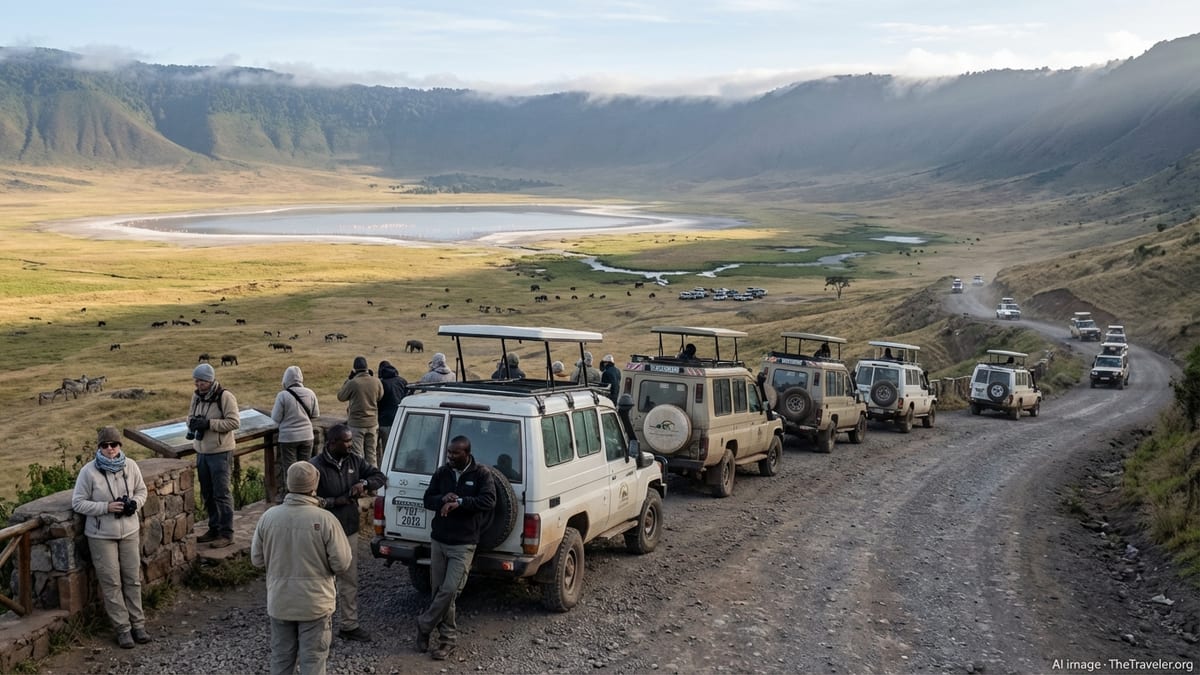
All of my mild irritation about fees and bureaucracy dissolved for a few minutes at the first viewpoint. The crater opens beneath the rim like a living map, 260 square kilometers of grassland, swamp, forest patches and a lake ringed by pale salt. In the clear morning light I could make out tiny dots that were actually herds of buffalo and wildebeest, and a hint of the shimmering water where flamingoes sometimes gather. The walls of the caldera rise on every side, steep and continuous. It feels both expansive and strangely contained, a self-contained world.
That view is genuinely spectacular. It did match my expectations and maybe even exceeded them. I had seen plenty of photos beforehand, but looking out in person, knowing that I would soon be down there among the dots, is different. The altitude cools the air, the rim can be cloaked in cloud, and there is a sense of dropping into a wildlife amphitheater that does not really exist in the same way anywhere else.
The descent itself, via the Seneto road in my case, is steep and winding. The gravel road had recently been graded, but it was still rough enough that I was glad someone else was driving. As we zigzagged down, I could see other 4x4s spaced along the road, all part of the morning wave of arrivals. There is a moment when you level out on the crater floor and the first zebra or gazelle appears close to the track when the whole thing feels as magical as the brochures promise.
Then, after a few more minutes, you start to notice how many other vehicles are sharing the same scene.
Wildlife: Intense, Reliable and Sometimes a Little Too Easy
Ngorongoro is famous for a reason. The wildlife density on the crater floor is very high, and the animals feel almost concentrated. Within the first hour I saw large herds of zebra and wildebeest, Cape buffalo, warthogs, hyenas, jackals, and a scattering of elephants. Birdlife along the marshes and around the lake was prolific. It did not take long before we found our first lion, a male resting in the grass not far from the road.
The wildlife viewing is almost shockingly efficient. This is not like some other parks where you can drive for hours and see only distant silhouettes. In Ngorongoro, especially in the dry season, animals are easy to find and often quite close. The crater is a relatively small, enclosed environment, and there is no migration out of it in the way there is in the Serengeti. The result is that you can tick off a large chunk of your wish list in a single morning: lion, hyena, big herds of ungulates, perhaps elephants with impressive tusks and, if you are lucky, a black rhino somewhere in the distance.
I appreciated this, but I also felt a bit conflicted. On one hand, it is ideal for a first safari. You are almost guaranteed to see a lot of animals in a short window, which is reassuring when you have spent a large sum to come all this way. On the other hand, it can feel almost too curated. My guide had done this circuit countless times, and he had a mental map of where each species usually hangs out. We dropped into the crater, traced a rough loop that he clearly knew by heart, stopping at known lion territories, hippo pools, and the marsh favored by elephants. There is of course still unpredictability, but you sense that the show is fairly repeatable day after day.
What surprised me in a good way was the variety of behavior I could observe in such a short time. We watched hyenas squabble over a piece of carcass, a martial eagle perched regally on a snag, and a bull elephant wading through reeds with cattle egrets fluttering around his feet. The crater’s open terrain makes it easy to see interactions that are often hidden in more wooded parks. For wildlife photography, this place is a gift, particularly in the early morning light before the haze builds.
Still, I never really shook the feeling that I was sharing each sighting with a small engine convention.
Crowds, Congestion and the Reality of a Famous Park
If you come to Ngorongoro expecting solitude, you will be disappointed. During my visit, which fell in one of the drier, more popular months, the crater felt busy. Vehicles bunch up at any notable sighting. At our first lion, I counted more than a dozen 4x4s spread in a rough semicircle, noses pointed toward the cat. Later, at a more dramatic scene involving a lioness and cubs, the tally climbed higher. Guides are supposed to avoid overcrowding a single animal, and official rules talk about limiting the number of vehicles around a sighting, but in practice it felt like a guideline rather than a strict cap.
Traffic on the main tracks could feel like a slow safari convoy. We were rarely alone on a road for more than a few minutes. This is not bumper to bumper gridlock, but it is also not empty wilderness. At the designated picnic spots, the sense of crowding becomes even more obvious. Ngoitoktok and other popular picnic areas can be packed at lunchtime, with safari vehicles lining up and travelers queuing for basic toilets. The atmosphere becomes more like a scenic rest area than a quiet bush lunch.
I found this more jarring than I expected. I had mentally prepared for costs and for structured rules, but I underestimated how much the sheer number of people would affect the experience. It is hard to feel that you are quietly observing nature when radio chatter buzzes from nearby vehicles and engines start and stop as each car inches into the best viewing position. My guide did what he could to linger at the fringes rather than forcing us into the densest clusters, but there are times when the geometry of the roads and animals means you inevitably end up in the scrum.
To be fair, this density of vehicles is closely tied to the crater’s strengths. Because animals are so visible and concentrated, everyone ends up in the same areas. Unlike big open parks where sightings are widely dispersed, Ngorongoro funnels both wildlife and visitors into a bowl with fixed tracks. I never felt unsafe or in danger, but I did occasionally feel like I was part of an assembly line of safari trucks.
Rules, Time Limits and the Feeling of Being Rushed
One of my biggest frustrations was the six hour structure. Officially, the area is open from 6:00 to 18:00, with vehicles required to be out of the crater by early evening and descent access closing at 16:00. In practice, almost all operators schedule a roughly six hour game drive on the crater floor because the one time crater service fee is high and they try to fit everything into what is effectively a half day. Once our descent began mid morning, the guide made it clear that we needed to be heading back toward the ascent road in time to be well out before the window closed.
That ticking clock changes the feel of the safari. Scenes that I might otherwise have watched for longer became brief stops before moving on to ensure that we covered the classic circuit. I had to accept that I would only scratch the surface of the crater in that timeframe. Yes, we technically could have gone in earlier, but that would have meant an even more punishing wake up time and still the same exit constraint.
There are other rules that are necessary but also contribute to a slightly controlled atmosphere. There is strictly no off road driving. You stay in the vehicle at all times except at designated picnic spots. Speed is limited. The basic message is clear, and justified by conservation: this is a fragile ecosystem and it is not a playground. I did not resent the rules themselves, but the combination of time pressure and fixed roads made the crater feel less like a wild landscape and more like a circuit that you complete, especially if you are used to parks where you can wander longer or return to sightings at different times of day.
It makes the experience intense but short. We saw a lot, quickly, and then we were climbing back up the Lerai ascent road well before sunset, looking down at the world we had just crossed in a few short hours. It felt almost abrupt, especially considering how much it costs to access the crater floor in the first place.
Cost vs Value: Is It Worth What You Pay?
I knew Ngorongoro would be pricey, but seeing the line items added up made me pause. The combination of conservation fees, crater service fee and, if you choose to stay on the rim, extra concession or camping fees means this is not a budget-friendly stop. A fairly standard scenario for two adults doing a one day crater visit with an overnight on the rim racks up several hundred dollars in government fees alone, quite apart from lodge rates and the cost of a private or group safari vehicle.
The question I found myself asking afterward was whether that brief, crowded but undeniably spectacular crater experience justified such a large chunk of the total safari budget. If this is a once in a lifetime trip and Ngorongoro has been at the top of your list for years, then the answer is probably yes. The crater is visually and biologically unique, and for many people it is the highlight of northern Tanzania. For first timers, the near guarantee of seeing a lot of wildlife in a contained area is comforting.
However, if you have already spent time in other premier parks, particularly the Serengeti, you might be more critical. In my case, I had just come from a few days in a quieter sector of the Serengeti where I spent long, unhurried hours with lions and cheetahs, often with no other vehicles in sight. Compared to that, Ngorongoro felt both more crowded and much more expensive per hour of actual wildlife time. The crater delivered black rhino at long range and an impressive density of animals, but it did not give me the feeling of spacious wilderness that I value most.
What eased the sting a little was knowing that the high fees do support conservation, anti poaching and infrastructure improvements, such as recent upgrades to crater roads and the maintenance of the tarmac route from Arusha and Karatu to the gate. Still, from a traveler’s perspective, you need to go in fully aware that this will be one of the most expensive single days of your safari, and those six hours will go by faster than you expect.
What I Would Do Differently Next Time
If I were planning the trip again, I would adjust a few things. First, I would aim more deliberately for a shoulder or greener season. Crowd levels are significantly higher from June to October and around December and January. During the heavier rains, especially April and May, there are fewer vehicles, lower lodge occupancy and often discounted rates. You trade clearer skies for lusher, sometimes muddier conditions, but you also trade some of the congestion for a calmer atmosphere. Having now seen how concentrated the vehicles can be in peak months, that compromise feels worth it to me.
Second, I would strongly consider staying on the crater rim rather than in Karatu, despite the extra concession costs. Staying right by the crater allows you to be among the first vehicles descending at 6:00 when the gate opens. Animal activity is highest in the early morning, and rhino and big cats are most visible before the sun climbs and the air warms. I started from outside the conservation area, which meant passing through the gate with the main wave of arrivals and reaching the floor when the sun was already well up. A rim stay would not solve the crowding problem entirely, but it would give you a head start and a quieter first couple of hours.
Third, I would mentally frame Ngorongoro as a concentrated half day highlight rather than as the spiritual centerpiece of the entire trip. That shift alone would have helped me manage my expectations. I went in imagining some semi mystical, extended immersion. What I got was a spectacular, tightly controlled wildlife drive that happened to be set in one of the most beautiful natural amphitheaters on the planet, but that was over by early afternoon. If you think of it as the most impressive half day game drive you are likely to have, the experience aligns much better with reality.
Finally, I would pair the crater with at least one quieter park where I could stretch out and absorb the landscape without watching the clock. Ngorongoro works best, in my view, as part of a broader northern circuit that includes places like Tarangire or less trafficked parts of the Serengeti, where you can get that slower, more meditative safari rhythm that the crater does not really allow.
The Takeaway
Walking away from Ngorongoro, I felt both deeply impressed and slightly ambivalent. The place itself is extraordinary. The view from the rim, the sudden abundance of animals as you reach the floor and the sheer variety of life in such a compact, dramatic setting are all exactly as special as I hoped. For first time visitors to Africa, it offers an almost guaranteed, high impact wildlife hit that would be hard to match elsewhere in such a short time.
At the same time, the experience is more controlled, more crowded and more expensive than many people realize before they arrive. This is not the park where you will find solitude or long, wandering days of exploration. It is a place where you follow a well worn route in a convoy of similar vehicles, obeying strict rules and a firm timetable. If your dream safari is about silence, open horizons and the feeling of being alone with the bush, the crater on its own will not fully satisfy you.
So is Ngorongoro Crater worth it? For me, yes, but with clear conditions. It is worth it if you accept that it is a concentrated, high cost, high reward experience rather than a leisurely immersion. It is worth it if you are prepared for the crowds and see them as the price of sharing a genuinely remarkable ecosystem. It is worth it if you combine it with other parks that offer more space and time to breathe.
If I had to plan again, I would still include the crater, but I would do it in a greener, quieter month, stay on the rim to catch the earliest descent and go in with a mindset that values those six hours for what they are: an intense, unforgettable glimpse into a unique wildlife bowl, to be savored and then balanced with slower, more expansive days elsewhere on the savannah.
FAQ
Q1. How long do I actually get to spend on the Ngorongoro Crater floor?
Most visitors spend about six hours on the crater floor. The conservation area operates from 6:00 to 18:00, with access to the crater closing around mid afternoon and all vehicles required to be out by early evening. Tour operators design their itineraries so that a single, roughly half day game drive makes the most of the one time crater service fee.
Q2. How crowded does Ngorongoro Crater really get?
In the main dry season months from June to October and around the Christmas and New Year period, the crater can feel very busy. It is common to find many vehicles clustered around lion sightings or rhinos, and picnic sites at lunchtime can be packed. In shoulder and wet seasons there are noticeably fewer vehicles and a calmer atmosphere.
Q3. Is it better to stay on the crater rim or in Karatu?
Staying on the rim is more expensive because of extra concession fees and generally higher lodge rates, but it puts you much closer to the descent roads and allows you to be among the first vehicles entering the crater at 6:00. Staying in Karatu is more affordable and offers a wider range of mid range accommodation, but you will arrive later and hit more of the crowd.
Q4. Can I self drive in Ngorongoro Crater?
Self drive is possible but comes with important conditions. You must have a proper 4x4, follow only marked tracks, respect all operating hours and, in many cases, hire a licensed guide or ranger for the descent. Fees still apply in full. For most travelers, joining a guided safari is simpler, but confident drivers who want more control can choose the self drive route with careful planning.
Q5. How expensive are the park fees and are they worth it?
The fees are significant. There is a per person conservation fee for entering the Ngorongoro Conservation Area and a separate crater service fee per vehicle to descend to the floor. For a couple on a day trip, this easily reaches several hundred dollars before adding transport and lodging. Whether it is worth it depends on your priorities and budget, but the crater’s uniqueness and dense wildlife do justify the cost for many visitors.
Q6. When is the best time to visit to avoid the worst crowds?
If your main goal is fewer vehicles, consider traveling in the green or shoulder seasons, especially from March to May and in November. You will likely encounter more rain and some muddier tracks, but you will also benefit from lower occupancy, potential discounts and a quieter experience both in the crater and at viewpoints.
Q7. What kind of wildlife can I realistically expect to see?
On a typical visit you can expect to see large herds of zebra, wildebeest and buffalo, along with warthogs, various antelope species, jackals, hyenas and often lions. Hippos inhabit the pools, and elephants frequent marshy areas and the forest edges. Black rhino are present and are one of the main draws, though sightings are usually at a distance and never guaranteed.
Q8. How does Ngorongoro compare to the Serengeti or other parks?
Ngorongoro delivers a very intense, compact wildlife experience with spectacular scenery. The Serengeti, by contrast, offers a much larger, more open landscape with far more room to roam and often fewer vehicles at individual sightings, especially away from the busiest migration zones. Many travelers find that the crater is best experienced as a dramatic one day highlight, while parks like the Serengeti or Tarangire provide the slower, more expansive safari feel.
Q9. Do I need any special equipment or preparation for a crater visit?
You do not need technical gear, but a few basics make the day more comfortable. A warm layer for the cool, often misty rim, a hat and sunscreen for the crater floor, and a light scarf or buff to help with dust are useful. Binoculars are extremely helpful for spotting rhino and distant animals. Everything else is generally provided by your safari operator, including a packed lunch and water.
Q10. Would I visit Ngorongoro Crater again?
I would, but I would plan it differently. I would aim for a quieter season, stay on the rim to maximize early morning time and approach the visit as a focused, half day spectacle rather than the centerpiece of the entire safari. With those expectations, I think the crater’s beauty and wildlife density would shine, and the crowds and costs would feel more like an accepted part of the deal than an unwelcome surprise.