

More news on this day
As Europe’s Mediterranean hotspots from Nice to the Amalfi Coast enter another record-setting tourism year, emerging research and on-the-ground measures suggest the soul-stirring transformation many travelers seek may require far less movement, and far more intention, than the packed itineraries and multi-country marathons that have come to define modern vacations.
Get the latest news straight to your inbox!
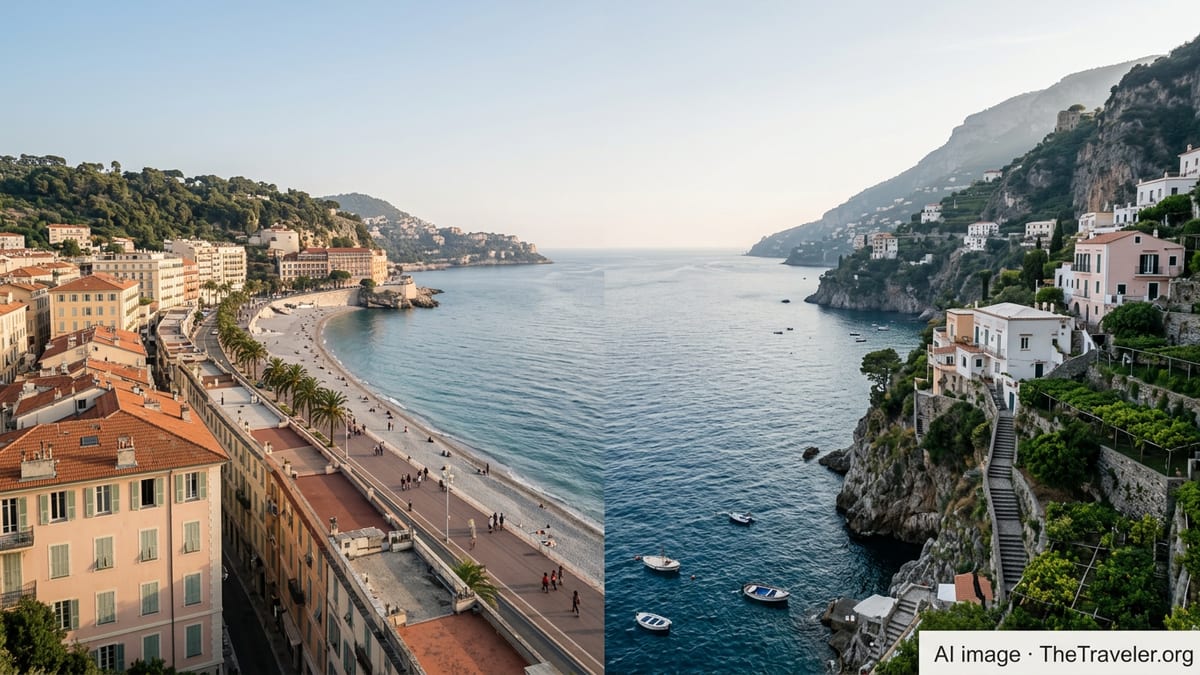
Mediterranean Icons Face a New Kind of Visitor Fatigue
Nice and the Amalfi Coast are starting 2026 in a tourism landscape defined by superlatives. Europe welcomed more than 740 million international arrivals in 2024, and France and Italy remain among the world’s most visited destinations, with France consistently at or near the top of global rankings and Italy drawing tens of millions of visitors each year. Publicly available data from European and global tourism bodies shows these flows continued to grow through 2025, particularly along Mediterranean coasts.
Yet this success carries a cost. Coverage of the Amalfi Coast in Italian and international media during 2024 and 2025 frequently highlighted overtourism, congestion and pressure on local infrastructure, echoing similar concerns in parts of the French Riviera during peak season. Reports describe packed coastal roads, saturation of short-term rentals and growing tension between residents’ quality of life and the economic weight of visitor spending.
In response, regional and national authorities across Italy and France have been experimenting with tools such as crowd-management apps, new heritage routes and seasonal caps in other cities to nudge travel away from peak days and overexposed hotspots. While most measures are still focused on major urban centers, observers note that coastal destinations like Nice and the Amalfi towns are closely watched bellwethers for how Mediterranean mass tourism might evolve.
This backdrop matters for travelers chasing personal transformation. As queues lengthen and streets clog, the long-held assumption that “more places equals deeper change” is increasingly being questioned. The emerging counterpoint from tourism researchers and industry trend reports is that less distance, but more depth, may do more for a traveler’s inner life than a frenetic race along the Côte d’Azur and the Campania coast.
Slow Travel and Shorter Hops Are Redrawing the Map
Recent travel trend analyses for 2025 and 2026 from consultancies and hotel groups indicate several converging shifts: a rise in wellness-focused trips, renewed interest in “slow travel” and a measurable increase in longer stays in fewer places, particularly among higher-income travelers. These reports describe travelers purposefully building in rest days, walking-based sightseeing and time with local food and culture in place of rapid-fire checklists.
Academic work on tourism patterns and digital nomadism also points to a post-pandemic recalibration. Studies tracking average stay lengths in major platforms between 2019 and 2024 identify a durable shift toward more extended visits, a finding that dovetails with anecdotal evidence from Mediterranean destinations where guests are opting to spend a full week or more in a single coastal town instead of hopping among multiple countries.
For Nice and the Amalfi Coast, this trend is significant. Both regions traditionally attract visitors on tight schedules who split a few days between multiple Riviera towns or combine Amalfi with Rome, Florence or Capri. Industry data on overnight stays suggests that even a modest rebalancing toward longer stays in one base town can reduce transport pressure, support local businesses year-round and give travelers the time needed to connect beyond postcard views.
Crucially, these findings suggest that a “transformative” Mediterranean journey does not require a months-long sabbatical. Instead, reports indicate that an intentionally structured week or even a long weekend, anchored in a single coastal hub, can deliver many of the reflective benefits people often associate with far larger journeys.
Nice and Amalfi Reposition as Gateways, Not Checkpoints
In France, recent national tourism overviews highlight how coastal destinations, including the Mediterranean, remain central to the country’s visitor economy even as officials and industry groups promote diversified, more sustainable experiences inland. Nice, with its role as a gateway to hilltop villages and lesser-known stretches of the Riviera, sits at the intersection of these efforts.
Local and regional campaigns increasingly frame the city not only as a beach and nightlife destination, but as a launchpad for walking trails, vineyard visits and cultural institutions that reward slower, curiosity-driven exploration. Publicly available planning documents and tourism strategies emphasize seasonality management and the promotion of nearby areas in an effort to spread visitor flows.
On the Amalfi Coast, a coordinated initiative branded under a shared UNESCO World Heritage identity has begun linking thirteen municipalities along a single cultural and tourism route. Announced in 2025, the project is presented as a way to tell a broader story of the coast beyond its most photographed viewpoints, with digital tools designed to steer visitors toward lesser-known sites and to encourage a more reflective, narrative-focused experience of the territory.
Together, these moves underscore a subtle but important reframing. Nice and Amalfi are no longer marketed solely as must-hit stops on a Mediterranean checklist, but as bases from which travelers can slow down, stay put and weave a deeper, more personal journey. The message aligns with wider industry data suggesting that visitors are more satisfied when they feel they have “lived” a place, however briefly, rather than skimmed across multiple destinations.
The Surprising Sweet Spot: Depth Over Distance
What, then, is the real secret to how much travel a person needs to feel transformed in 2026? Large-scale tourism statistics focused on nights, arrivals and spending do not measure inner change directly, but a number of recent wellness and vacation trend reports converge on an unexpected answer. Instead of very long or very complex trips, many travelers report the greatest sense of reset and perspective from compact journeys that combine three elements: limited geographic scope, intentional downtime and genuine encounters with local environments and communities.
In practice, this might mean choosing Nice as a sole base for five days, building in unstructured mornings along the Promenade des Anglais and day trips only to a handful of nearby villages, rather than attempting to cross two or three countries in a week. On the Amalfi Coast, it could look like a stay concentrated in one town, with travel by local boat or bus on select days, and the rest devoted to walking historic stairways, visiting small churches and tasting regional produce without rushing.
Travel psychologists and tourism scholars note in published research that reflection, novelty and moderate challenges tend to matter more for perceived personal growth than sheer mileage. When visitors are less exhausted by logistics, they are more likely to notice subtle details, engage in meaningful conversations and integrate what they experience once they return home.
That emphasis on depth over distance is reshaping how both destinations are positioned in global travel media. While Nice and Amalfi still appear frequently in aspirational lists and social media feeds, coverage is increasingly pairing their iconic imagery with guidance on off-peak visits, shoulder seasons and low-impact activities, signaling that the most powerful journeys here may be shorter, slower and closer to the ground than expected.
A Testing Ground for the Future of Transformative Tourism
With Mediterranean tourism once again near or above pre-pandemic levels and anti-tourism protests surfacing in some parts of southern Europe, Nice and the Amalfi Coast are emerging as early test cases for what a more conscious, transformation-oriented travel model might look like in practice. Publicly available policy discussions and industry forums frequently cite the region as an example of both the promise and pressure of global wanderlust.
Observers warn that without continued efforts to manage visitor numbers, safeguard housing for residents and protect fragile coastal ecosystems, even well-intentioned slow travelers risk contributing to cumulative strain. At the same time, data on visitor spending shows that travelers who stay longer in one place often support a wider range of local businesses, from family-run guesthouses to neighborhood markets, making them attractive partners in a shift toward more sustainable tourism.
For travelers planning 2026 itineraries, the clearest message from this evolving picture is that transformative experiences do not require chasing ever more distant frontiers. The combination of robust rail connections, dense cultural heritage and ongoing sustainability efforts means that a carefully chosen stint in Nice or on the Amalfi Coast can offer a powerful reset, even within the constraints of limited vacation time.
In an era of record-breaking visitor numbers and climate-conscious decision-making, the surprise is not that Mediterranean journeys still change people, but that the change may come fastest when they travel less, stay longer and allow a single coastline to do the quiet work they once expected from entire continents.