

More news on this day
Nigeria is intensifying security across its busiest airports, deploying newly armed aviation security teams, upgrading training and tightening screening procedures in a bid to reassure travellers and strengthen the country’s appeal as a safe gateway for business and leisure tourism.
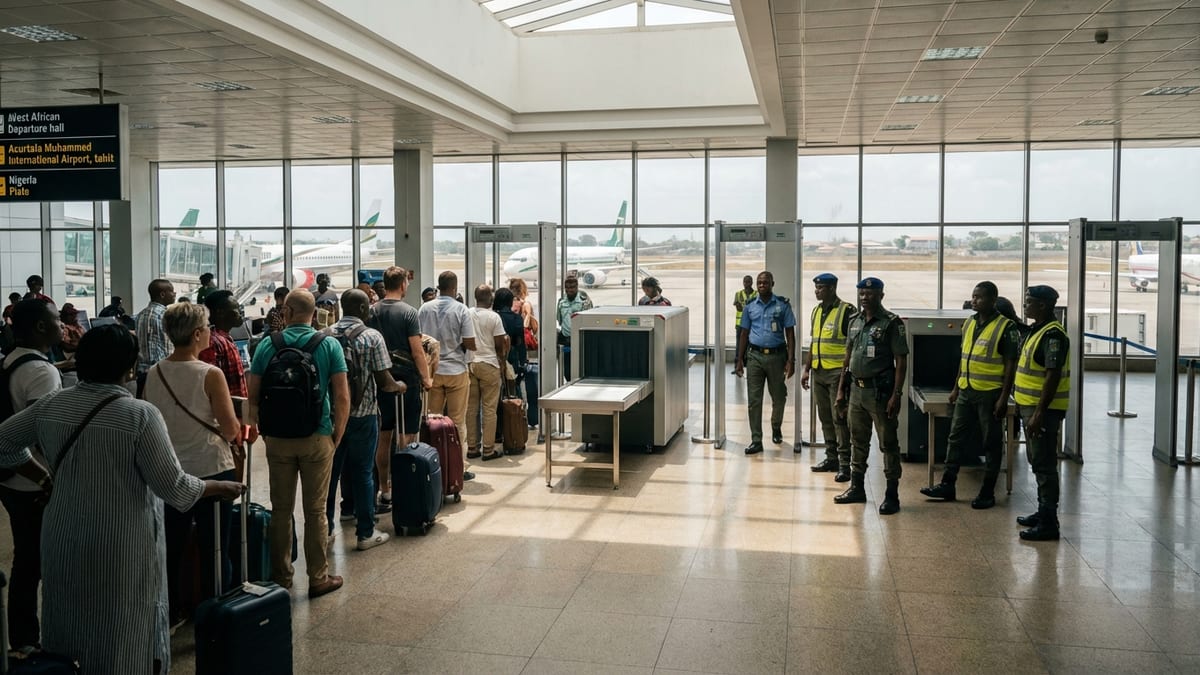
New Armed Aviation Security Teams at Key Gateways
The Federal Government has moved to a more assertive security posture at major airports, formally arming select aviation security officers and commissioning a specialised Aviation Security Special Force. The first batch of 120 officers was deployed to Nigeria’s five busiest international gateways, including Lagos, Abuja, Kano, Port Harcourt and Enugu, with a clear mandate to deter criminal activity and respond swiftly to threats.
The units, drawn from the Federal Airports Authority of Nigeria’s aviation security directorate, have undergone weapons handling and rules-of-engagement training aligned with international civil aviation standards. Their presence is most visible in airside zones, access control points and perimeter areas that had been vulnerable to vandalism, theft and unauthorised entry. Authorities say the armed capability is meant to complement, rather than replace, the work of regular police and military units based at airports.
Senior aviation officials emphasise that the decision to arm selected officers followed years of consultation with regulators and security agencies. They argue that the upgraded posture brings Nigeria closer to practices already in place at large hubs in other regions and will help restore confidence among airlines and high-yield international passengers who demand robust visible security.
Industry analysts note that while Nigeria has not recorded a major international aviation security incident in recent years, persistent reports of airside theft, cable vandalism and encroachment around airport perimeters had raised concerns. The new special force is designed to plug those gaps through a round-the-clock presence and coordinated patrols at strategic points along runways, taxiways and terminal vicinities.
Stronger Training and Oversight to Meet Global Standards
Alongside the new armed teams, the Nigeria Civil Aviation Authority is tightening professional standards for all aviation security staff. Regulators have ordered that, by October 1, 2025, every aviation security officer in the country must complete a baseline security training programme based on the Basic STP123 AVSEC course, as well as recurrent certification for screeners handling passengers, baggage and vehicles. The aim is to align local competence levels with International Civil Aviation Organization requirements and the National Civil Aviation Security Programme.
Security experts have long warned that underinvestment in training and career development left some frontline officers ill-prepared for evolving threats such as insider collusion, cyber-enabled attacks and complex smuggling networks. In response, officials are introducing more rigorous background checks for sensitive posts, structured training in behavioural detection and emergency response, and clearer progression paths to boost morale and retention within aviation security ranks.
To reinforce accountability, the Office of the National Security Adviser is rolling out a nationwide aviation security assessment framework that will regularly evaluate airports on risk management, response readiness and information sharing. Airports will face periodic audits and simulations designed to test their ability to react to scenarios ranging from unruly passengers and bomb threats to coordinated incursions on restricted areas.
Authorities say the combination of armed capability, standardised training and stronger oversight is intended to forge a more professional security culture across Nigeria’s aviation network. By raising minimum qualifications and recertifying thousands of officers, regulators hope to address long-standing vulnerabilities without compromising the customer service ethos that modern travellers expect.
Multi‑Agency Cooperation Tightens Airport Perimeters
Nigeria’s aviation security upgrade is also reshaping how different agencies work together at airports. The Police Airwing, immigration, customs, civil defence and aviation authorities have stepped up joint planning at major hubs such as Abuja, where senior security leaders recently met to deepen collaboration on threat assessment, intelligence sharing and incident response. The goal is to avoid duplication of checks while closing loopholes that criminals can exploit between agencies.
A key element of this coordination is a one‑stop joint screening concept, directed by the national security adviser, in which relevant agencies share data and conduct harmonised checks rather than subjecting passengers to multiple overlapping procedures. Officials say this model is being gradually introduced at selected terminals to reduce congestion at checkpoints while preserving stringent security controls.
On the ground, passengers are already seeing tighter enforcement of existing rules. The Federal Airports Authority of Nigeria has reiterated that all persons and baggage entering terminal buildings must be screened and that only travellers with valid documents will be granted access to departure halls. Airport managers have also upgraded explosive detection equipment, fine‑tuned grass and wildlife management around runways to reduce bird‑strike risks, and expanded CCTV coverage in public and restricted zones.
Security planners argue that a more integrated, technology‑supported approach is essential in a country with 30‑plus airports serving a mix of domestic, regional and long‑haul routes. They say the new aviation security teams can only be fully effective if supported by reliable intelligence, interoperable communications and clear lines of authority that span federal, state and private stakeholders operating at the nation’s gateways.
Boosting Traveller Confidence and Tourism Prospects
Tourism stakeholders are closely watching how the security reset translates into traveller perceptions. Nigeria’s aviation system is the primary gateway for international visitors to destinations such as Lagos, Abuja, Calabar, Yankari Game Reserve and emerging beach and cultural circuits along the Atlantic coast. Any doubts about safety at airports can quickly ripple into decisions by tour operators, conference organisers and airlines considering new routes.
Industry representatives say the visible deployment of professional, well‑equipped security officers can reassure first‑time visitors who may have preconceived concerns about crime or instability. At the same time, they caution that heavy‑handed or poorly coordinated checks could undermine the effort if they lead to long queues, inconsistent procedures or perceived harassment at entry points. Striking the right balance between firmness and hospitality is therefore central to Nigeria’s tourism strategy.
Federal and state tourism bodies are working with airport operators to ensure that upgraded security is complemented by clearer signage, more transparent communication about screening processes and better customer care training for frontline staff. Some airports are introducing multilingual information screens and announcements to guide foreign travellers through checkpoints and explain why certain measures, such as secondary bag searches, are necessary.
Travel consultants note that confidence is likely to grow if the new security posture coincides with other visible improvements, including cleaner terminal environments, more efficient immigration processing and reliable ground transport links into city centres. In that context, the armed aviation security teams are seen as one piece of a broader effort to position Nigerian hubs as competitive, trusted entry points for regional business travel and leisure tourism.
New International Gateways to Support Regional Tourism Growth
Nigeria’s security reforms are unfolding just as new airports gain international status, widening the map of potential tourism gateways. Victor Attah International Airport in Uyo, for example, has secured federal approval to handle full international operations, with authorities highlighting its long runway, modern maintenance facilities and upgraded passenger infrastructure. The airport is expected to welcome its first scheduled international services in 2026.
Officials in Akwa Ibom State and other regions argue that combining tighter aviation security with expanded international access will help disperse visitor flows beyond Lagos and Abuja, opening up coastal, cultural and eco‑tourism destinations that have historically been harder to reach from overseas. They say strengthened security frameworks make it easier to market these emerging hubs to foreign airlines and tour operators that demand evidence of robust risk management before committing capacity.
As more Nigerian airports court international designations, security standards will be a decisive factor in regulatory approvals and commercial negotiations. The newly armed aviation security teams, enhanced training mandates and multi‑agency coordination structures are therefore not only about preventing incidents but also about demonstrating that Nigeria’s air gateways can meet the expectations of a growing global travel market.
For travellers, the most immediate impact will be more visible security personnel and stricter compliance with screening rules. For Nigeria’s tourism industry, officials hope the medium‑term payoff will be greater confidence in the country’s skies and a steadier flow of visitors choosing its cities, beaches and wildlife as their next destination.