

More news on this day
Nigeria has been swept into the widening global air travel meltdown triggered by the escalating conflict between the United States, Israel and Iran, as sweeping airspace closures across the Middle East force Emirates and Qatar Airways to halt services from Lagos and Abuja, stranding passengers and severing one of West Africa’s most important long-haul corridors.
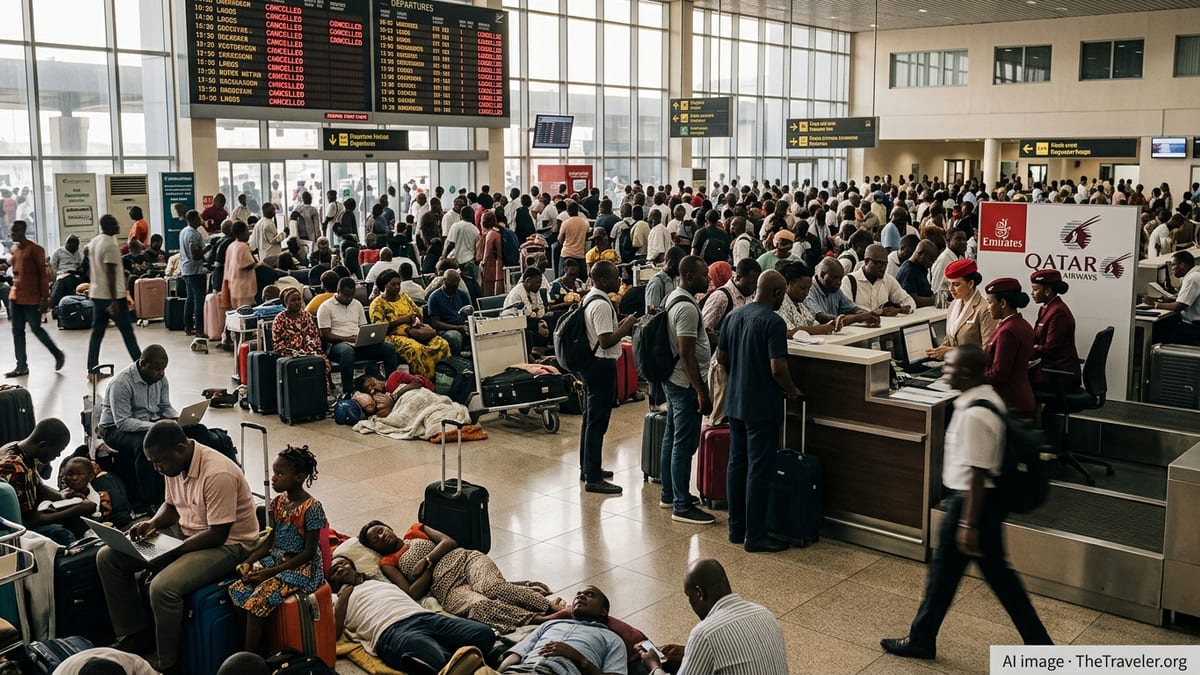
Nigeria Becomes Latest Casualty of Middle East Airspace Shutdown
With major Middle Eastern hubs effectively shuttered or operating at a fraction of their usual capacity, Nigeria has joined the United Arab Emirates, the United States, Kenya, Egypt, Germany and other countries reporting mass disruption to long-haul travel. Aviation analysts estimate that the halt in operations through Dubai, Abu Dhabi and Doha, combined with partial or full airspace closures in states including Qatar, Bahrain, Kuwait and Saudi Arabia, has triggered an unprecedented global rerouting of passengers and cargo.
In Nigeria, Emirates and Qatar Airways have suspended regular passenger services, cutting off two of the most heavily used gateways to Asia, the Middle East and parts of Europe for Nigerian travelers. Industry figures cited by local aviation stakeholders suggest the conflict-linked shutdown could already be costing airlines serving Nigeria billions of naira in lost revenue as aircraft sit grounded and ticket refunds mount.
Travel agencies in Lagos and Abuja report that passengers who were due to fly via Gulf hubs to destinations such as London, Dubai, Mumbai and Guangzhou are now stuck in limbo, their itineraries cancelled outright or placed on indefinite hold. The advice from many agents to clients planning new trips has shifted virtually overnight from price comparison to crisis avoidance, with warnings to postpone any nonessential travel reliant on connections through the Gulf.
Passengers Stranded as Key Gulf Carriers Suspend Nigerian Routes
The suspension of Emirates and Qatar Airways services from Nigeria has left hundreds of passengers a day without their usual options, with ripple effects across the wider West African region. Emirates, which had previously restored its Nigeria operations after a lengthy suspension over foreign exchange issues, had been operating high-demand flights out of Lagos. Qatar Airways, which developed Nigeria as an important market for connecting traffic to Asia and the Middle East, has also halted departures as its Doha hub remains largely closed to regular passenger movements due to the conflict.
At Murtala Muhammed International Airport in Lagos, travelers who had arrived early for flights learned at check-in that their journeys were no longer operating, creating crowded scenes at airline desks as passengers sought clarity on refunds, accommodation and alternative routing. Some had onward connections to the United States, Europe or East Africa, and now face complex rebookings on carriers that are themselves struggling to avoid conflict-affected airspace.
Passengers report receiving mixed messages in recent days, as schedules first showed flights as pending or under review before being formally cancelled. Many travelers purchased tickets weeks or months in advance and now find that available seats on alternative airlines, particularly those routing via Europe, are significantly more expensive or sold out entirely in the near term.
Global Network Feels the Shock from Middle East War
While Nigeria’s immediate pain is focused on Gulf connections, the disruption is global in scope. The United Arab Emirates, normally one of the world’s busiest aviation crossroads, has seen most commercial traffic through Dubai and Abu Dhabi suspended or sharply reduced as authorities impose temporary airspace closures for safety reasons. Qatar has halted normal operations at Doha, while Israel, Iran, Iraq, Kuwait and several other states have also restricted flights, forcing airlines to cancel or take long detours that add hours to flight times.
For travelers from the United States and Europe transiting through the Gulf to destinations in Africa and Asia, the closures have shattered what had become routine one-stop itineraries. Long stretches of airspace usually used by global carriers are now effectively off limits, with some airlines routing via Central Asia or deep into the Mediterranean to maintain critical links, while others have simply withdrawn services until the security situation stabilizes.
Countries such as Kenya, Egypt and Germany, which depend heavily on traffic to and from Gulf super-connectors, are also reporting large numbers of stranded or rerouted passengers. Aviation data shows that before the conflict, the principal Gulf carriers handled tens of thousands of travelers daily through their hubs, concentrating disruption when those hubs are suddenly taken offline.
Limited Relief Flights Offer Only Partial Respite
As the shutdown stretches into its second week, some Gulf airlines have begun cautiously operating limited relief flights to move stranded passengers out of improvised holding points. Qatar Airways has announced a small number of services from alternative airports including Muscat and Riyadh, prioritizing those whose flights were diverted or cancelled at short notice. These flights are a fraction of normal operations and are subject to change depending on shifting security assessments.
Emirates has also started restoring a reduced network using carefully controlled corridors through reopened sections of airspace, while maintaining a full suspension on many regular routes until at least the end of the week. Other regional carriers such as Etihad and low-cost operators in the Gulf are following a similar pattern, with small numbers of special flights scheduled to repatriate citizens and clear backlogs rather than resume full commercial operations.
For Nigerian passengers, however, these relief measures are of limited use, as they largely focus on hubs closer to the immediate conflict zone. Without direct relief services from Lagos or Abuja, most affected travelers are being encouraged to seek refunds, accept travel credits or rebook on alternate airlines that can route via European or African hubs where airspace remains open.
Nigeria’s Travel Industry Scrambles to Adapt
Nigerian travel agencies, tour operators and corporate travel managers are now working around the clock to remodel itineraries and salvage urgent trips. Some are turning to carriers that connect via Addis Ababa, Johannesburg or European cities, but capacity constraints mean that not every stranded passenger can be accommodated quickly. Business travelers and students with fixed reporting dates abroad are among those facing the most acute pressure to find new routes.
Airline representatives in Nigeria say customer service teams have been inundated with calls and messages from worried travelers seeking clarity on next steps. Policies on refunds and rebooking vary by carrier, and many include complex conditions tied to original travel dates and ticket types. Travel consultants are advising passengers to document all communications, keep receipts for emergency accommodation and seek written confirmation of cancellations where possible.
In the medium term, the crisis is likely to reignite debate in Nigeria over dependence on foreign carriers for long-haul connectivity and the vulnerability of that model when geopolitical shocks occur far beyond the country’s borders. For now, however, the priority remains getting stranded Nigerians and transiting passengers safely to their destinations, as the war-driven shutdown of key Middle Eastern airspace continues to ripple through global travel networks.