

More news on this day
Holland America Line’s Noordam is set to play a prominent role in 2026’s Pacific cruise calendar, with new long-haul crossings that spotlight Sydney and San Diego as opposing anchors of a gradually reviving trans-Pacific tourism market.
Get the latest news straight to your inbox!
How Noordam’s 2026 Pacific Season Is Taking Shape
Publicly available planning documents and industry listings indicate that Holland America Line is positioning Noordam as a key player in extended South Pacific and trans-Pacific cruising in 2026. The ship’s program includes a 36-day South Pacific Crossing that departs Sydney in March 2026 and sails to the United States West Coast via a mix of Polynesian and Pacific island ports before continuing on toward Seattle.
Brochures for Holland America’s 2025–2026 and 2026–2027 seasons highlight a broader strategy built around so-called Legendary Voyages, many of them longer than a month and focused on in-depth regional exploration. Within that portfolio, Noordam’s crossings link Australia, the South Pacific and North America on itineraries that are marketed as once-in-a-lifetime routes rather than routine repositioning moves.
While several retail travel sites describe the marquee 36-day voyage as operating between Sydney and Seattle, Holland America’s own voyage planners list Noordam in both Australian and San Diego lineups for 2026. These materials collectively point to an operating pattern in which the ship uses Sydney as its primary Southern Hemisphere base and the San Diego and Seattle region as its North American gateway during key parts of the year.
The result is that Noordam’s movements effectively recreate a classic trans-Pacific arc just as airlines, tour operators and ports around the Pacific are reporting steadier demand for long-haul leisure travel compared with the early 2020s.
Sydney and San Diego Step Forward as Pacific Gateways
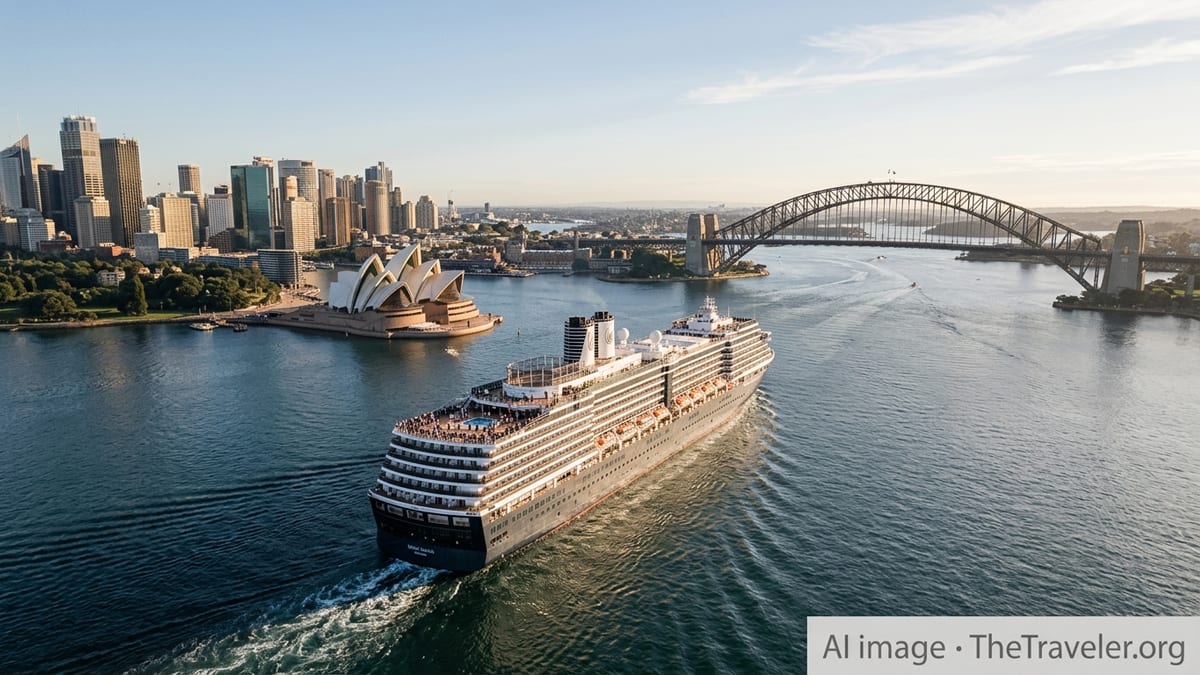
The choice of Sydney as a departure anchor reflects its status as one of the most established cruise homeports in the Southern Hemisphere. Travel agency descriptions of Noordam’s March 2026 departure emphasize the visual impact of sailing past the Sydney Opera House and Harbour Bridge, as well as the city’s extensive hotel inventory and public transport network, which simplify pre- and post-cruise stays for international passengers.
On the eastern side of the Pacific, San Diego has been gaining prominence in Holland America Line deployment plans across multiple seasons. Corporate announcements about the line’s 2026–2027 Mexico and Pacific Coast program describe San Diego as a key homeport for itineraries to the Mexican Riviera, Baja Peninsula and Sea of Cortez, suggesting the city will see a steady flow of embarkations and debarkations tied to longer repositioning and regional cruises.
For Noordam, that means San Diego and nearby ports on the U.S. West Coast are likely to function as turnaround or connecting points when the ship shifts between its South Pacific itineraries and North American operations. Cruise industry schedules for late 2026, for example, show Noordam operating a separate 34-day Legendary South Pacific Crossing from Seattle to Sydney, illustrating how the vessel shuttles between hemispheres while keeping both Sydney and the Southern California–Pacific Northwest corridor central to its deployment.
This dual-anchor pattern effectively ties together two tourism markets that are both emphasizing outdoor, coastal and cultural experiences. Sydney leverages iconic cityscapes and easy access to New South Wales beaches, while San Diego promotes milder year-round weather, urban waterfront districts and proximity to Mexico.
What the 2026 Crossing Means for Pacific Tourism
Industry analysts note that long-haul itineraries like Noordam’s 2026 crossings are often seen as a bellwether for confidence in discretionary travel. These voyages typically attract guests who are willing to commit several weeks and significant budgets to a single trip, a segment that was cautious in the earlier recovery years after 2020 but has been returning more strongly since 2024.
Extended South Pacific and trans-Pacific itineraries also support a wide range of destinations along the route. Itinerary maps and descriptions for the 36-day Sydney departure show calls at island nations across Polynesia and the broader South Pacific, as well as U.S. Pacific ports. Each call generates local spending on shore excursions, restaurants, transport and guides, helping smaller communities as well as major cities participate in the cruise rebound.
For ports like San Diego, which already features prominently in Holland America’s published 2026–2027 Mexico and Pacific Coast seasons, the presence of repositioning-style voyages complements shorter regional cruises. Travelers who sail from Sydney or Seattle may choose to extend their stays in Southern California, adding hotel nights and independent touring before or after their voyage.
The pattern is similar in Sydney, where travel providers commonly package pre-cruise city stays and side trips to destinations such as the Blue Mountains or the Hunter Valley. The inclusion of Noordam’s crossings in 2026 schedules reinforces expectations that international arrivals to Australia will continue to normalize and that demand for complex, multi-week itineraries will remain resilient.
Key Practical Considerations for 2026 Passengers
For travelers considering Noordam’s 2026 Pacific deployments, the length and structure of the crossings are among the most important practical factors. The 36-day South Pacific Crossing from Sydney, for example, combines long stretches at sea with a series of remote island calls, which can appeal to guests who enjoy sea days and immersive time on board but may be challenging for those who prefer port-intensive routes.
Long voyages also come with planning implications around flights, visas and travel insurance. Because Noordam links Australia with the United States and multiple island nations, passengers must check entry rules for each country on the itinerary and build in time buffers around long-haul flights to and from Sydney, San Diego or Seattle. Travel forums discussing similar repositioning cruises highlight that many guests choose to arrive several days early to adjust to time zones and reduce the risk of travel delays.
Cabin selection is another consideration, as the extended duration can magnify the impact of noise, motion and layout. Public discussions among recent Noordam passengers suggest looking closely at deck plans and avoiding cabins directly beneath busy public areas for a more comfortable experience on a multi-week voyage.
Finally, fare structures for longer itineraries can evolve as departure dates approach. Observers of Holland America pricing note that early-booking promotions and loyalty incentives are commonly applied to extended voyages, while some travelers report occasional late discounts or value-added offers as sailings near. Prospective guests are often advised to monitor pricing over time and compare direct bookings with specialist cruise agencies to find packages that match their budget and flexibility.
Signals to Watch as 2026 Approaches
Although Noordam’s 2026 itineraries are already appearing in corporate planners and retail listings, the broader trans-Pacific landscape remains dynamic. Adjustments to deployment, port selections or dates are possible in response to operational factors, regional regulations or shifts in demand. Industry watchers therefore recommend keeping an eye on updated brochures and booking engines for any changes that might affect the Sydney departures or associated North American turnaround ports.
At the same time, the decision to schedule multi-week South Pacific and Pacific Coast programs for Noordam, framed around anchor ports such as Sydney and San Diego, is widely interpreted as a sign of confidence in the continued recovery of long-distance cruising. As booking windows for 2026 move into their prime, these itineraries are expected to attract a mix of repeat Holland America guests and new travelers drawn by the chance to cross the Pacific in relative comfort.
For the wider tourism sector, the ship’s role in reconnecting Australia, the South Pacific islands and the U.S. West Coast provides one more indicator that the Pacific corridor is returning to its place as a core route for global leisure travel, with cruise lines once again using repositioning-style voyages as both a logistical necessity and a high-profile product in their own right.