

More news on this day
A powerful Nor’easter battering the Northeast, combined with knock-on disruption from Denver International Airport, has triggered a fresh wave of flight cancellations and delays across the United States, stranding passengers on United, Southwest, Delta, JetBlue, SkyWest and Volaris flights from Boston and New York to Philadelphia, Newark, Dallas and beyond.
Denver Disruption Ripples Across the National Network
Denver International Airport, one of the country’s busiest connecting hubs, saw at least 96 flights canceled and 84 delayed as wintry weather and airspace constraints collided with the broader Nor’easter system hitting the East Coast. The disruptions, reflected in data from real-time tracking services on Monday, quickly rippled beyond Colorado as airlines rebalanced aircraft and crews already stretched thin by the storm.
Denver’s role as a major hub for United and a key operation for Southwest and Frontier meant that cancellations there did not just affect local travelers. Flights passing through Denver on their way to or from the Northeast were especially vulnerable, with some aircraft unable to position into place and others grounded preemptively as carriers tried to keep planes and staff out of the worst of the weather.
For passengers booked on multi-leg journeys, even a single Denver cancellation often meant missed connections in cities hundreds of miles away. Travelers heading for New York, Boston and Philadelphia reported being rebooked multiple times or rerouted through less congested hubs, with some opting to abandon trips altogether as delays stretched into many hours.
Airlines emphasized that the Denver cancellations were part of a national weather response, not an isolated operational breakdown. Still, the timing could hardly have been worse: with East Coast airports already operating at sharply reduced capacity, Denver’s troubles compounded a systemwide crunch that left few easy alternatives for stranded passengers.
Nor’easter Shuts Down Key East Coast Gateways
By Monday morning, the heart of the crisis had shifted firmly to the Northeast corridor. Data from FlightAware showed more than 5,300 flights canceled within, into or out of the United States and hundreds more delayed as the Nor’easter intensified over New York, New Jersey and New England. At major hubs such as Boston Logan, LaGuardia, Newark Liberty, John F. Kennedy International and Philadelphia International, cancellation rates hovered around or above 80 percent of scheduled departures and arrivals.
Airlines and airport officials described a simple but stark reality: snow was falling at rates of 2 to 3 inches an hour in some locations, with winds gusting toward 70 miles per hour. Under those conditions, plows and de-icing crews could not safely keep up, and visibility frequently dropped below levels required for safe takeoffs and landings. Authorities imposed ground stops at multiple airports, effectively freezing operations for hours at a time.
Local governments responded with emergency measures. In New York City, officials enacted a temporary ban on nonessential road travel during the worst of the blizzard, mirroring restrictions in parts of New Jersey and New England where whiteout conditions made driving treacherous. Schools closed across the region, and transit agencies curtailed or suspended some rail and bus services, further complicating journeys for air travelers diverted to ground options.
Airline executives insisted that halting most flying was the safest course of action, even as images of snowbound aircraft and crowded terminals circulated widely on social media. They argued that attempting to “push through” the storm would only heighten risk and likely create even more extensive knock-on disruption later in the week.
United, Southwest, Delta, JetBlue, SkyWest and Volaris Under Strain
Among U.S. carriers, JetBlue appeared to bear the brunt of the storm’s impact. With its largest operations at New York–JFK, LaGuardia and Boston Logan, the airline canceled the vast majority of its Monday schedule, according to multiple data analyses, temporarily reducing its presence at some airports to a trickle of flights. The disruption was reminiscent of previous winter meltdowns that have prompted questions about JetBlue’s vulnerability to Northeast weather.
United and Delta, both with significant transcontinental and international networks, also canceled nearly a fifth of their flights as they pared schedules at Newark, JFK and Boston. At the same time, they juggled operations at other hubs such as Denver, Chicago and Atlanta to accommodate passengers who could be rerouted away from the storm-affected region. Southwest, with a smaller footprint in the Northeast but heavy operations in Denver, Chicago Midway and Dallas Love Field, scrubbed dozens of departures as it worked to realign aircraft that had been scheduled to feed East Coast routes.
Regional carrier SkyWest, which operates feeder flights for United, Delta, American and Alaska, played an outsized role in the unfolding disruption. When SkyWest cancels or delays service into a hub, it can strand passengers even when the mainline airline’s long-haul flights are still operating. Snow and wind at smaller airports in the Midwest and Northeast, combined with crew duty-time limits, prompted SkyWest to cancel clusters of regional connections, complicating rebooking efforts for customers already bumped from larger jets.
Volaris, the low-cost Mexican airline, was affected more indirectly. The storm and related security concerns in parts of Mexico collided with the U.S. weather crisis to upend cross-border travel patterns, particularly on routes linking Denver and other U.S. hubs with leisure destinations. While Volaris’ Mexico-heavy network insulated it from the worst of the Northeast cancellations, some customers still found themselves stranded when connecting U.S. domestic legs were canceled or when departures from affected U.S. airports were halted altogether.
Stranded Passengers Face Long Delays in Boston, New York, Newark and Philadelphia
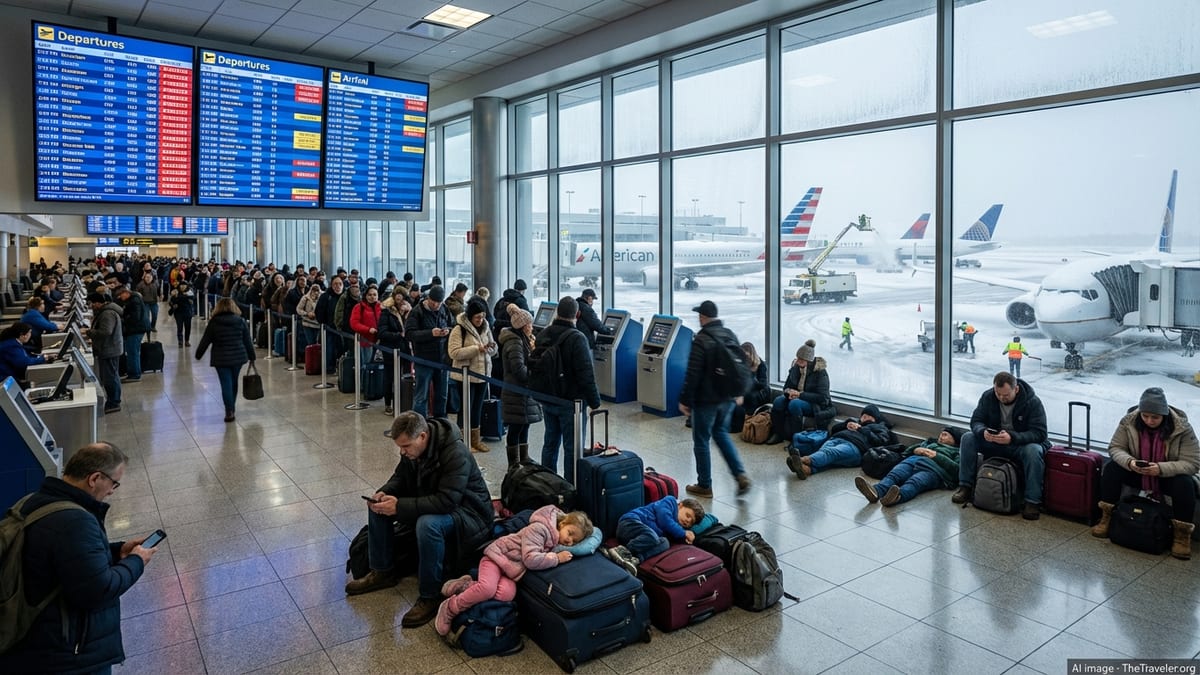
Inside the terminals of Boston Logan, JFK, LaGuardia, Newark and Philadelphia, the human impact of the storm was unmistakable. Rows of passengers slept on terminal floors or in chairs as rolling cancellations upended carefully laid plans. Some travelers reported being given rebooking options two or three days out, while others were offered connections through distant hubs that would require overnight stays and lengthy layovers.
Airport authorities urged passengers to check their flight status before leaving home, but for many already en route when the storm intensified, that advice came too late. At Boston Logan, travelers described long lines at ticket counters as airlines struggled to process rebookings while also handling phone and app-based requests. Similar scenes played out across New York City’s three major airports and in Philadelphia, where more than four out of five flights were canceled according to multiple data sets.
For some, the storm meant missed cruises, weddings or once-in-a-lifetime trips. International travelers arriving on flights that beat the worst of the weather sometimes discovered that their onward connections to smaller U.S. cities no longer existed, forcing them to seek hotel rooms in cities already close to capacity or to reconfigure their journeys entirely by train or rental car.
While many carriers handed out meal vouchers and hotel information, others reminded customers that weather-related cancellations fall into a category where airlines are not legally required to provide lodging or compensation beyond refunds and rebooking. That left some travelers to bear the cost of extended stays, even as they waited on hold for hours to secure new flights out of the storm zone.
Dallas and Other Hubs Feel the Knock-On Effects
Far from the blizzard’s epicenter, airports in Dallas, Chicago, Atlanta and other major hubs confronted their own operational headaches as the Northeast shutdown reverberated through the national airspace system. At Dallas–Fort Worth International and Dallas Love Field, cancellations and delays accumulated as American and Southwest adjusted schedules to cope with aircraft and crew that were stuck on the East Coast or diverted to alternate cities.
By late morning Monday, tracking services showed more than 5,000 flights canceled nationwide and thousands more delayed, a level of disruption comparable to some of the worst winter events of recent years. Even flights on seemingly unaffected routes, such as Dallas to West Coast destinations, were at risk if the assigned aircraft had previously been scheduled to operate into or out of the Northeast or Denver.
Travelers at these secondary hubs often found themselves on the receiving end of “downline” disruptions. Flights that did depart sometimes left with open seats because connecting passengers from Boston, New York or Philadelphia could not reach the hub in time. In other cases, airlines consolidated departures, moving customers from several lightly booked flights onto a single operation to free up aircraft for use later in the day.
Regional airports feeding into Dallas, Chicago and Atlanta were similarly affected, particularly those relying on SkyWest and other regional partners. The loss of just a few inbound and outbound flights could effectively isolate smaller communities for a day or more, as airlines prioritized scarce resources for trunk routes.
What Airlines Are Offering: Waivers, Refunds and Limited Flexibility
Facing a storm that forecasters had warned about for days, airlines moved early to roll out flexible travel policies in an attempt to reduce the number of passengers flying directly into the chaos. United, Delta, JetBlue, Southwest and other major carriers issued broad weather waivers covering travel to, from or through key affected airports, allowing customers to change their itineraries without paying standard change fees or, in many cases, fare differences, provided new travel dates fell within specified windows.
For customers whose flights were canceled outright by the airline, federal rules require that carriers offer a full refund if the traveler chooses not to rebook, regardless of ticket type. Consumer advocates have urged passengers to remember that right and to request refunds rather than vouchers if they no longer intend to take the trip, although actual processing times can vary by airline and payment method.
At the same time, the Department of Transportation’s customer service dashboard underscores that airlines are not obligated to provide compensation for hotel stays or other expenses when cancellations result from weather rather than issues within the airline’s control. Some carriers may still offer goodwill gestures such as meal vouchers or frequent flyer miles, but these are typically handled case by case and at the discretion of front-line staff or supervisors.
Experts recommend that passengers keep receipts for unexpected costs and document their interactions with airlines, both for potential reimbursement through travel insurance policies and for any later complaints to regulators. Those who purchased comprehensive coverage, particularly policies including trip interruption benefits, may have more options for recouping expenses than travelers who relied solely on basic tickets.
How Travelers Are Adapting and What Comes Next
Even as the storm’s heaviest snow begins to shift away from New York and Boston toward parts of coastal New England, airlines and airports warn that the disruption will not end overnight. With thousands of crews and aircraft displaced, it could take several days for networks to normalize, especially for carriers that had already scaled back schedules to manage winter demand and staffing constraints.
Some travelers are abandoning air altogether, pivoting to Amtrak and intercity buses where service remains available. Rail operators in the Northeast have trimmed some schedules but continue to run many core routes, offering a lifeline to those able to reach major stations. Others are renting cars and braving still-challenging road conditions to complete journeys between cities such as New York, Philadelphia, Boston and Washington once local travel bans are lifted.
Looking ahead, meteorologists warn that late February and early March can remain volatile for winter weather in the United States, particularly along the East Coast where cold air masses and Atlantic moisture frequently collide. Airlines, chastened by a series of high-profile meltdowns over recent years, have invested in additional de-icing equipment, snow-removal capacity and scheduling tools designed to better anticipate and manage such events. Yet the scale of the current Nor’easter underscores that there are limits to what technology and planning can achieve when nature delivers a direct hit to some of the country’s most important aviation hubs.
For now, the advice from both regulators and carriers is straightforward: travelers with flexible plans should consider postponing trips through the affected region by at least a couple of days, while those who must travel should build in extra time, closely monitor their flight status and be prepared for last-minute changes. As Denver digs out and the Northeast’s runways are cleared, the industry faces another stern test of its ability to restore order quickly to a system strained by yet another season of travel turbulence.