

More news on this day
A fast‑moving nor’easter tied to the broader Blizzard of 2026 has unleashed fresh travel chaos across the United States, with major carriers including Delta Air Lines, United Airlines, JetBlue, American Airlines and Southwest scrapping more than 300 flights and disrupting schedules at key hubs from New York’s JFK to Los Angeles, Boston, Miami and Orlando.
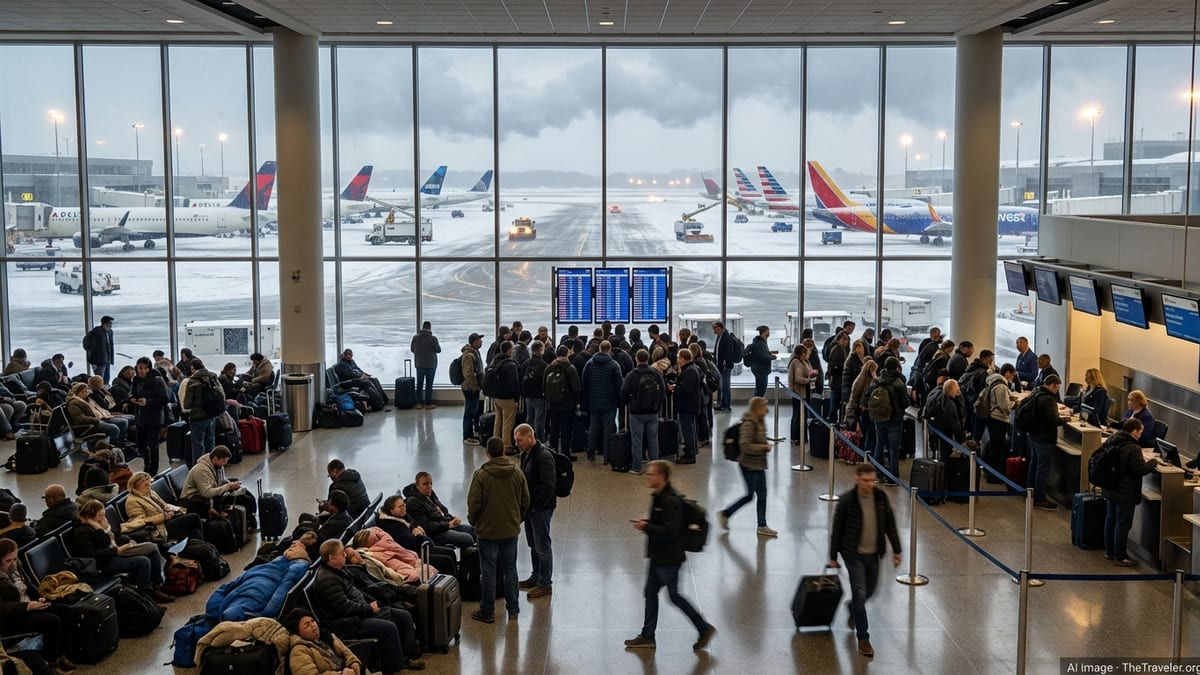
Storm Hernando and the Blizzard of 2026 Hit a Fragile Aviation System
The latest wave of cancellations comes as Winter Storm Hernando, part of the February 2026 North American blizzard, continues to hammer the Northeast corridor with heavy snow, near whiteout conditions and damaging winds. The system intensified through the weekend of February 22 and into Monday, February 23, turning one of the world’s busiest air corridors into a no‑go zone for much of the day.
Forecasts had warned that a rapidly deepening coastal low would evolve into a full‑blown nor’easter, with blizzard warnings stretching from New Jersey through New York City and into much of New England. Those projections have largely played out, with the National Weather Service reporting widespread snow totals exceeding 1 foot across metropolitan New York and Boston, and gusts strong enough to prompt coastal flood alerts along parts of the Mid‑Atlantic and New England shoreline.
For airlines already operating on tight schedules and facing lingering crew and fleet imbalances from earlier winter storms, Hernando has acted as a force multiplier. While the day’s headline numbers focus on thousands of cancellations nationwide, today’s fresh wave of more than 300 scrubbed flights from the largest U.S. carriers underscores how even incremental schedule cuts can ripple through an already stressed network.
Industry analysts note that the Blizzard of 2026 is the second major winter event to hit U.S. aviation in less than a month, following a bomb cyclone in late January that also forced mass cancellations. The back‑to‑back nature of these storms has made it harder for airlines to reset operations, leaving the system acutely vulnerable when this latest nor’easter swept into the Northeast.
JFK, LAX, Boston, Miami and Orlando Bear the Brunt
New York’s three major airports are once again at the center of the disruption. Data from flight‑tracking services on Monday morning showed that John F. Kennedy International Airport and LaGuardia had canceled a majority of their schedules, with Newark Liberty International Airport not far behind. JetBlue, which relies heavily on JFK and Boston Logan as hubs, has seen a particularly high proportion of its flights grounded.
At Boston Logan International Airport, where blizzard warnings have been in place since Sunday, runway conditions and visibility have periodically fallen below safe thresholds. Airlines have responded with sweeping pre‑emptive cancellations, effectively reducing Monday’s operation to a skeleton schedule. Delta, which had already warned it would halt most operations at New York and Boston airports into Tuesday, is among the carriers trimming the deepest.
Farther afield, the fallout is being felt at major coastal gateways that, while outside the storm’s direct impact zone, are intimately tied to East Coast traffic flows. At Los Angeles International Airport, flights to and from the Northeast have been thinned out or canceled entirely, leading to pockets of congestion at departure gates as passengers try to rebook onto limited alternatives. Similar patterns are emerging in Miami and Orlando, where peak‑season leisure demand is colliding with a wave of inbound and outbound cancellations tied to the disrupted Northeastern corridor.
Orlando International Airport, a crucial hub for family and theme‑park travel, is seeing a steady stream of cancellations on transcontinental and East Coast routes. Miami International, a key gateway for Latin America as well as domestic traffic, is reporting disruption on northbound flights into storm‑affected areas, with knock‑on delays for onward connections throughout the hemisphere.
Major U.S. Carriers Trim Schedules and Retime Key Routes
Among U.S. airlines, JetBlue, Delta, United, American and Southwest are all reporting significant schedule adjustments linked to the nor’easter. While official tallies of canceled flights shift by the hour, the combined impact of pre‑emptive scrubs and day‑of disruptions has already surpassed 300 flights across these carriers alone for Monday, with some projections indicating the number will continue to climb through the afternoon and evening.
JetBlue, with its heavy reliance on JFK and Boston, has once again found itself in the storm’s crosshairs. Early‑morning data showed the carrier canceling a large share of its departures in the Northeast, including many shuttle‑style flights along the busy Boston–New York–Washington corridor. That corridor is often treated as a pressure valve for the nation’s air system, and when it seizes, the effects tend to spread quickly.
Delta and United have been aggressively trimming schedules at affected hubs in New York and Boston, while also adjusting operations at secondary airports such as Philadelphia and Hartford. Delta signaled on Sunday that it expected to suspend most flights at LaGuardia, JFK and Boston Logan into Tuesday, citing safety concerns and the likelihood of prolonged snow‑removal operations on runways and taxiways.
American Airlines and Southwest are meanwhile contending with a mix of weather‑related cancellations and secondary disruptions elsewhere in their networks. As flights into key Northeastern cities are pulled, aircraft and crews fail to arrive where they are scheduled next, forcing additional cancellations as far away as Chicago, Dallas and Denver. For Southwest, which depends on high aircraft utilization and quick turnarounds, even a localized storm can ripple quickly across its point‑to‑point route map.
Passengers Face Long Lines, Confusion and Limited Rebooking Options
For travelers caught in the middle of this latest disruption, the experience on the ground is familiar but no less frustrating. Early reports from JFK, Boston Logan and Miami described long lines at ticket counters and gate podiums, as passengers sought rerouting or refunds for canceled flights. With entire banks of departures pulled from the schedule, options for same‑day or next‑day travel are constrained, especially on transcontinental routes and international connections.
Digital channels have offered only partial relief. Airline call centers and mobile apps have been inundated with rebooking requests since Sunday evening, leading to extended hold times and sporadic outages. While most carriers have issued weather waivers allowing customers to change travel dates without standard change fees, fare differences can still apply once the immediate storm window passes, leaving some passengers with the prospect of significant extra costs.
At Orlando and Miami, where vacationers often travel with families and time‑sensitive hotel or cruise bookings, the stakes are especially high. Travelers have reported scrambling for scarce hotel rooms near the airport when late‑night departures were canceled, while others have opted to rent cars and drive long distances to bypass the worst‑affected hubs. For inbound passengers, the uncertainty has spilled over into plans at their final destinations, with some resorts and tour operators now waiving change penalties in recognition of the unprecedented disruption.
Airports themselves are attempting to manage the human side of the crisis. Public‑address systems at major hubs have been broadcasting regular storm and operations updates, and some terminals have set up additional seating and charging areas to accommodate delayed passengers. Still, with gate areas overflowing and overnight stays becoming more common, the limits of airport infrastructure are again in sharp focus.
Operational Challenges: Deicing, Crew Limits and Airspace Constraints
Behind the scenes, the decision to cancel or delay a flight in a storm like Hernando involves far more than a check of runway visibility. Airlines must weigh factors including deicing capacity, ground‑crew availability, air traffic control constraints and strict federal limits on pilot and flight‑attendant duty hours. When these constraints converge, even marginal weather can tip a route from feasible to impossible.
In the Northeast, deicing backlogs have emerged as a major choke point. Heavy, wet snow and near‑freezing temperatures require frequent and thorough deicing treatments, which are both time‑consuming and resource‑intensive. With multiple aircraft vying for access to a limited number of deicing pads, queues can stretch well beyond an aircraft’s legally permissible taxi or duty time, forcing airlines to cancel flights pre‑emptively rather than risk stranding passengers on the tarmac.
Air traffic control has also been forced to impose flow restrictions over parts of the Eastern seaboard, reducing the number of arrivals and departures that airports can safely handle per hour. That, in turn, compels airlines to trim schedules beyond what runway conditions alone would dictate. With high winds and low visibility interfering with standard approach and departure patterns, controllers have shifted to more conservative spacing between aircraft, further diminishing capacity.
Crew scheduling adds another layer of complexity. Federal rules limit how long pilots and flight attendants can remain on duty, and winter storms often push these limits to the breaking point as delays accumulate. Once a crew “times out,” the flight cannot depart unless a fresh crew is available. In a large weather event that spans multiple days and regions, spare crews quickly become scarce, and airlines may decide it is safer and more predictable to cancel flights outright.
What Travelers Need to Know Right Now
For passengers with flights scheduled through the affected period, the most important step is to verify the status of their itinerary before leaving for the airport. Airlines are pushing real‑time updates through mobile apps, text messages and email, and many are allowing free changes for travel originally booked over the February 22 to 24 window. Some carriers have quietly expanded their waivers to include additional airports beyond the hardest‑hit Northeast hubs, recognizing that the disruption is now national in scope.
Travelers who must fly in the coming 48 hours are being urged to build in additional time at every stage of the journey. That includes arriving at the airport earlier than usual, expecting longer queues at security and check‑in, and preparing for the possibility of last‑minute gate changes. Seasoned road warriors recommend packing medication, chargers, snacks and basic toiletries in carry‑on bags in case an unplanned overnight stay becomes necessary.
Those with flexible travel plans may want to consider rerouting through less‑affected hubs or postponing nonessential trips altogether. With storms of this scale, even airports not directly in the path of heavy snow can experience rolling delays as diverted aircraft and displaced crews work their way back into position. Seats on remaining flights can command premium fares, and hotel availability near major hubs tends to tighten as evening approaches.
Travel insurance may offer some relief, but coverage terms vary widely. Policies that include “trip interruption” or “travel delay” benefits can sometimes reimburse for additional hotel nights, meals or ground transportation incurred during a weather disruption. However, most insurers require detailed documentation from airlines and hotels, and claims can take weeks to process, making it important for travelers to retain receipts and confirmation emails.
How Long Will the Disruptions Last?
Meteorologists expect the core of the nor’easter to move northeastward into Atlantic Canada late Monday into Tuesday, bringing some relief to the Mid‑Atlantic and New York City regions but prolonging hazardous conditions in parts of New England. Even as skies begin to clear over the busiest hubs, long‑lasting impacts on the aviation system are all but guaranteed.
Once snow and winds subside, airport operations teams face the task of clearing runways, taxiways and gate areas of accumulated snow and ice. Depending on local resources and temperatures, that process can take many hours, and often continues in stages while a reduced number of flights resume. In the meantime, airlines must reposition aircraft and crews, rebuild tightly choreographed schedules and work through massive rebooking backlogs.
Industry experts say it can take several days for operations to fully normalize after an event of this magnitude. With demand still strong in the early‑spring travel period and aircraft utilization already high, there is little slack in the system to absorb lingering delays. As a result, travelers may continue to encounter scattered cancellations and missed connections throughout the week, even under clear skies.
There is also the broader question of what this winter’s back‑to‑back storms signal for the resilience of U.S. air travel. As severe weather events become more frequent and intense, airlines and airports are under growing pressure to invest in more robust deicing capacity, hardened infrastructure and smarter scheduling tools. For now, however, passengers are once again bearing the brunt of a system stretched to its limits by a powerful storm at exactly the wrong moment.