

More news on this day
A powerful nor’easter sweeping across the United States has unleashed one of the most disruptive air travel days in recent years, with nearly 6,000 flights canceled and more than 14,000 delayed as carriers from JetBlue and Republic to Delta and United struggle to keep operations running from New Jersey and Boston to Miami, Chicago and Detroit.
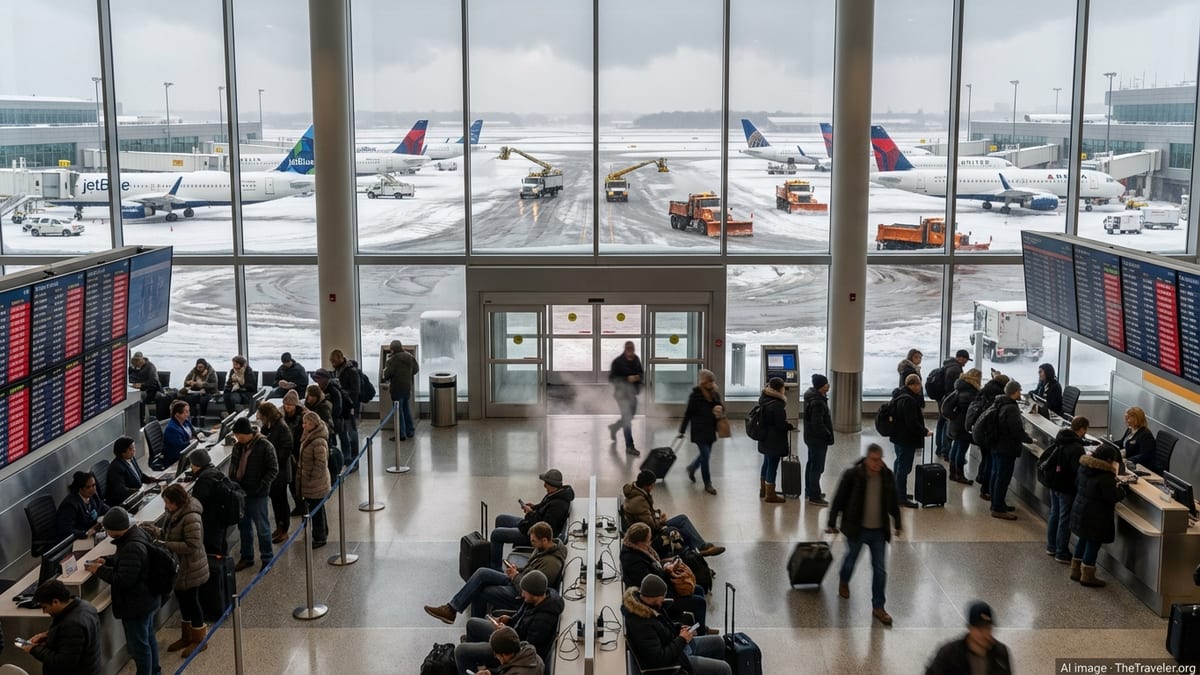
Nor’easter Turns Busy Travel Corridor Into No-Fly Zone
The fast-deepening winter storm roared into the Northeast late Sunday and intensified through Monday, transforming one of the world’s busiest aviation corridors into an extended no-fly zone. From the New York metropolitan area to Boston and Philadelphia, near whiteout conditions and near hurricane-force gusts made safe operations on runways and taxiways nearly impossible.
Flight-tracking data showed that by Monday morning more than 5,300 to 6,400 flights within, into or out of the United States had been canceled, with thousands more delayed as the cascading effects rippled across the national network. Airports that normally serve as high-frequency hubs instead became crowded holding areas as departure boards filled with red text and outright shutdowns replaced rolling delays.
Airports in New York and New England bore the brunt of the storm, but the storm’s vast footprint and the intertwined nature of airline schedules meant that disruptions radiated far beyond the snow zone. Travelers departing or arriving through Florida, the Midwest and even the Caribbean found their plans abruptly unraveled as aircraft and crew were stranded far from where they were needed.
Meteorologists likened the system to a classic bomb cyclone, a rapidly intensifying low-pressure system that can deliver extreme winds and heavy snowfall in a narrow window of time. For airlines already contending with winter’s usual operational stresses, the nor’easter proved to be a worst-case scenario, forcing extensive preemptive cancellations and ground stops at key hubs.
JetBlue, Republic and Jazz Among Hardest-Hit Carriers
No airline escaped the storm’s reach, but it was particularly punishing for carriers heavily tied to the Northeast. JetBlue, which relies on New York’s JFK and LaGuardia airports as well as Boston Logan as cornerstone hubs, canceled the vast majority of its schedule into and out of the region. At points Monday, around four out of every five JetBlue flights were grounded, turning its normally dense shuttle-style network into a patchwork of stranded aircraft.
Regional operators that feed larger carriers into major hubs also saw their operations gutted. Republic Airways, a key partner for several U.S. majors, cut a similarly high percentage of flights as snow and crosswinds overwhelmed smaller regional jets’ ability to safely operate from affected airports. Canada-based Jazz Aviation, which links U.S. cities with Canadian hubs, faced a wave of cancellations and delays as the storm complicated cross-border operations and limited available slots at congested northeastern fields.
Legacy giants including Delta Air Lines and United Airlines recorded cancellations in the high teens to around 20 percent of their schedules at some points, a significant blow for carriers that typically pride themselves on maintaining reliability even in difficult weather. American Airlines, Southwest and Alaska Airlines also reported elevated disruption as aircraft bound for or originating from the Northeast were forced to wait out the storm or be repositioned to less affected airports.
For airlines, the decision to cancel is often a calculation between short-term chaos and longer-term stability. By preemptively scrubbing large portions of their schedules, carriers attempted to avoid scenes of passengers waiting for hours at gates only to see flights repeatedly delayed. Yet the sheer volume of grounded flights underscored how vulnerable the U.S. system remains when a single powerful storm parks itself over such a critical aviation corridor.
Major Hubs from Newark to Boston Brought to a Standstill
At the airport level, the nor’easter’s impact was starkest in the New York and Boston areas. LaGuardia, located on the edge of Flushing Bay and exposed to punishing winds, saw the vast majority of its operations canceled, with runways briefly turning into snow-covered strips dotted with idle aircraft and snowplows. John F. Kennedy International, a crucial transatlantic gateway, reported well over three-quarters of its flights canceled at various points in the day.
Newark Liberty International, which serves as a major hub for United, experienced cancellation rates at or above 70 percent, according to aviation analytics data. With multiple runways reduced to intermittent use by near constant plowing, deicing queues grew longer and departure banks collapsed into a single objective: getting as many aircraft as possible out before conditions worsened again.
In Boston, Logan International found itself at the heart of the storm’s later phase. Blizzard conditions and strong winds sweeping across Boston Harbor forced lengthy ground stops, with more than four out of five flights canceled during the height of the event. Philadelphia, Hartford and Providence all reported cancellation rates above 80 percent, turning what is normally a busy Monday morning business rush into an eerie tableau of empty concourses and shuttered security lines.
Even airports not directly under the blizzard’s heaviest snowfall, including Washington Reagan National and Baltimore/Washington International, saw severe operational constraints. Air traffic control programs throttled arrivals into the storm zone, and flights that did depart often did so with long reroutes to avoid the worst of the weather, further tightening available airspace.
Disruptions Spread to Miami, Chicago, Detroit and Beyond
As the storm choked off traffic in and out of the Northeast, its effects quickly rippled across the broader U.S. network. In Florida, airports in Orlando, Fort Lauderdale, Miami and Tampa reported more than a thousand cancellations and scores of delays, many tied to aircraft that were scheduled to continue on to New York, Boston or Philadelphia. Passengers expecting routine northbound hops instead faced indefinite waits as airlines attempted to reassign equipment or rebook travelers on the few flights still operating.
In the Midwest, major hubs such as Chicago O’Hare and Detroit Metropolitan Wayne County Airport were also pulled into the disruption. While local weather conditions there were less extreme than in the Northeast, a significant share of their traffic is built around connections to and from the New York and New England markets. With those destinations effectively offline, airlines were forced to cut or consolidate flights, leaving travelers in Chicago, Detroit, Minneapolis and other connecting cities grappling with missed connections and unplanned overnight stays.
Spillover effects extended as far as the Caribbean and Central America. Flights linking Jamaica’s Kingston and Montego Bay with East Coast gateways were canceled or delayed as blizzard warnings in the northern United States shut down their onward connections. Similar issues emerged for flights serving Mexico and other warm-weather destinations that rely on Northeast-originating travelers, complicating the journeys of holidaymakers returning from school vacations and long-planned winter escapes.
Because airline schedules are tightly interwoven, a single grounded jet in Newark or Boston often means subsequent flights in Miami, Chicago or Detroit cannot operate. This domino effect accounts for the unusually high number of delays recorded nationwide, as carriers kept planes and crews in place while they waited for weather and traffic-flow restrictions to ease.
Passengers Face Hours-Long Waits, Confusion and Limited Options
For passengers, the numbers translated into a day of frayed nerves and difficult choices. At Newark, Boston and New York’s airports, travelers arriving for early morning departures were greeted by departure boards already filled with cancellations and snaking lines at airline counters as customers scrambled to secure the shrinking pool of available seats over the next several days.
Families returning from school holidays in Florida and the Caribbean described long waits to speak with agents, with some being told the earliest rebooking options would depart two or even three days later. In Miami and Orlando, where cancellations were concentrated among flights bound for the Northeast, stranded travelers sprawled across gate areas, charging phones from crowded power outlets while repeatedly refreshing airline apps.
Hotel availability in and around major airports tightened rapidly as airlines issued vouchers for those unable to secure same-day departures. Ride-hailing wait times stretched as local road conditions deteriorated in snow-hit cities, and mass transit systems in New York and Boston reduced or rerouted service as the storm intensified. The combination left some passengers questioning whether to stay put at airports or risk venturing out to hotels further afield.
Airlines urged customers to check flight status before heading to the airport and, where possible, to take advantage of self-service rebooking tools. Yet with tens of thousands of passengers competing for a finite number of available seats once operations resume, many travelers face the prospect of extended disruptions to their work, family commitments and onward travel plans.
Airlines Issue Weather Waivers and Struggle to Rebuild Schedules
In response to the rapidly deteriorating outlook, major U.S. airlines rolled out broad weather waivers allowing passengers to change travel dates without standard change fees or fare differences within defined rebooking windows. JetBlue, Delta, United, American and others encouraged customers to shift itineraries to later in the week, hoping to spread demand and avoid overwhelming limited capacity once the storm passed.
Despite these efforts, the unprecedented scale of cancellations has left carriers facing a complex recovery. Getting aircraft, crews and passengers back into the right places requires a carefully choreographed restart, particularly when key airports have effectively lost an entire day of flying. Airlines must balance the need to restore long-haul and international services with pressure to clear backlogs on short-haul domestic routes linking smaller communities to major hubs.
Adding to the challenge are existing strains in the aviation ecosystem. Pilot and crew availability remains tight across the industry, and air traffic control staffing shortages in the Northeast have already forced carriers to trim schedules in recent seasons. When a major storm triggers thousands of cancellations in a compressed window, it can take days before the system regains anything resembling normal flow.
Industry analysts note that while preemptive cancellations can help avoid passengers being trapped on tarmacs or facing rolling delays, they also compress the disruption into a shorter period, amplifying the immediate pain but potentially shortening the overall recovery time. For now, travelers are caught in that difficult middle ground, waiting to see how quickly airlines can piece their fractured networks back together.
Regulators and Consumer Advocates Increase Pressure on Reliability
The storm and its sweeping impact arrive against the backdrop of heightened scrutiny of airline reliability and consumer protections in the United States. In recent years, regulators at the Department of Transportation have pushed carriers to improve transparency around delays and cancellations and to provide more automatic compensation or refunds when flights are significantly disrupted.
Airlines argue that extreme weather events like the current nor’easter are beyond their control and should be treated differently from mechanical issues or scheduling failures. However, consumer advocates contend that carriers have become too reliant on aggressive scheduling in congested airspace such as the Northeast corridor, leaving little slack in the system when storms inevitably hit.
Public frustration has been particularly acute with airlines that have suffered persistent operational challenges, especially during peak travel periods. Advocates are calling for clearer rules on passenger entitlements when weather-related disruptions cascade into multi-day delays and missed international connections, as well as more robust requirements for airlines to coordinate with airports and local authorities on shelter, food and ground transportation for stranded travelers.
For policymakers, the current crisis offers another test of whether recent reforms and enforcement actions are sufficient to protect travelers when the aviation system is under severe stress. How well airlines, airports and regulators collaborate during the recovery phase may shape future debates over capacity planning and passenger rights.
What Travelers Can Expect in the Days Ahead
With more snow and high winds lingering over parts of New England and the Mid-Atlantic, aviation forecasters warn that the disruption is unlikely to end as soon as the skies clear. Airlines have already canceled flights scheduled for Tuesday, with additional cuts likely as carriers assess runway conditions, staffing levels and aircraft positioning at key hubs.
Travelers with flexible plans are being urged to postpone nonessential trips to and from affected regions until later in the week, to allow airlines to prioritize passengers who are already stranded mid-journey. Those who must travel should prepare for longer-than-usual security lines, limited food and retail options at airports and the possibility of last-minute gate or schedule changes as operations ramp back up.
Analysts expect that it could take several days before flight counts and on-time performance metrics return to normal levels. The most congested corridors, including those linking New York and Boston with Florida, the Midwest and major international gateways, are likely to see elevated levels of rebooking and standby demand as carriers work through residual backlogs.
For thousands of travelers from New Jersey and Boston to Miami, Chicago and Detroit, the nor’easter has already turned a routine late-winter trip into an ordeal of cancellations, delays and anxious waits. As the storm gradually moves offshore, the focus now shifts from survival mode to recovery, with the resilience of the U.S. air travel system facing yet another stern midwinter test.