

More news on this day
More than 150 passengers and crew aboard a Princess Cruises ship sailing the Caribbean have been sickened by a fast-spreading gastrointestinal illness, prompting a federal investigation amid growing concern about suspected norovirus cases across multiple voyages.
Get the latest news straight to your inbox!
CDC Confirms Outbreak Aboard Star Princess
The U.S. Centers for Disease Control and Prevention said at least 153 people on the Star Princess reported gastrointestinal symptoms including vomiting and diarrhea during the ship’s current Caribbean sailing. The vessel, carrying more than 4,000 guests and over 1,000 crew, departed from Fort Lauderdale and is scheduled to return to Port Everglades on March 14.
According to the agency’s Vessel Sanitation Program, 104 guests and 49 crew members met the case definition for acute gastrointestinal illness during the voyage. While laboratory results are still pending, public health officials say the pattern and rapid spread of symptoms are consistent with norovirus, the leading cause of gastroenteritis outbreaks on cruise ships.
Princess Cruises said in a statement to multiple U.S. media outlets that only a “limited number of individuals” had reported mild illness and that enhanced cleaning measures were implemented as soon as cases emerged. The company said affected guests were asked to remain in their cabins and were provided with medical care and room service at no additional cost.
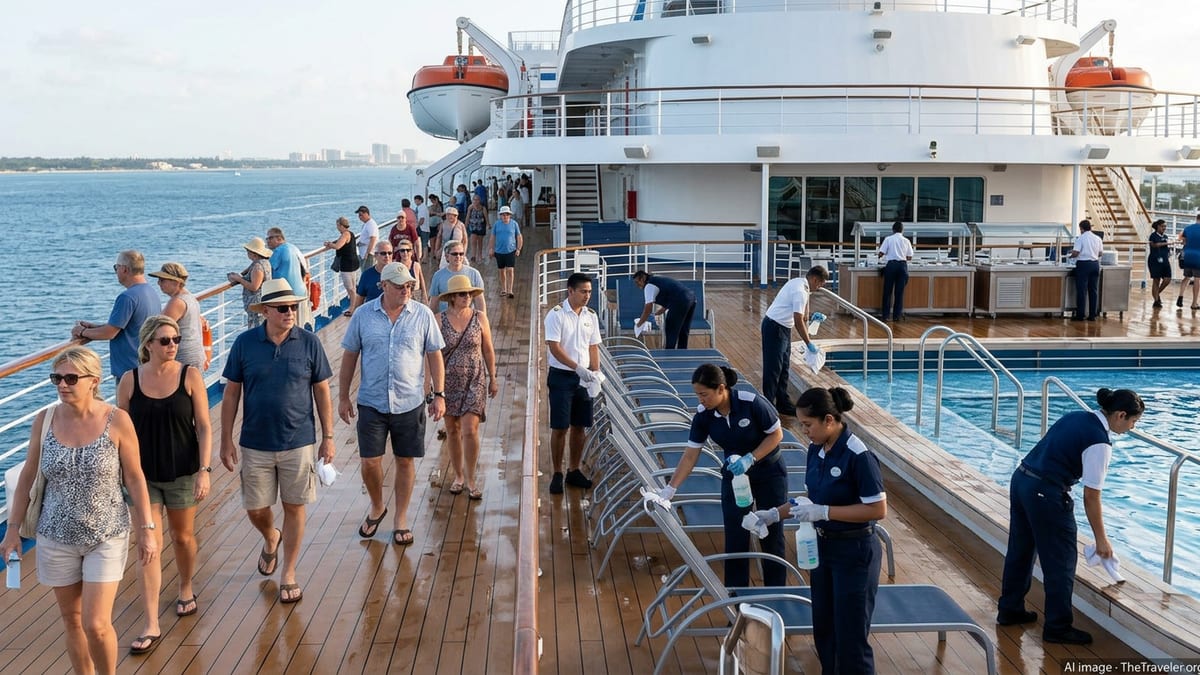
The Star Princess continued its itinerary with adjusted onboard operations, including expanded cleaning of high-touch surfaces, temporary self-service restrictions in buffets, and additional announcements reminding guests to wash their hands frequently.
Illness Spans Multiple Voyages on the Same Ship
Health officials are also reviewing reports of gastrointestinal illness on the Star Princess’ immediately preceding sailing, which began March 7. Princess Cruises acknowledged that some passengers on that voyage reported similar symptoms and that the ship underwent additional sanitization before boarding commenced for the current cruise.
Because norovirus can linger on surfaces and is easily transmitted in close quarters, investigators are working to determine whether cases on successive voyages are linked. The CDC’s Vessel Sanitation Program has dispatched a field team to meet the ship in Fort Lauderdale to conduct an environmental assessment and to interview passengers and crew.
Investigators are expected to examine food preparation areas, cabin and restroom hygiene, and shipboard water systems, while also reviewing medical logs to identify when and where the outbreak may have started. Samples from ill passengers will be tested to confirm the causative agent, a process that can take several days.
Princess Cruises said it is cooperating fully with public health authorities and has reiterated that guests who feel unwell should report symptoms promptly to the ship’s medical center. Early reporting is considered critical to limiting further spread in the confined cruise environment.
Norovirus a Persistent Threat to the Cruise Industry
Norovirus is one of the most contagious gastrointestinal viruses, spread primarily through person-to-person contact, contaminated food or water, and surfaces touched by infected individuals. Even tiny amounts of viral particles can cause illness, and people may remain infectious for several days after symptoms subside.
On cruise ships, where thousands of people share dining venues, common lounges, pools, and elevators, the virus can spread quickly once introduced. The CDC has repeatedly identified norovirus as the leading source of gastrointestinal outbreaks at sea, and recent years have seen multiple U.S.-departure voyages across various cruise lines affected.
Outbreaks do not typically indicate poor overall sanitation, experts say, but rather highlight how efficiently norovirus can move through any crowded setting. The cruise industry has invested heavily in upgraded cleaning protocols, onboard laboratories, and passenger education campaigns that stress handwashing and prompt reporting of symptoms.
Still, the highly visible nature of cruise travel means that even relatively small outbreaks can generate outsized attention and raise questions for travelers weighing the risks of a vacation at sea.
Passenger Experience and Operational Impact
Guests on board the Star Princess have described a noticeably heightened sanitation presence, with crew frequently wiping railings, elevator buttons, and buffet areas with disinfectants and placing additional hand-sanitizing stations at entrances to dining rooms and theaters. Some reported that popular activities were modified or temporarily scaled back to reduce crowding.
Standard practice during such outbreaks is to ask symptomatic passengers to self-isolate in their cabins until at least 24 hours after symptoms resolve. Cruise lines generally offer complimentary room service and sometimes future cruise credits for days lost to illness-related confinement.
While the current outbreak has not forced the Star Princess to cancel ports of call, some destinations reserve the right to deny docking to ships that report a high number of cases. Port authorities often coordinate closely with cruise lines and health officials to weigh the risks, particularly when outbreaks occur on consecutive voyages of the same vessel.
For crew members, norovirus outbreaks can mean longer shifts focused on disinfection, increased use of personal protective equipment, and temporary reassignment away from guest-facing roles if they exhibit symptoms. Maintaining staffing levels in key operations while managing illness among crew is a central challenge for ship operators during such events.
What Travelers Should Know Before Boarding
Public health authorities emphasize that most people who contract norovirus recover within one to three days without lasting effects, though dehydration can be a concern, especially for older adults and young children. They advise travelers to postpone cruises if they have been recently ill and to inform medical staff immediately if they develop vomiting or diarrhea on board.
Simple measures remain the most effective defense for passengers: frequent and thorough handwashing with soap and water, especially before eating and after using the restroom; avoiding touching the face with unwashed hands; and using a tissue or sleeve to cover coughs and sneezes. Alcohol-based hand sanitizers can be helpful but are not a substitute for handwashing against norovirus.
Prospective cruisers are encouraged to review health advisories and to understand that, even with strict protocols, no voyage can guarantee an illness-free environment. Travel insurance policies that cover trip interruption or additional medical costs may offer added reassurance, particularly for those with underlying health conditions.
As the Star Princess returns to Fort Lauderdale for deep cleaning and further investigation, the latest outbreak underscores the delicate balance between maintaining confidence in cruise travel and acknowledging the ongoing reality of infectious disease risks at sea.