

More news on this day
Norse Atlantic is bolstering its new long haul link between London Gatwick and Bangkok with extra flights in March 2026, a swift capacity boost that underscores booming demand for Thailand and raises the stakes in the battle for budget-conscious travelers between the UK and Southeast Asia.
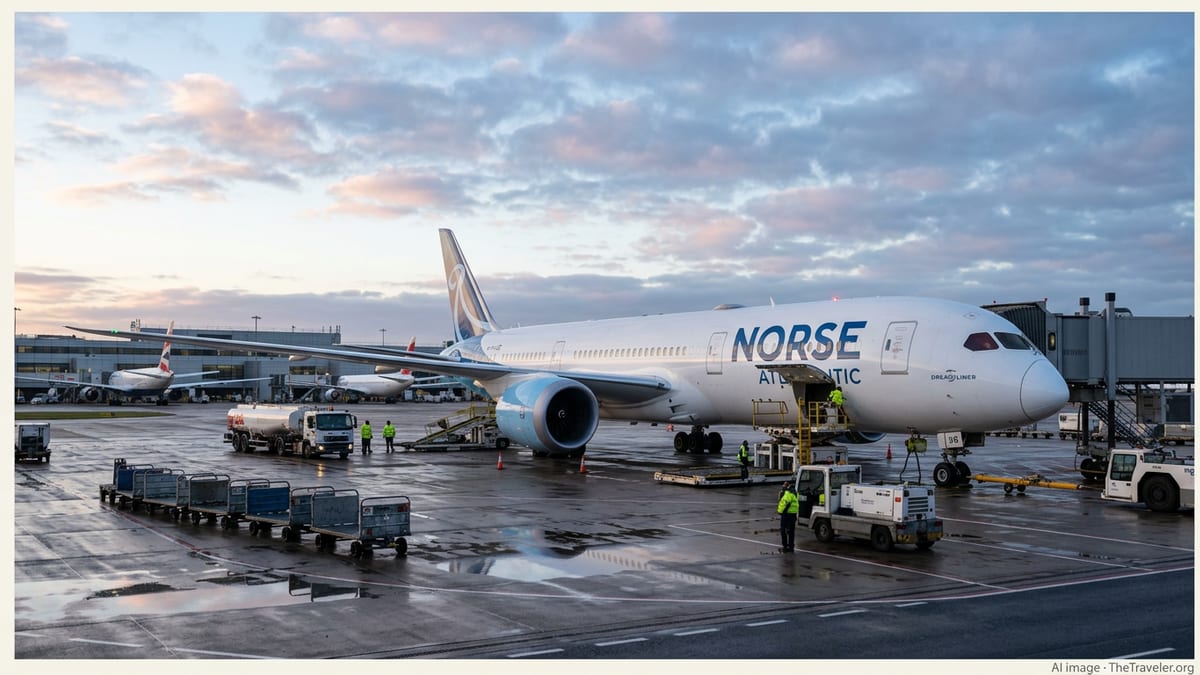
New Frequencies on a Young Route
The additional services, filed for the week of 8 March 2026, will see Norse Atlantic operate two extra round trips between London Gatwick and Bangkok Suvarnabhumi on top of its scheduled winter program. Operated by Boeing 787-9 aircraft, the extra flights temporarily lift capacity on what has quickly become one of the airline’s marquee leisure routes.
The move comes only months after Norse inaugurated its UK–Asia operation. The carrier’s maiden London Gatwick to Bangkok flight arrived in Thailand in late October 2025, marking Norse’s first route between the UK and Asia and the latest step in its strategic pivot away from transatlantic dependence toward winter-sun destinations.
Initial schedules for winter 2025/26 put London–Bangkok at up to four to five weekly flights, with frequencies ramping up through the season as sales strengthened. By adding extra rotations in mid-March, Norse is effectively stress-testing just how much late-winter and early Easter demand it can capture before the route settles into a more stable pattern.
Capacity growth on such a young service is notable in a long haul market where new low cost routes are often launched cautiously. For travelers, it translates into more departure options on peak travel days and a better chance of finding competitive fares on popular dates.
A Cornerstone of Norse’s Winter Pivot
The enriched London–Bangkok schedule sits at the heart of Norse Atlantic’s broader winter 2025/26 reshuffle. The airline has already trimmed several US routes from Gatwick and other European gateways while promising a roughly double-digit increase in total flights for the season, largely by shifting aircraft toward Thailand and other long haul leisure hotspots.
Bangkok is central to that strategy. Alongside the London link, Norse is building a small Thailand network with flights from Oslo and Stockholm and seasonal services to Phuket, creating a web of point-to-point connections designed for Northern European winter escapees. The UK–Bangkok route, however, combines one of Europe’s largest outbound markets with one of Asia’s most visited destinations, giving it outsized importance within the portfolio.
Gatwick Airport, which has been actively courting long haul leisure growth, has celebrated Norse’s arrival as a boost to its Asia connectivity at a time when demand for flights to the region is rebounding strongly. The airport has highlighted double-digit growth to Asian destinations compared with pre-recovery levels, suggesting there is room for more capacity without immediately overwhelming yields.
For Norse, concentrating on a handful of high-demand leisure routes also fits its business model. The airline operates an all-787 fleet with relatively low unit costs, but it still needs dense, price-sensitive markets where travelers are willing to trade some flexibility and frills for a cheaper non-stop ticket. London–Bangkok ticks all those boxes.
What It Means for Fares and Competition
The immediate question for travelers is whether extra Norse flights will make Thailand cheaper from London. Historically, the arrival of a new long haul low cost carrier on routes like London–New York or Scandinavian–Bangkok has triggered fare skirmishes, especially in economy cabins outside the busiest holiday peaks.
Early sales for Norse’s London–Bangkok launch season included aggressively marketed headline fares, with one-way prices from Europe to Thailand promoted at levels well below many full-service rivals. As the schedule deepens, those rock-bottom tickets are likely to remain capacity-limited and tied to specific travel windows, but more overall seats should still add downward pressure on average prices, particularly for travelers booking several months ahead.
The competitive landscape is complex. Full-service carriers via the Middle East and Europe continue to offer one-stop itineraries with more generous baggage, lounge access and loyalty benefits, while established Asian and European airlines provide premium cabins and dense connectivity beyond Bangkok. Norse, by contrast, is targeting travelers whose priority is a non-stop flight and a low base fare, even if that means paying extra for baggage, meals or seat selection.
The extra March rotations are unlikely to upend the market overnight, but they do nudge supply higher at a time when demand to Thailand remains robust. If Norse can keep loads healthy, competitors may face pressure to sharpen their pricing or add tactical capacity of their own, particularly around school holiday periods.
Reliability, Comfort and the Low Cost Trade-Off
Norse Atlantic’s expansion also revives questions about reliability and service levels in the long haul low cost segment. While some passengers praise the airline’s modern Dreamliner cabins and competitive premium seats, others report frustration with schedule changes, tight baggage rules and extra fees that quickly erode the headline savings.
On London–Bangkok, flight time is typically around 12 hours eastbound and slightly longer westbound, making cabin comfort a significant factor. Norse configures its 787s with high-density economy seating but benefits from Dreamliner features such as larger windows, improved cabin pressure and higher humidity, which can help reduce fatigue. Travelers willing to pay for extra legroom or the carrier’s premium cabin can secure a noticeably more spacious experience without reaching the price point of many legacy business products.
However, the bare-bones base fare model requires careful planning. Checked luggage, meal service, seat reservations and ticket flexibility are usually sold as add-ons, so travelers comparing prices with one-stop competitors need to factor in these extras. For families or those carrying sports gear or heavy luggage for extended stays, the total cost can narrow the gap with full-service options, especially when promotions are available on one-stop itineraries.
As Norse leans harder into London–Bangkok, the airline will be under pressure to demonstrate consistent operational performance on the route. Extra flights mean extra complexity in crew and aircraft rotations, and any reliability issues will quickly surface on social media and forums frequented by Thailand-bound travelers.
A Potential Game-Changer, With Caveats
The question for the market is whether Norse’s latest capacity bump turns London–Bangkok into a genuine game-changer for travelers, or simply adds another value-focused option to an already crowded field. The answer likely lies somewhere in between.
For budget-conscious passengers based in or near London, the combination of a non-stop service, competitive fares and multiple weekly frequencies is a meaningful shift. Where travelers once had to choose between premium-priced non-stops or cheaper but longer one-stop journeys, Norse offers a middle path that can shave hours off travel time without necessarily inflating the budget.
Yet structural constraints remain. Norse is still a relatively small player with a limited network and no global alliance ties, which means little in the way of through-ticketing or protected connections. Travelers starting their journeys outside London may still find one-stop itineraries on legacy carriers more convenient or less risky, especially where tight self-connects at Gatwick would be required.
In the near term, the extra March flights look less like a radical disruption and more like an important proof of concept. If Norse can fill those seats profitably and maintain acceptable reliability, it will strengthen the case for making London–Bangkok a long-term pillar of its network. For travelers eyeing a trip to Thailand from the UK, that alone is welcome news, even if the true transformation of fares and flexibility will depend on how competitors respond in the seasons ahead.