

More news on this day
North America’s airline industry is heading into the 2026 summer season with sharply diverging strategies, as U.S. carriers lean into robust domestic demand, Canadian airlines continue to pull back from the United States, and Mexican operators accelerate expansion across the continent.
Get the latest news straight to your inbox!
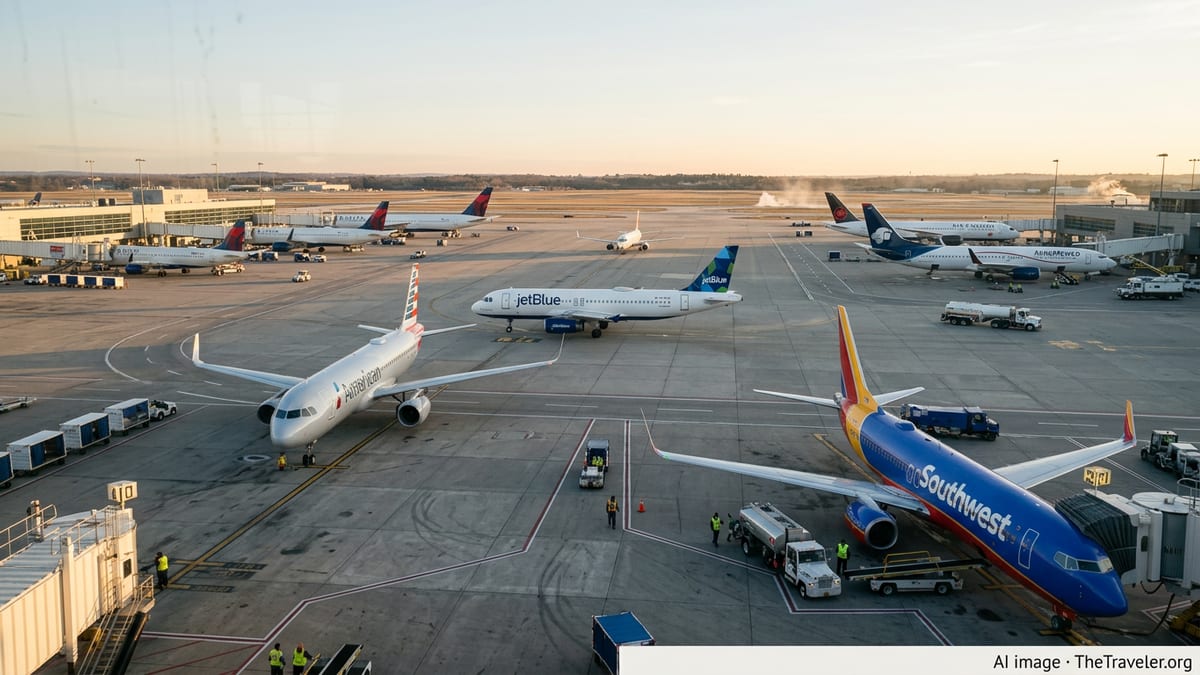
U.S. Airlines Stretch to Capture Surging Domestic Demand
Major U.S. carriers including American, Southwest, Delta, United and JetBlue are entering 2026 with capacity plans that reflect a still-resilient domestic market, even as costs and competitive pressures intensify. Publicly available traffic and financial data show that U.S. passenger volumes remain close to or above pre-pandemic levels on many domestic routes, with leisure demand in particular helping to fill aircraft.
Southwest Airlines, long a bellwether for U.S. price-sensitive travelers, has signaled only modest capacity growth of roughly low single digits annually through 2027, but is pushing a major commercial overhaul to extract more revenue per seat. Investor disclosures indicate that the airline is rolling out new fare families, assigned seating and extra-legroom options in response to evolving customer preferences, while warning that higher labor and fuel costs are pressuring margins.
Legacy network carriers such as American, Delta and United are meanwhile leaning on their extensive domestic and hub networks to keep aircraft full while reallocating capacity toward markets with stronger yields. Schedule data and recent earnings coverage indicate that these airlines are continuing to shift seats toward core U.S. hubs and high-demand sun and leisure destinations, even as they trim or rationalize underperforming routes.
JetBlue, still digesting recent strategic setbacks and a more challenging cost structure, has been slower to grow overall capacity but is concentrating on core East Coast and transcontinental markets where demand remains solid. Analysts note that across the U.S. market, competitive fare sales are returning in shoulder periods, but load factors remain high enough that airlines see room to sustain current or slightly higher capacity through 2026.
Canada Pulls Back From the U.S. as Travel Patterns Shift
North of the border, Canadian airlines are taking a notably more cautious stance toward the U.S. market. Industry analyses and schedule data for early 2026 indicate that Canada–U.S. capacity has been reduced meaningfully compared with a year earlier, with most of the cuts coming from Canadian carriers rather than U.S. rivals.
Data compiled by aviation analytics providers show that Canadian airlines have trimmed transborder capacity by high single-digit percentages on average for the first quarter of 2026, with some carriers cutting far more. One recent capacity review reported that WestJet reduced U.S.-bound capacity by close to one-fifth year over year, while Air Canada’s capacity to the United States fell by several percentage points, reflecting a clear shift in strategy.
At the same time, Air Canada has outlined plans to grow overall capacity modestly in 2026, suggesting that the airline is redeploying aircraft away from weaker transborder demand into more resilient domestic and long-haul international markets. Company guidance and third-party commentary describe 2026 as a “transitional” year in which the flag carrier focuses on higher-yield intercontinental services and select leisure markets outside the United States.
Traffic data also point to changing traveler behavior, with some Canadian leisure demand shifting from traditional U.S. sun destinations toward alternatives in Mexico and other Latin American countries. That shift is feeding into Canadian airlines’ decisions to scale back certain U.S. routes while increasing frequencies and seat offerings to non-U.S. beach and resort markets.
Mexico’s Carriers Expand Aggressively Into North America
As Canadian airlines retreat from the United States, Mexican carriers are moving in the opposite direction. Aeromexico, Viva Aerobus and other Mexican operators are using 2026 as a springboard to deepen their presence across North America, even amid regulatory frictions and airspace constraints around Mexico City.
Aeromexico has detailed plans to increase U.S. capacity, in part by deploying larger aircraft on transborder routes from Mexico City International Airport beginning in 2026. Coverage in Mexican business media indicates that the airline is shifting to higher-capacity jets on U.S. routes where new frequencies are restricted, effectively boosting available seats without adding more daily flights.
The flag carrier has also marked its return to public equity markets with fresh listings in Mexico and New York, following a multiyear restructuring. Analysts view the move as a signal of confidence in long-term growth prospects, underpinned by expanding networks to the United States, Canada, Europe and Asia.
Low-cost rivals are pursuing their own cross-border growth. Viva Aerobus, for example, has outlined new routes linking secondary Mexican cities to both U.S. and domestic destinations through 2025 and 2026, targeting cost-conscious leisure travelers and diaspora traffic. Regional airline announcements highlight new services from mid-sized Mexican markets into U.S. cities such as San Antonio, further intensifying competition on cross-border leisure flows.
Regulatory Turbulence Complicates Delta–Aeromexico and Transborder Growth
Expansion by Mexican airlines is unfolding against a backdrop of heightened regulatory tension in U.S.–Mexico air relations. In late 2025, the U.S. Department of Transportation moved to revoke antitrust immunity for the long-standing joint venture between Delta Air Lines and Aeromexico, citing concerns about competitive fairness and market access around Mexico City’s airports.
Published coverage of the decision notes that the move will require Delta and Aeromexico to unwind deep commercial coordination that had previously allowed them to align schedules and share revenue on transborder routes. The change is expected to reshape competitive dynamics on key U.S.–Mexico city pairs, potentially opening space for other U.S. and Mexican airlines to add or reposition capacity.
Separately, U.S. authorities have taken steps affecting certain Mexican carrier operations to and from specific Mexican airports, including limitations on new services centered on the main Mexico City hub and on the newer Felipe Angeles airport. Reports indicate that these measures are tied to broader disputes over bilateral air transport agreements and airport policy, adding another layer of uncertainty for airlines planning cross-border growth.
Despite these headwinds, Mexican carriers appear determined to exploit demand from U.S. travelers seeking beach destinations and from Mexico-origin traffic heading north. The use of larger aircraft, new point-to-point routes outside congested hubs and deeper penetration into secondary markets in both countries are all emerging as tools to work around regulatory bottlenecks.
JetBlue, United and Others Navigate a Fragmented North American Map
The diverging national strategies are fragmenting what was once a more synchronized North American aviation market. United is leaning heavily on its U.S. hubs and global network to capture connecting flows amid strong U.S. demand, while adapting capacity plans to reflect softer conditions in certain international and transborder segments.
JetBlue continues to recalibrate after an intense period of regulatory scrutiny and network reshaping. Publicly available schedule data show the airline paring back some secondary-city transborder routes while reinforcing core corridors in the Northeast and Florida, where demand from both U.S. and Latin American travelers remains comparatively strong.
For American and Delta, Canada’s pullback from U.S. routes and Mexico’s expansion create both challenges and openings. Reduced Canadian competition on some transborder city pairs potentially benefits U.S. carriers, even as Mexican low-cost entrants pressure fares on overlapping U.S.–Mexico leisure routes. Airlines across the region are responding by refining revenue management, targeting premium cabin demand and, in some cases, introducing new fare products to segment passengers more finely.
Industry analysts broadly expect 2026 to test how durable the current U.S. demand surge will be, and whether Canadian and Mexican strategies will prove well-timed or overly cautious and aggressive, respectively. For travelers, the immediate impact is a reshaped route map, with more choices to and from Mexico, fewer options on some Canada–U.S. routes, and continuing competition among the largest U.S. carriers on domestic and key international corridors.