

More news on this day
Passenger train services between Beijing and Pyongyang have resumed after a years-long suspension during the pandemic, a move that observers view as a significant step toward reestablishing tourism and transport links across Northeast Asia.
Get the latest news straight to your inbox!
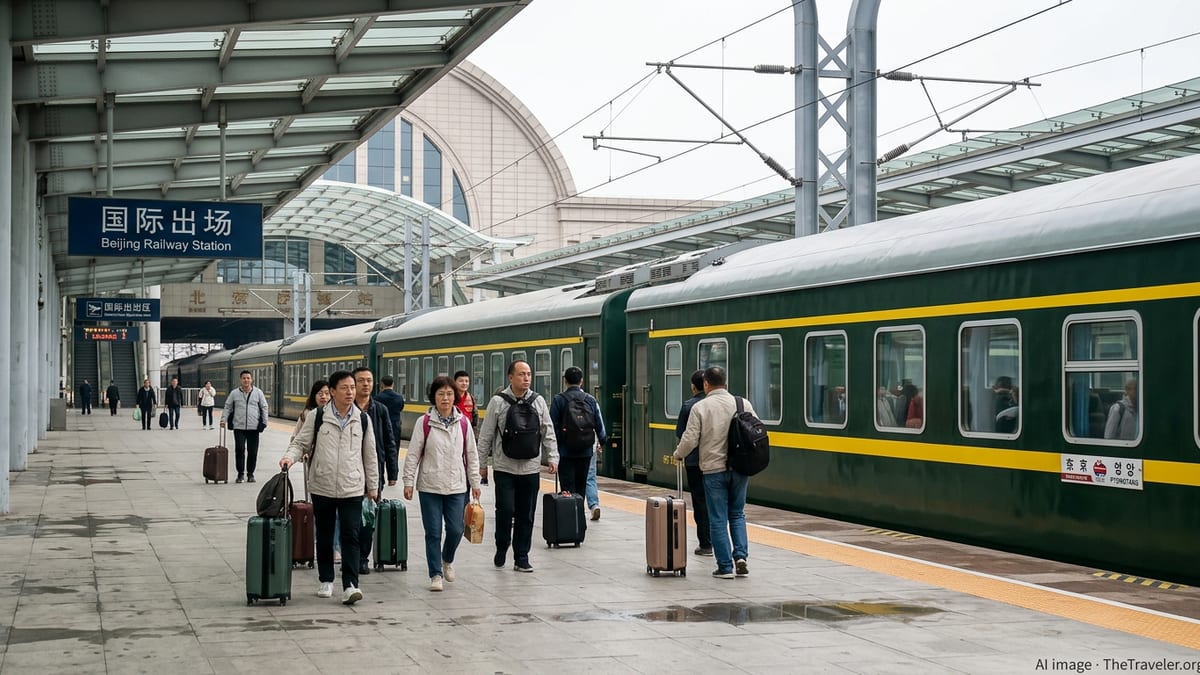
Regular Beijing–Pyongyang Rail Link Returns After Pandemic Halt
Publicly available information from Chinese rail authorities indicates that international passenger trains between Beijing, the border city of Dandong and Pyongyang have restarted in mid March 2026, restoring one of the most symbolic cross border connections in the region. The services were suspended in early 2020, when North Korea closed its borders and imposed some of the strictest pandemic controls in the world.
The renewed link reportedly includes multiple weekly departures between the Chinese capital and Pyongyang, along with daily services connecting Dandong to the North Korean capital. Timetables show overnight journeys that follow the historic corridor used by the K27 and K28 through trains, which have linked the two capitals since the 1950s and long served as a lifeline for trade, students and tightly controlled tour groups.
Ticketing is currently arranged through offline sales offices inside China, according to rail announcements. Travel agencies that specialize in trips along the China North Korea corridor are beginning to advertise new itineraries built around the reopened trains, although availability remains limited and subject to sudden change.
The restoration of cross border rail has also coincided with plans by Air China to resume limited commercial flights between Beijing and Pyongyang at the end of March. Together, the rail and air links are seen by analysts as early indicators of a broader normalization in movement between the two neighbors after years of near total isolation.
Cautious Tourism Reopening After Years of Isolation
Tourism to North Korea effectively stopped in 2020, when Pyongyang banned foreign visitors, expelled most diplomats and sharply restricted trade in response to the spread of COVID 19. According to historical tourism data, visitors from China previously accounted for the vast majority of inbound travelers, with many arriving by overnight train from Beijing or shorter services from Dandong.
Since 2023 and 2024, signs of a gradual reopening have emerged. Published coverage shows that North Korea first welcomed limited groups of Russian tourists for sightseeing tours, before later allowing in a small number of visitors from other countries under tightly managed arrangements. The relaunch of regular rail services from Beijing is being interpreted by tourism specialists as a further step toward rebuilding this sector, although exact entry rules and eligible nationalities remain fluid.
For now, most tour products being promoted to international travelers still revolve around highly structured packages that combine rail or air travel with pre approved hotel stays and guided visits in Pyongyang and selected regional cities. Itineraries typically include iconic sites such as Kim Il Sung Square, the Mansudae Grand Monument and the Pyongyang Metro, as well as side trips to locations like the border town of Sinuiju or the eastern port of Wonsan when domestic transport allows.
Industry observers caution that, despite the resumption of cross border trains, North Korea’s tourism reopening is likely to remain tightly controlled and subject to abrupt suspension. Potential visitors are being advised by travel operators to monitor advisories in their home countries and to build flexibility into their plans in case of schedule changes or renewed border measures.
Boost to Regional Connectivity and Cross Border Commerce
Beyond tourism, the return of passenger trains between Beijing and Pyongyang is widely viewed as a symbolic reinforcement of broader connectivity in Northeast Asia. The route closely parallels key freight corridors that handle much of North Korea’s overland trade with China, its largest economic partner. Although cargo services were restored earlier than passenger traffic, the presence of regular international trains adds capacity for business travelers, students and officials who previously relied on charter arrangements.
Transport analysts highlight that international rail corridors linking China with both North Korea and Russia are regaining momentum at a time of shifting trade patterns across Eurasia. A separate long distance passenger service between Russia and North Korea has also been reported as resuming, underscoring efforts by Pyongyang to re anchor itself to overland networks that connect to Beijing, Vladivostok and eventually Moscow.
Within China, the reopened services are expected to generate modest but visible activity in border hubs such as Dandong, where traders, logistics firms and tourism businesses rely on the flow of visitors and small scale commerce. Hotels, restaurants and travel companies in the city are beginning to prepare for renewed demand, particularly from domestic tourists interested in viewing the Yalu River frontier and the North Korean cityscape just across the water.
Rail specialists note that the Beijing–Pyongyang corridor retains strategic value out of proportion to its passenger volumes. The line functions as both a diplomatic symbol and an economic conduit, and its closure during the pandemic was widely interpreted as a mark of extreme caution by Pyongyang. Its reopening, therefore, is being read as a calibrated signal that the country is ready to re engage, at least with close partners and under highly managed conditions.
Opportunities and Constraints for Prospective Travelers
For international travelers, the resumption of passenger trains creates new possibilities but also notable constraints. The rail journey itself has long appealed to rail enthusiasts and geopolitically minded tourists who value the chance to cross one of the world’s most tightly controlled borders by land. The overnight ride offers views of rural northeast China, the crossing of the Yalu River bridge and, for those permitted entry, a rare glimpse of North Korean countryside on the approach to Pyongyang.
At the same time, access to tickets and visas remains highly specialized. Reports indicate that seats on the reopened trains are being allocated primarily through designated tour operators and official channels, rather than open online booking platforms. Travelers generally must join approved group tours, adhere to strict photography and movement rules once inside the country, and accept limited connectivity, with mobile and internet access heavily restricted.
Travel insurance and consular support present additional considerations. Many major insurers classify trips to North Korea as high risk and either exclude coverage or impose special conditions. Several Western governments continue to advise against all travel to the country, and in some cases impose legal restrictions on tourism, which means that only certain nationalities can realistically take advantage of the new train options.
Despite these barriers, specialist agencies report renewed inquiries from travelers interested in visiting North Korea by rail, often combining the journey with extended stays in Beijing or other Chinese cities. For such travelers, the train is both a practical transport option and a central part of the travel experience itself.
Implications for Future Rail Based Tourism in Northeast Asia
The reopening of the Beijing–Pyongyang passenger service is also feeding into broader conversations about rail based tourism in Northeast Asia. Regional planners and tourism researchers have long highlighted the potential for multi country itineraries linking China, the Korean Peninsula and Russia by train, with routes that could one day allow travelers to continue onward across Siberia or down through the Korean Peninsula if inter Korean relations allow.
While such scenarios remain speculative, the restoration of cross border services represents a concrete step toward a more interconnected regional rail map. In the near term, travel companies are more likely to focus on pairing North Korea itineraries with established routes inside China, such as high speed lines radiating from Beijing to coastal and interior destinations.
The move also reflects a post pandemic pattern seen elsewhere in Asia, where the return of international rail links is both a practical transport measure and a tourism marketing opportunity. From Laos and Thailand to border crossings in Central Asia, governments are promoting cross border trains as lower carbon, experience rich alternatives to short haul flights.
For North Korea and its neighbors, the resumed Beijing–Pyongyang trains are expected to remain modest in scale but outsized in symbolism. Their continued operation will serve as a barometer of Pyongyang’s willingness to welcome foreign visitors and participate in regional connectivity, even as political tensions and security concerns continue to shape the broader landscape.