

More news on this day
Authorities in North Sikkim have issued a travel advisory and mobilised the Sikkim State Disaster Management Authority after a landslide near Chungthang left an estimated 150 to 200 tourists stranded, disrupting access to key mountain destinations during the busy spring travel period.
Get the latest news straight to your inbox!
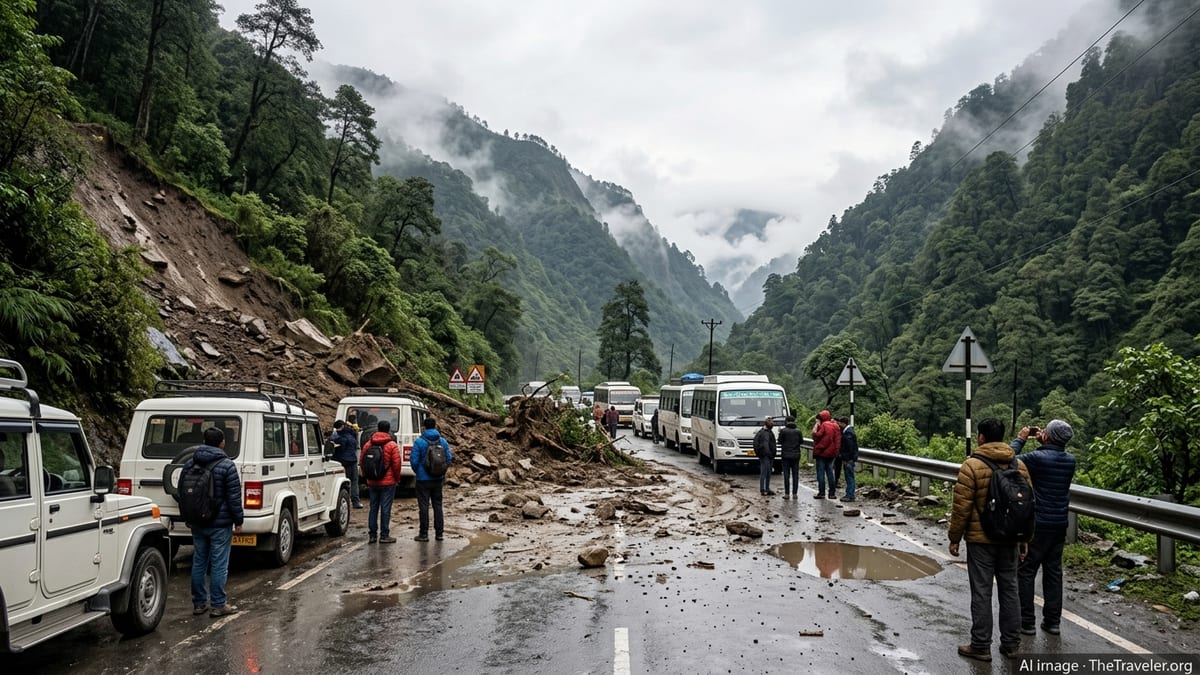
Landslide Near Chungthang Disrupts Access to North Sikkim
Recent heavy rain in the higher reaches of North Sikkim has triggered a significant landslide in the Chungthang area, cutting off a key stretch that connects popular destinations such as Lachung and Lachen. Publicly available information and regional news coverage indicate that debris, slush and rockfall have blocked parts of the road network that branches out from Chungthang, a critical junction on the way to remote valleys and high-altitude lakes.
The disruption has left between 150 and 200 domestic and international tourists temporarily stranded in and around Chungthang, according to local reports tracking vehicle and hotel occupancies. Road-clearing efforts are reported to be underway, but steep slopes, loose soil and ongoing showers are slowing progress and raising concern about fresh slips along already fragile hillsides.
Chungthang sits at the confluence of routes leading towards both Lachung and Lachen, and the impact of a landslide in this corridor tends to ripple quickly through North Sikkim’s tourism economy. When this narrow road is blocked, scheduled tours to Yumthang Valley, Zero Point and Gurudongmar Lake are abruptly halted, leaving visitors unable to move forward or return to lower elevations until engineers and road crews reopen at least one safe passage.
Government Advisory and SSDMA Mobilisation
In response to the latest blockage, the North Sikkim district administration has issued a formal travel advisory, urging visitors to defer non-essential trips into the affected sector and to remain in touch with tour operators for route-specific updates. Public advisories shared through local media and police communication channels indicate that permits for certain high-risk stretches have been paused or restricted while road conditions are reassessed.
The Sikkim State Disaster Management Authority (SSDMA) has been mobilised to coordinate with district agencies, road-building units and police to manage both immediate relief and ongoing risk. According to published coverage of earlier weather-related disruptions in the region, SSDMA typically oversees evacuation planning, deployment of heavy machinery for clearance and the arrangement of temporary shelters when long delays are expected for stranded travellers.
Standard operating procedures in such situations include prioritising vulnerable groups such as elderly travellers, families with young children and those with medical conditions, while also ensuring that fuel, food and basic supplies are available at key halting points. Coordination with transport operators is considered critical, as only certain categories of vehicles are suitable for navigating partially restored or alternative routes.
Impact on Tourists and Local Travel Plans
The immediate effect of the landslide has been an abrupt stop to itineraries that typically link Gangtok with Lachung, Yumthang Valley, Zero Point, Lachen and, conditions permitting, Gurudongmar Lake. Public discussions in regional travel forums show several visitors now facing cancellations or last-minute re-routing, with some being asked to remain in Gangtok or other lower-altitude bases until there is clarity on road status.
Visitors already in the Chungthang sector are reported to be sheltering in hotels and guesthouses while road-clearing work continues. Tour operators and drivers are adjusting plans day by day, with some itineraries shortened to focus on Lachung and nearby viewpoints if the Lachen side remains inaccessible for a longer period. Similar patterns were observed during previous landslide episodes, when authorities temporarily suspended fresh permits for North Sikkim and treated all pre-issued permits as cancelled for safety reasons.
For local communities whose livelihoods depend heavily on seasonal tourism, such closures can mean an immediate drop in bookings, particularly for homestays, small restaurants and drivers operating long-distance taxis and shared vehicles. However, residents are also familiar with the dangers of unstable slopes and typically support short-term restrictions when weather indicators and recent damage suggest heightened risk along the valley roads.
Known Risk Corridor and Seasonal Vulnerability
The corridor between Mangan, Chungthang and the higher valleys has long been recognised as a landslide-prone zone, with narrow roads hugging steep mountainsides and rivers cutting deep gorges below. Infrastructure such as the Theng Tunnel on the Mangan to Chungthang highway was built to reduce exposure to particularly unstable segments, but high rainfall, seismic activity and ongoing construction continue to test the resilience of the network.
Travel advisories for North Sikkim in recent years have frequently referenced the same broad geography, highlighting that intense rainfall over short periods can quickly translate into slope failures, road washouts and rockfall. According to publicly available weather and disaster bulletins, prolonged wet spells, cloudbursts and the after-effects of earlier flood events have all contributed to repeated disruptions around Chungthang and adjacent stretches.
The current incident follows a pattern in which strong pre-monsoon or monsoon showers prompt authorities to restrict movement to high-altitude tourist spots that are only accessible via single, exposed mountain roads. The emphasis in these advisories is on limiting night-time travel, discouraging non-essential movement during active rainfall and encouraging the use of four-wheel-drive vehicles on routes where surface conditions have deteriorated.
What Prospective Travellers Should Know Now
For travellers with upcoming plans to visit North Sikkim, publicly accessible notices and travel commentary currently urge a cautious approach. Prospective visitors are being advised to monitor district-level advisories, stay in close contact with registered tour operators and be prepared for itinerary changes that may exclude Lachen, Gurudongmar Lake or even the entire North Sikkim sector if clearance takes longer than anticipated.
Flexible bookings, including refundable hotel reservations and adjustable transport arrangements, are proving particularly valuable in this context. Travel planners recommend allowing additional buffer days at hubs like Gangtok so that journeys can be rearranged around evolving road reports rather than fixed departure times that leave little room for delays.
Those already in Sikkim are being encouraged by regional tourism updates to prioritise safety over sightseeing, avoid attempting to bypass closures, and follow local instructions on timing windows when roads partially reopen for staggered traffic. If conditions remain unstable, alternative itineraries within East, West or South Sikkim are often suggested, where road infrastructure is less exposed to large-scale landslides and access to medical facilities is faster.
As clearance and inspection work progresses, further updates on the reopening of the Chungthang approaches and the relaxation of the current travel advisory are expected to shape visitor flows into high-altitude North Sikkim over the coming days.