

More news on this day
In the gently rolling countryside of Northamptonshire, a cluster of vast rail-linked logistics parks is quietly emerging as one of the UK’s most important inland transport hubs, powering new patterns of travel, touring and tourism from the centre of England.
Get the latest news straight to your inbox!
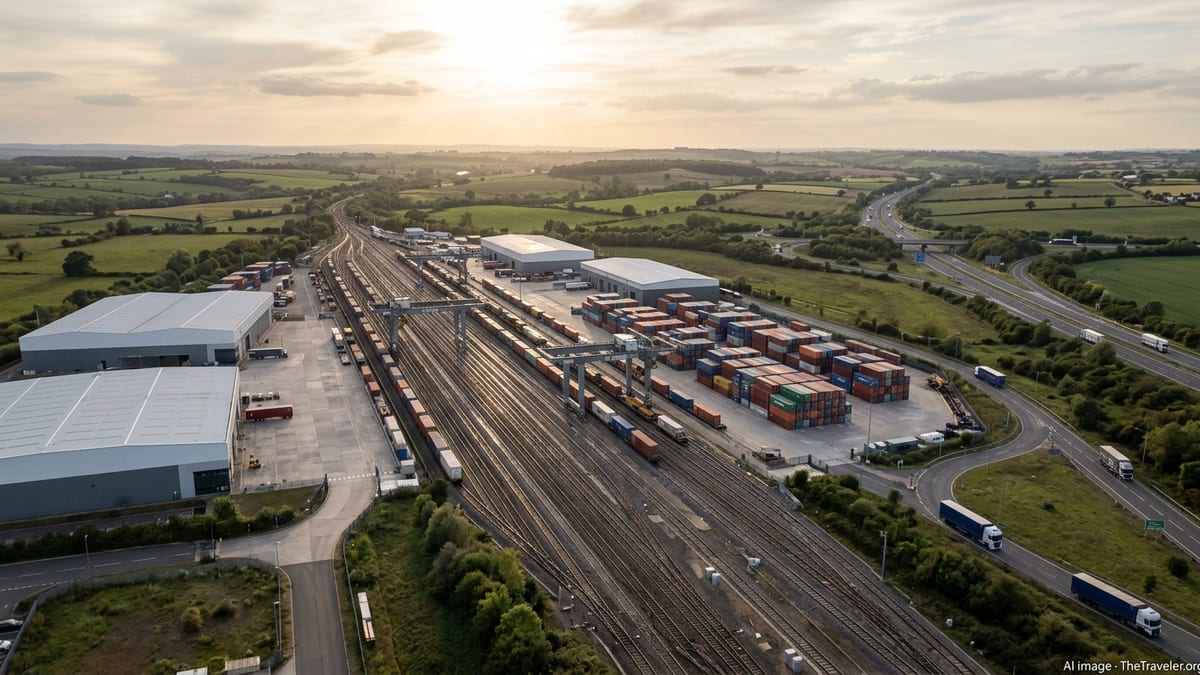
A Strategic Rail Powerhouse in the Heart of England
Publicly available planning and economic documents describe West Northamptonshire as sitting at the heart of the UK’s so-called logistics “Golden Triangle,” where the motorway network and key rail corridors intersect within a half-day drive of most of the British population. At the centre of this network is a concentration of strategic rail freight interchanges that has effectively turned a largely rural county into a national rail super-hub.
The best known of these is Daventry International Rail Freight Terminal, or DIRFT, a rail-road intermodal complex on the West Coast Main Line surrounded by high-specification warehousing. Recent technical material from project partners indicates that ongoing upgrades are intended to lift capacity to around 32 freight trains a day and more than half a million containers per year, linking the Midlands directly with deep-sea ports and major conurbations.
Alongside DIRFT, the newer SEGRO Logistics Park Northampton, just south of the town, has rapidly moved from construction site to operational rail hub. Engineering updates in mid-2025 reported that the first freight services have now started running from its dedicated rail terminal, providing an additional rail-connected node within the county’s growing cluster of inland ports.
Together with other approved and emerging rail freight schemes around Northampton and Daventry, these developments are transforming a previously overlooked stretch of central England into one of the UK’s most concentrated corridors for rail-based distribution.
From Freight Trains to Visitor Flows
While these sites are primarily engineered for freight, their impact reaches far beyond container yards and warehouse sheds. Local economic strategies and tourism briefs highlight how the same connectivity that moves goods efficiently is also enabling a surge in short breaks, day trips and touring itineraries centred on Northamptonshire and its neighbours.
Travel and tourism operators are increasingly building itineraries around the county’s central position on the rail and road network, with Northampton, Wellingborough and other stations promoted as convenient gateways to the surrounding countryside. The presence of major rail freight interchanges nearby has encouraged investment in parallel passenger infrastructure, including new station parking, bus interchange facilities and cycle access, improving the experience for leisure travellers.
Regional visitor-economy reports point to a steady rise in overnight stays linked to high-profile attractions within a short drive of these hubs, from the Silverstone motor-racing circuit to stately homes, canals and country parks. The same distribution parks that have drawn global brands to build national logistics centres are also generating employment and hotel demand, quietly feeding a broader hospitality and visitor-services boom.
Industry-facing coverage notes that rail-served logistics has become a selling point for conference and events organisers seeking sustainable access for delegates. Northamptonshire’s central location and strong rail links are being marketed as a way to reduce travel times and carbon footprints for nationwide gatherings.
New Investments Deepen the Super-Hub Role
Recent months have brought a series of investment announcements that point to the next phase of growth for the region’s rail super-hub. Trade and business publications report that global logistics and property firms are committing hundreds of millions of pounds to expand warehousing and cold-chain facilities at DIRFT and neighbouring sites, reinforcing the county’s role as a national distribution pivot.
One major logistics operator has outlined plans for a large, highly automated national distribution centre in Northamptonshire, citing the ability to reach almost all of the UK population within a single driver shift as a decisive factor. Planning papers linked to this and other schemes emphasise rail access as crucial to their long-term operating model, with increased train paths and terminal capacity seen as central to commercial viability.
At SEGRO Logistics Park Northampton, rail freight operator Maritime Transport has recently opened its own strategic rail freight interchange on site. Industry coverage describes this as a significant milestone, creating a new east–west freight corridor that links the park via the national rail network to other logistics clusters, ports and manufacturing regions.
Local economic strategy documents project that these combined investments will support thousands of jobs across logistics, transport services, maintenance, technology and ancillary sectors over the coming years. The concentration of rail-linked employment is, in turn, expected to sustain additional growth in accommodation, food services and visitor-focused businesses.
Sustainability, Congestion Relief and Rail-Led Tourism
National transport and climate policy papers increasingly frame strategic rail freight interchanges as a key tool for reducing heavy goods traffic on Britain’s roads. Northamptonshire’s rail hubs are frequently cited as examples of how rail-based logistics can cut emissions by shifting long-distance trunk movements from lorries to trains, particularly on routes from ports to inland distribution centres.
For travellers, this shift is beginning to have visible effects. Reports from advocacy groups and regional planners indicate that moving more freight onto rail can ease congestion on core motorway corridors, especially around junctions near Daventry and Northampton. Smoother traffic flows are regarded as beneficial for coach tourism, self-drive visitors and domestic touring routes that rely on reliable journey times.
Tourism bodies are also positioning the county’s rail connectivity as part of a wider sustainable travel offer. Marketing material increasingly encourages visitors to arrive by train and use local buses, cycling routes and walking trails to reach attractions, highlighting the environmental benefits of combined passenger and freight rail investment.
Industry observers suggest that as the rail freight network becomes more efficient, timetable planners may find greater scope for additional passenger services on key corridors, further enhancing access to heritage sites, market towns and event venues in and around Northamptonshire.
Balancing Growth with Local Character
The rapid emergence of Northamptonshire as a rail and logistics powerhouse has not been without debate. Parliamentary transcripts, council papers and local commentary show that some residents and representatives have raised concerns about landscape change, traffic on local roads and the scale of new warehousing around traditional villages.
In response, recent planning and economic strategy documents place growing emphasis on design standards, landscaping, biodiversity measures and transport mitigations designed to soften the visual and environmental impact of large logistics parks. There is also a stronger focus on securing training, skills programmes and local hiring commitments so that nearby communities benefit directly from the jobs created.
Tourism strategies for West Northamptonshire now stress the importance of maintaining the area’s appeal as a destination of countryside breaks and heritage visits alongside its industrial growth. Initiatives promoting canal boating, walking routes, historic estates and motorsport heritage aim to ensure that visitors experience more than distribution parks when they travel through the county.
As container trains lengthen and new rail-connected warehouses rise, Northamptonshire’s role in the national transport map is becoming clearer. What was once an under-the-radar rail freight cluster is evolving into a hidden super-hub, shaping how goods move and how people travel, and quietly supporting a new wave of tours, short breaks and business visits from the centre of the country.