

More news on this day
Air travelers across Norway are facing a difficult travel day as Oslo, Bergen and Stavanger airports report more than a dozen flight cancellations and numerous delays affecting services operated by SAS Link, Scandinavian Airlines, Lufthansa, KLM, Norwegian Air Shuttle and several other European carriers.
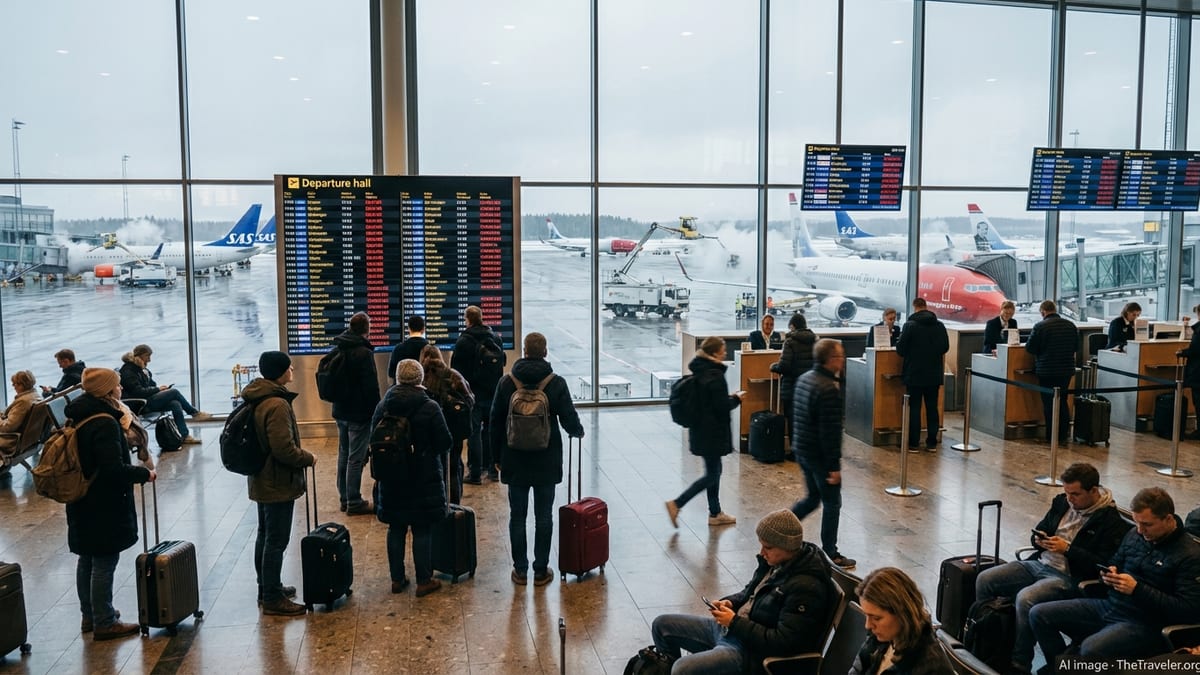
Disruptions Mount Across Norway’s Key Hubs
The latest operational data on Friday, 20 February 2026, show a growing number of cancellations and late departures across Norway’s three main western and central hubs: Oslo Gardermoen, Bergen Flesland and Stavanger Sola. While the scale is far from a complete shutdown, the combined effect of grounded aircraft and rolling delays is rippling through both domestic and international networks.
Passengers flying on regional routes between Stavanger and Bergen, as well as on selected intra-European services to and from Oslo, have been particularly affected. Short-haul connections that normally allow seamless same-day travel for business and leisure customers are seeing gaps in schedules and last-minute time changes, forcing many travelers to rebook or accept significantly extended journey times.
What makes the situation especially challenging for travelers is that no single airline is responsible. Instead, a mix of legacy carriers, regional operators and low cost airlines are all contending with operational pressures. This has complicated rebooking options and reduced the number of available alternative flights on already busy winter Friday schedules.
Airlines Impacted: SAS Link, Major European Carriers and Norwegian
Among the most visible disruptions are those involving SAS and its regional partner SAS Link, which together operate a dense mesh of domestic services linking Norway’s coastal cities with Oslo and other Scandinavian gateways. Several point to point connections that underpin Norway’s internal air network have been affected, including services on the busy Stavanger to Bergen corridor, a key route for the energy and maritime sectors.
Internationally, traditional European network airlines such as Lufthansa and KLM are also contending with delays on flights linking Norway to major hubs in Germany and the Netherlands. These connections are critical for onward long haul travel, so even moderate delays can lead to missed transfers and rebookings onto later flights, cascading disruption throughout the day for travelers bound for North America, Asia and Southern Europe.
Norwegian Air Shuttle, which has a strong presence on domestic and short haul European routes from Oslo and Bergen, is likewise reporting schedule adjustments. While there are no indications of a single systemic failure at Norwegian, the carrier is managing isolated delays on certain departures and arrivals, underscoring how tightly coupled airline operations are in the winter peak period.
Conditions Behind Today’s Cancellations and Delays
The exact configuration of causes differs by route and operator, but today’s cancellations and delays appear to reflect a combination of winter weather challenges in parts of northern Europe, tight aircraft and crew rotations, and knock on effects from earlier operational constraints. At Norway’s coastal airports in particular, gusty winds, low cloud and intermittent precipitation can quickly narrow operating margins, demanding additional spacing between flights and, at times, forcing precautionary cancellations.
When aircraft and crews arrive late from earlier sectors in Europe, it can be difficult for airlines to recover their schedules quickly, especially on Fridays when flights often operate close to capacity. This creates a scenario where a single delayed inbound from a continental hub can trigger a late departure out of Oslo or Bergen, which in turn affects a subsequent domestic leg and any passengers booked on tight connections.
Airports and airlines stress that safety is never compromised in efforts to maintain punctuality. That means that when weather, runway conditions or visibility thresholds are marginal, operations are slowed or suspended where necessary, even if this leads to inconvenience and missed plans for travelers. In winter, these conservative safety margins are applied more often, particularly during early morning and late evening peaks.
Impact on Passengers: Missed Connections and Overnight Changes
For passengers, the most immediate consequences are missed meetings, lost holiday time and, for some, the need to arrange overnight accommodation when onward connections cannot be met. Travelers relying on tight connections through Oslo to reach regional airports or international destinations are at the highest risk of disruption, particularly when their inbound flights are operated by one airline and their outbound legs by another.
Queues at service desks in Oslo, Bergen and Stavanger have lengthened at times as customers seek rebooking assistance, meal vouchers and updated information. While many airlines have improved their digital tools for self-service changes, busy travel days can still overwhelm call centers and apps, leaving some passengers frustrated as they try to secure new itineraries.
Families traveling with young children, elderly passengers and those with mobility needs are disproportionately affected when schedules change at short notice. Longer waits in terminals and the stress of re-planning journeys can be difficult to manage, even when airports provide seating, play areas and accessible facilities to help mitigate the strain.
How Oslo, Bergen and Stavanger Airports Are Responding
Airport operators in Oslo, Bergen and Stavanger are coordinating closely with airlines and ground handling providers to manage the day’s irregular operations. Duty managers monitor runway conditions, weather forecasts and air traffic control restrictions and relay updates to airlines, which in turn adjust boarding times and gate allocations in an effort to keep traffic flowing.
Terminal staff are focusing on maintaining clear communication, both through public address announcements and updated departure and arrival boards. In crowded gate areas, staff members are helping to direct passengers whose flights have been cancelled or delayed toward service counters or self-service kiosks where rebooking options are displayed.
Cleaning and security teams are also adjusting their routines, as longer dwell times in departure lounges can place additional pressure on airport facilities. By staggering security flows and increasing patrols in busy areas, airports aim to maintain an orderly environment even as flight schedules become less predictable.
Guidance for Affected Travelers in Norway Today
Travelers booked to fly from or through Oslo, Bergen or Stavanger today are being urged to adopt a proactive approach to their journeys. Airlines and airports consistently recommend checking flight status before leaving for the airport and enabling notifications in airline apps so that gate changes or schedule shifts are received in real time.
Passengers whose flights have already been cancelled should avoid going to the airport unless explicitly instructed to do so, as most rebookings can now be processed online or via mobile channels. For those who are already at the terminal when a cancellation is announced, seeking assistance early at an airline desk or kiosk will usually lead to more rebooking options than waiting until later in the day.
Experienced travelers also advise packing essential items, including medications, chargers and a change of clothes, in cabin baggage in case of unplanned overnight stays or extended layovers. Having digital copies of booking confirmations, travel insurance details and identity documents readily accessible can further streamline discussions with airline staff if alternative arrangements are required.
Passenger Rights and What Airlines Are Offering
Under applicable European air passenger protection rules, travelers whose flights are cancelled or significantly delayed may be entitled to certain forms of assistance. These can include meals and refreshments during long waits, hotel accommodation if an overnight stay becomes necessary, and ground transport between the airport and accommodation. Eligibility for financial compensation depends on factors such as the cause of disruption, notice given, and whether the airline can reasonably claim that extraordinary circumstances were to blame.
Most airlines operating to and from Norway supplement these legal obligations with their own commercial policies. In practice, this means that even where compensation is not mandated, carriers may offer travel vouchers, fee free rebookings or routing via alternative hubs to retain customer goodwill. Passengers are usually provided with written information at the airport outlining their rights and the steps required to submit claims after travel.
Even so, processing compensation or reimbursement requests can take time, especially after a day with widespread disruption. Travelers are therefore encouraged to keep copies of receipts for meals, accommodation and transport that they may need to arrange themselves when immediate airline support is unavailable, so that potential reimbursement can be evaluated later.
Outlook for the Remainder of the Day
Operational planners at airlines and airports will spend the rest of Friday working to restore schedules in time for the weekend. If weather and runway conditions stabilize and air traffic control restrictions ease, some of today’s cumulative delays may begin to shrink later in the evening, particularly on shorter domestic legs between the affected Norwegian cities.
However, certain rotations, especially those involving long haul flights or overnight aircraft positioning, may remain out of sequence into Saturday. This can result in minor knock on delays even after the immediate disruption has been contained. Travelers flying early on Saturday morning through Oslo, Bergen and Stavanger are therefore advised to check their flight status regularly, even if their flights have not yet been flagged as affected.
For now, Norway’s aviation system remains operational, but today’s events highlight how quickly a combination of weather, scheduling pressures and interconnected European air traffic can lead to cascading delays and cancellations. With winter still in full swing, both airlines and passengers will be watching conditions closely in the days ahead.