

More news on this day
Families booking Norwegian Joy for Spring Break sailings in 2026 are discovering a tougher set of policies that could reshape how younger guests move around the ship, use the pools, and respond when crew members invoke the captain’s authority to keep order at sea.
Get the latest news straight to your inbox!
Stricter Age Limits Put Parents on Notice
Norwegian Joy will again be a popular choice for Caribbean and Alaska sailings over the Spring Break period, but families are being reminded that the ship now enforces a more clearly defined framework of age-related rules. Publicly available policy summaries indicate that, across Norwegian Cruise Line’s fleet, passengers under 21 must be booked with an adult over 21 in the same or a connecting stateroom, with additional documentation required when that adult is not a parent or legal guardian. These rules are not new, but recent coverage and discussion have highlighted that they are being applied more rigorously as ships fill with school-age travelers.
For teenagers, Norwegian’s youth and teen program guidance specifies a shipwide curfew, often set at 1:30 a.m., limiting how long unaccompanied guests can remain in public areas late at night. The curfew is intended to curb late-night roaming in corridors and lounges, a recurring complaint on busy school-holiday cruises. Reports from recent sailings suggest that crew members are increasingly likely to check keycards, verify ages, and direct unsupervised teens back to their cabins or youth spaces once curfew takes effect.
Families traveling with multiple teens, or with older siblings looking after younger ones, may find that these rules feel tougher than in the past. The expectation outlined in Norwegian’s minor policies is that a responsible adult assumes full accountability for under-21 guests, including making sure they follow curfews, refrain from alcohol use, and respect all shipboard regulations. During peak Spring Break sailings, when passenger counts are high and nightlife runs late, the stricter interpretation of these requirements can become far more visible.
Travel advisors note that parents used to more relaxed resort environments may be surprised by how firmly cruise lines apply age rules at check in and while at sea. Some recent commentary in cruise forums points to families being turned away from boarding or required to adjust cabin assignments when documentation or rooming arrangements did not match published age policies, underscoring that the rules are not merely suggestions.
Pool Deck Restrictions Change the Atmosphere
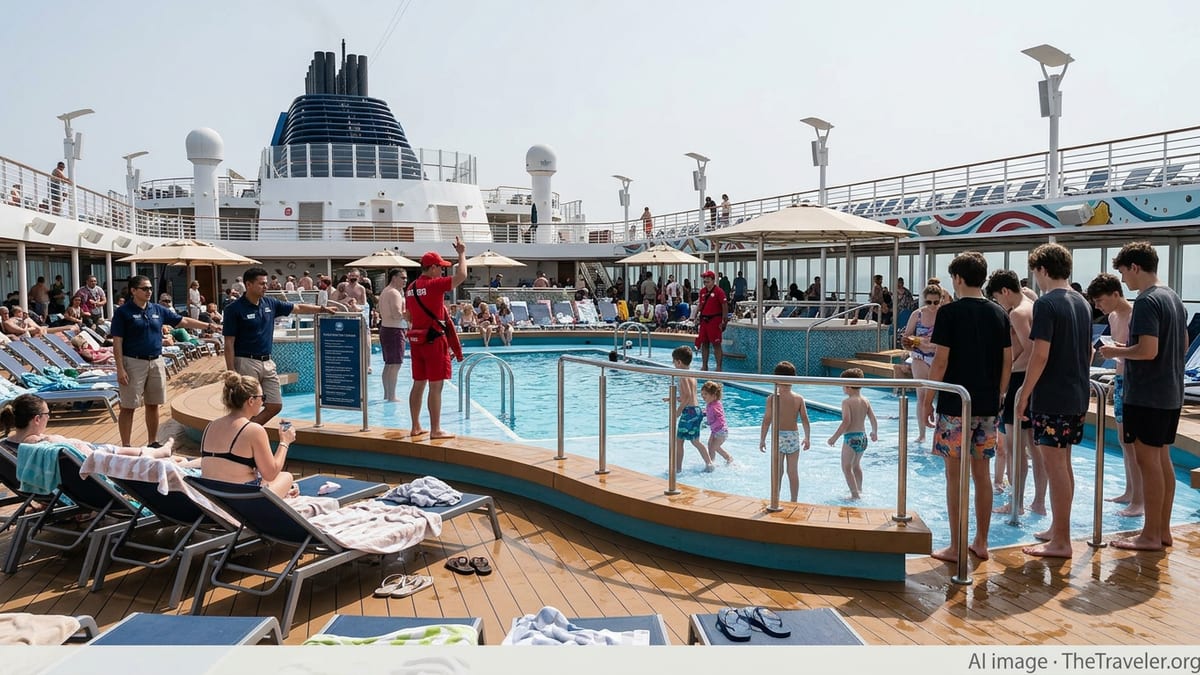
For many guests, the pool deck is the heart of a Spring Break cruise, and Norwegian Joy’s main pool area is frequently described as crowded and energetic on high-demand sailings. At the same time, a combination of safety guidance and courtesy rules is reshaping how guests of different ages can use these spaces. Norwegian’s published age and pool policies emphasize that children who are not toilet trained must use designated splash or water play zones and wear swim diapers, and that they are not permitted in the main pools. These restrictions, which trace back to health regulations, are being more visibly enforced as crew attempt to manage heavily used water areas.
Recent first-hand accounts from passengers sailing on related Norwegian itineraries indicate that drink rules around the main pool are also tightening. Guests describe lifeguards and pool staff asking passengers to keep beverages away from pool edges or out of the water entirely, citing safety and spill concerns. On Norwegian Joy, this can mean that guests who recall being served while seated along the pool edge in earlier seasons now find themselves being whistled at or redirected to nearby tables when they bring drinks too close to the water.
Chair-reservation practices have drawn additional scrutiny. Passengers discussing Norwegian Joy specifically report that staff are removing items from apparently unattended loungers after a set period, with towels and personal belongings taken to a designated collection point. The goal is to discourage early-morning “chair hogging” but it can come as a shock to families who believed they had secured spots for the afternoon. On Spring Break cruises where every lounger is in demand, enforcement of these rules can feel especially strict.
These layered restrictions can alter the tone of a sea day for families expecting a free-form, resort-like pool scene. Parents may need to divide time between splash zones and deeper pools based on children’s ages, keep a closer eye on beverages around the water, and return to loungers frequently to avoid having belongings cleared away. For some, these are sensible crowd-control steps; for others, they risk making relaxation feel more like compliance.
Curfews, Youth Programs, and Late-Night Crackdowns
Norwegian promotes its youth and teen programs as major selling points for family cruising, and Norwegian Joy typically offers structured spaces for children and teenagers, from playrooms to teen lounges. The Spring Break period, with its concentration of school-age guests, puts particular pressure on these venues and on the policies that govern them. Norwegian’s youth program information stresses that only authorized adults can check minors in and out of supervised spaces, and that teens, while allowed more freedom, must still respect set curfews and conduct rules.
Reports from across the fleet, echoed by travel blogs that track family cruising trends, indicate that curfew enforcement has become more consistent over the past year. Crew members on several lines, including Norwegian, are said to be checking public spaces around curfew time and directing underage passengers back to their cabins if they are not accompanied by adults in their travel party. The effect is especially noticeable on Spring Break cruises, when packs of teens traditionally roam the ship late into the night.
Parents who rely on older teens to supervise younger siblings may experience friction if crew interpret the rules more narrowly, insisting on adult presence in certain venues late at night or discouraging groups of younger teens from lingering in busy corridors and stairwells. At the same time, many travelers commenting in public forums view the stricter stance as overdue, pointing to noise complaints, minor altercations, and unsupervised behavior on previous high-season voyages.
The combination of a defined curfew, clear youth-program rules, and the sheer number of young passengers means that families on Norwegian Joy this Spring Break can expect more frequent interactions with staff about where their children are, and when. While the policies are designed around safety and comfort, they can feel intrusive to guests expecting a looser resort-style environment at sea.
Captain’s Authority Takes Center Stage
Behind every onboard rule is a broader legal framework that gives cruise ship captains wide latitude to maintain order and safety, and Norwegian Joy is no exception. Publicly accessible terms and conditions for major cruise lines explain that the master of the vessel and senior officers can restrict access to certain areas, disembark passengers, or confine individuals to cabins when behavior is deemed unsafe, disruptive, or in violation of company policy. During crowded Spring Break sailings, this authority becomes more visible as staff refer guests to the captain’s overarching responsibility for shipboard conduct.
Travel-law experts and consumer advocates note that such powers are not new, but recent incidents across the cruise industry have brought them into sharper focus. Coverage of disciplinary actions on other lines, including fines tied to curfew violations and removal of guests for repeated rule-breaking, has prompted Norwegian passengers to look more closely at the fine print on their own tickets. The implications are clear: if a family or group repeatedly ignores age limits, pool rules, or curfew requirements, the captain has broad discretion to escalate consequences.
On Norwegian Joy, this can translate to stronger messaging around compliance at muster drills, in daily programs, and through announcements and signage. References to the captain’s right to deny service, restrict movement, or order disembarkation for individuals who refuse to follow safety instructions are increasingly emphasized, particularly on voyages that coincide with Spring Break and other youth-heavy travel windows. For guests unused to maritime norms, the reminder that their vacation effectively takes place under shipboard authority can feel jarring.
While most families will never encounter the sharp end of that authority, the knowledge that it exists, and that it can be used to cut short a trip, adds weight to policies that might otherwise seem negotiable. Ignoring posted restrictions in the pool area, arguing with crew about youth supervision, or treating curfew as optional can carry consequences far beyond a simple warning.
What Spring Break Cruisers Should Expect
For travelers considering Norwegian Joy this Spring Break, the emerging picture is of a ship that remains highly attractive for families but operates under a firmer rule set than some may remember. Age limits for cabin occupancy, youth-program access, and late-night movement are being highlighted more prominently in pre-cruise materials and onboard signage. Pool and sun-deck restrictions are enforced with an eye toward crowding and safety, with rules around drink placement, swim diapers, and chair use more consistently applied.
Passengers studying recent accounts from similar Norwegian sailings will find that those who adapt quickly to the expectations tend to report smooth experiences, while those caught off guard by curfews, documentation requirements, or pool rules describe frustration. The gap often reflects how closely families review official policies before sailing and how ready they are to adjust long-standing habits from land-based resorts.
Norwegian Joy’s Spring Break voyages continue to offer the combination of large-ship amenities, youth activities, and busy pool decks that draw families back year after year. The difference in 2026 is the sharper focus on enforcement, framed by the captain’s authority to intervene when necessary. For some, that focus represents reassurance that crowded sailings will be kept orderly. For others, it may feel like a reminder that, at sea, even vacation fun takes place within carefully defined boundaries.