

More news on this day
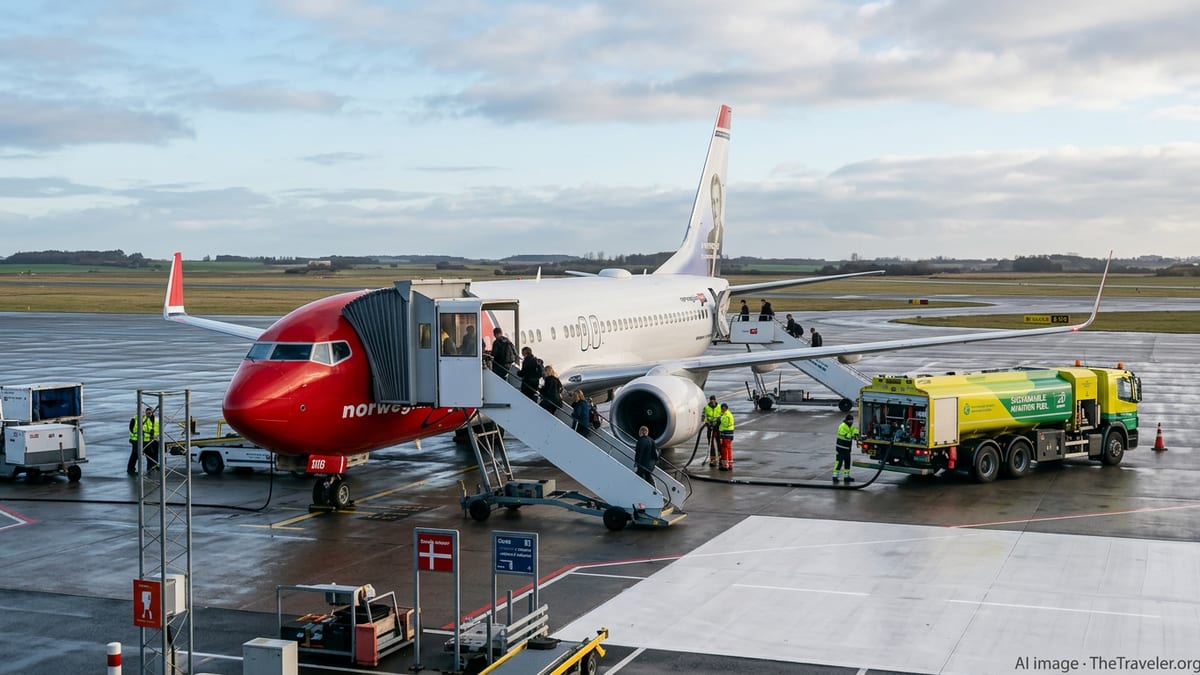
Norwegian Air Shuttle has launched a landmark domestic service between Aalborg and Copenhagen using a 40 percent blend of sustainable aviation fuel, marking what Danish authorities say is the European Union’s first permanent commercial route to operate with such a high share of SAF on every flight.
Green Milestone for Danish and European Aviation
The inaugural flight on the Aalborg–Copenhagen route departed in early March from northern Jutland, signaling a new phase in Denmark’s drive to cut emissions from one of its busiest domestic air corridors. The service will operate with at least 40 percent sustainable aviation fuel in the tanks on every departure through 2027, close to the current technical blend limit of 50 percent for most commercial aircraft.
Officials in Copenhagen describe the project as the first of its kind in the EU: a scheduled commercial route, not a one-off demonstration, committed to such a high SAF share as standard practice. While airlines across Europe have conducted individual SAF-powered flights and shorter trials, the Danish government and Norwegian emphasize that this route is designed as a long-term blueprint for greener everyday flying, not a publicity stunt.
The Aalborg–Copenhagen corridor is one of Denmark’s most heavily trafficked domestic connections, with thousands of annual flights and hundreds of thousands of seats. By embedding SAF into every rotation, the partners aim to demonstrate that significant emissions cuts are possible on mainstream routes while still using existing aircraft and airport infrastructure.
State-Backed Tender and EU-Approved Support Scheme
The 40 percent SAF route is the centerpiece of Denmark’s national green aviation strategy, backed by a dedicated state aid scheme approved by the European Commission. The program earmarks funding to bridge the cost gap between conventional jet fuel and more expensive sustainable alternatives, on the condition that airlines meet strict environmental and operational criteria.
Norwegian secured the contract to operate the route following a competitive tender launched by the Danish government. Under the terms, the airline must maintain at least 40 percent SAF on all eligible flights between Aalborg and Copenhagen and run a minimum number of weekly services through the end of 2027. The scheme is explicitly structured to avoid double subsidies and to align with the EU’s ReFuelEU Aviation regulation, which will gradually mandate SAF use across the bloc.
Danish officials say the initiative is intended both to cut emissions and to help kick-start a broader market for sustainable fuels in northern Europe. By providing predictable, multi-year demand on a major route, the tender is designed to give fuel suppliers and investors greater confidence to scale production capacity, which remains a key bottleneck for SAF worldwide.
Used Cooking Oil to Power a Busy Domestic Corridor
The fuel used on the Aalborg–Copenhagen flights is produced primarily from used cooking oil, one of the most mature and widely deployed feedstocks for sustainable aviation fuel. Processed to meet stringent aviation standards, the resulting fuel can be blended with conventional Jet A1 without modifications to aircraft engines or fueling systems, making it a practical near-term solution for airlines.
According to figures shared by the partners, the 40 percent blend is expected to cut carbon dioxide emissions on the route by several thousand tonnes per year compared with flying solely on fossil jet fuel. Over the full operating period to 2027, the cumulative reduction is projected to reach well over six thousand tonnes, a meaningful though still modest contribution relative to Denmark’s overall climate targets.
Experts note that SAF derived from waste oils can reduce life-cycle emissions by up to around 80 percent compared with traditional kerosene, depending on the production pathway and sourcing. However, supplies of waste-based feedstocks are finite, and the Danish project also serves to highlight the need for new generations of synthetic “e-fuels” and other advanced options if aviation is to meet long-term net-zero goals.
Norwegian’s Sustainability Strategy Takes Flight
For Norwegian, the route represents a high-profile step in a broader sustainability strategy that includes fleet renewal, efficiency measures and long-term SAF procurement agreements. The airline has previously introduced SAF on select services in Scandinavia and entered into partnerships aimed at developing large-scale e-fuel production in the Nordic region.
Company executives say operating an entire domestic route at a 40 percent blend will provide valuable operational experience, from fuel logistics and quality control to passenger communication. Norwegian has framed the Aalborg–Copenhagen corridor as a “green flagship” for the brand, underscoring its ambition to be seen as a frontrunner on climate action among European low-cost carriers.
The carrier also acknowledges that higher fuel costs remain a challenge. While the Danish support scheme helps offset some of the price premium of SAF, industry analysts expect part of the additional expense to flow through to ticket prices over time, especially as broader EU mandates raise demand for limited supplies of sustainable fuel.
Template for Future Routes Across the EU
Aviation and climate specialists are watching the Danish experiment closely as EU member states prepare to implement ReFuelEU Aviation, which will require airlines to gradually blend more SAF into fuel uplifted at European airports from 2025 onward. The Aalborg–Copenhagen service, with its relatively high mandated share and multi-year horizon, is seen as an early test case for how such policies might work on a larger scale.
If successful, the model could be replicated on other short-haul routes in Scandinavia and beyond, especially in markets where governments are willing to co-finance the initial cost gap and where airports can secure reliable SAF supplies. Industry groups point out that predictable, long-term demand signals such as the Danish tender are crucial to unlock the billions of euros needed to build new production plants.
For travelers passing through Copenhagen and Aalborg, the shift may at first be largely invisible. Flights operate on standard aircraft, schedules remain familiar and ticketing processes are unchanged. Yet the fuel pumped into the wings represents a tangible move toward lower-carbon travel, and one that is likely to become more commonplace as Europe tightens climate rules. In that sense, the Norwegian service linking northern Jutland with the Danish capital offers a glimpse of how flying within the EU could look in the years ahead.