

More news on this day
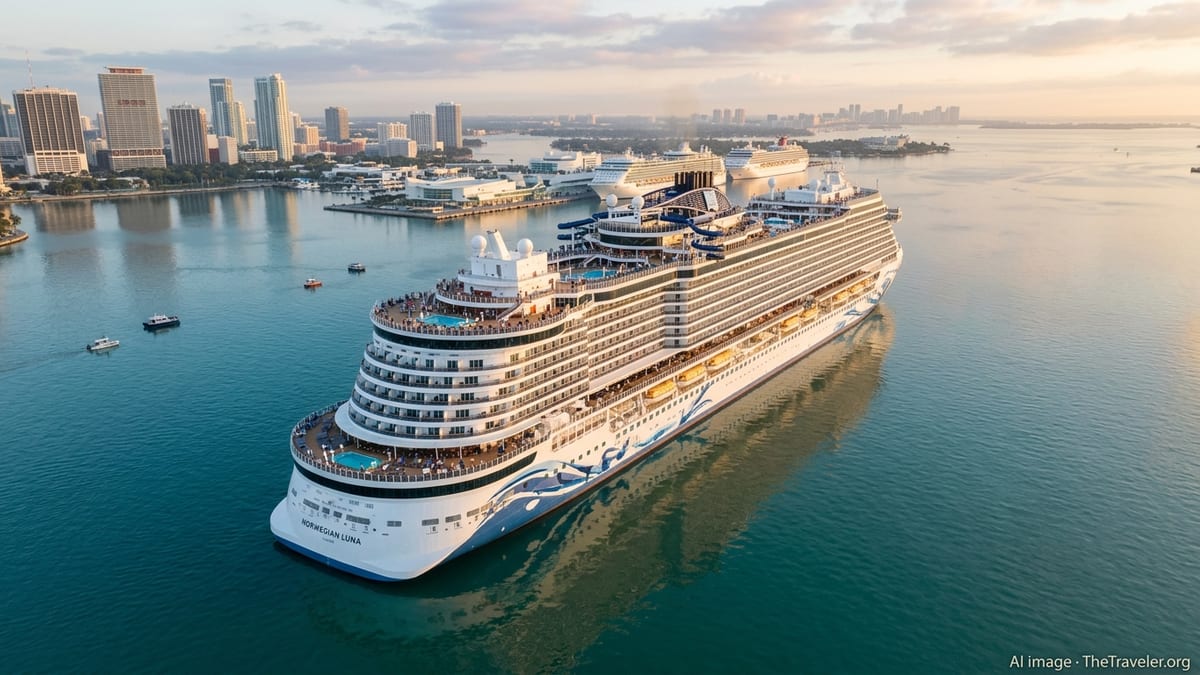
Norwegian Cruise Line’s newest ship, Norwegian Luna, is set to make a record‑setting Atlantic crossing from Rome to Miami in March 2026, a high‑profile arrival that is already rippling through Caribbean cruise bookings, hotel demand and regional air connectivity ahead of the ship’s first full Caribbean season.
Get the latest news straight to your inbox!
Transatlantic Showcase Positions Miami as 2026 Caribbean Gateway
Norwegian Luna’s 13‑night maiden voyage is scheduled to depart Civitavecchia, the port for Rome, on March 10, 2026, sailing largely at sea before arriving in Miami on March 23, 2026. Industry schedules list the itinerary as a one‑way repositioning cruise with 12 sea days, designed to highlight the Prima Plus‑class ship’s onboard amenities before it begins short Bahamas and week‑long Caribbean sailings from South Florida.
Publicly available deployment documents and trade coverage indicate that Luna’s transatlantic run will be among the earliest major cruise movements into Miami for the 2026 Caribbean summer build‑up, effectively serving as a floating launch event for the ship’s year‑round Caribbean program. With capacity for more than 3,500 guests at double occupancy, the crossing represents one of the largest single injections of high‑spend leisure travelers into Miami in late March.
Tourism analysts following cruise deployment note that high‑profile newbuild arrivals often trigger a wave of add‑on travel, as passengers extend stays on either side of the voyage. In Luna’s case, hotel operators in Miami and nearby beach destinations are preparing for elevated late‑March demand from cruise guests who may combine the crossing with city breaks or onward Caribbean holidays.
The ship’s debut also reinforces PortMiami’s position as a primary staging point for Caribbean cruising in the second half of the decade. Cruise schedules through 2027 show Norwegian Luna homeporting in Miami for its inaugural year before redeploying seasonally to New York and Bermuda, underscoring Miami’s role as the ship’s Caribbean anchor.
Year‑Round Caribbean Itineraries Lift Island Demand
After the Atlantic crossing and a short series of Bahamas sailings, Norwegian Luna is scheduled to begin its main Caribbean program from April 4, 2026, operating three‑ and four‑night Bahamas getaways alongside seven‑night Eastern and Western Caribbean cruises. Trade publications and cruise line materials highlight key ports such as Cozumel in Mexico, Tortola in the British Virgin Islands, and select Eastern Caribbean islands as regular calls.
Travel trade reporting suggests that these itineraries are already contributing to a stronger forward booking picture for the 2026 to 2027 Caribbean high seasons. The combination of Luna and its sister Prima‑class and Prima Plus‑class ships is expected to keep Norwegian Cruise Line among the larger single cruise providers in core Caribbean destinations, with Luna’s additional berths translating into tens of thousands more passenger arrivals over its first year.
Destination marketing organizations across the region have been promoting new experiences aligned with the arrival of next‑generation cruise ships, with a focus on upscale beach clubs, curated shore excursions and marine conservation outings. The deployment of Norwegian Luna, equipped with expanded outdoor spaces and a strong focus on premium leisure experiences, appears to support this shift toward higher‑value Caribbean tourism.
Market observers also note that Luna’s consistent seven‑night patterns can help stabilize weekly visitor flows on several islands, allowing hotels, tour operators and transport providers to plan staffing and inventory more efficiently. That regular schedule is particularly important for smaller ports that rely on predictable cruise calls to anchor their tourism economies.
Flight Connectivity Grows in Step With Cruise Capacity
The expansion of Norwegian Luna’s Caribbean program from Miami is coinciding with a noticeable buildup in regional airlift for 2026. Airline schedule filings and route announcements over the past year show U.S. carriers and regional airlines adding frequencies between Miami, Fort Lauderdale and major Caribbean hubs such as San Juan, Montego Bay and Nassau, as well as secondary islands that feature prominently on cruise itineraries.
Aviation and tourism reports indicate that the cruise sector is an important driver for these air service decisions. As ships like Norwegian Luna homeport in Miami, they generate recurring demand from international and domestic travelers flying in to join sailings. In turn, expanded air capacity into both Miami and key Caribbean islands supports pre‑ and post‑cruise stays, multi‑island holidays and fly‑in guests joining portions of longer itineraries.
Some island tourism boards have highlighted 2026 as a pivotal year for air connectivity, linking the arrival of new large‑capacity ships with recently announced non‑stop routes from cities such as Dallas, Chicago and Toronto. While these air routes serve broader leisure and visiting‑friends‑and‑relatives demand, the timing aligns closely with Luna’s deployment and the wider growth of Caribbean cruising out of South Florida.
For travelers, the net effect is a denser network of flight options that can make it easier to combine a Norwegian Luna voyage with extra time on individual islands before or after a cruise. Travel advisors are increasingly promoting such hybrid itineraries, citing improved schedule coordination between cruise departure days and peak flight times.
New Ship Technology and Passenger Spend Support Regional Recovery
Norwegian Luna, as a Prima Plus‑class newbuild, incorporates a range of design and technology updates that Caribbean tourism stakeholders view as beneficial for both guest experience and local economies. Cruise industry coverage points to expanded outdoor promenades, elevated dining concepts and upgraded entertainment, positioning the ship to attract higher‑spending travelers interested in premium leisure products.
Economic impact assessments from earlier generations of large ships suggest that higher onboard spending potential often translates into stronger demand for private excursions, specialty restaurants ashore and boutique shopping in port cities. Observers expect Luna’s passenger mix to mirror this pattern, providing a lift for local guides, transport providers and small businesses in popular cruise towns across the region.
At the same time, environmental and efficiency features described in shipyard and operator materials, including optimized hull design and more efficient propulsion and energy systems, are intended to reduce fuel use per passenger compared with older vessels. Caribbean destinations that have increasingly tied port development to sustainability benchmarks are watching these technical improvements as they negotiate future calls and terminal upgrades.
Regional tourism analysts say the combination of higher economic value per visitor and incremental steps toward more efficient operations could strengthen the case for continued cruise investment, particularly in ports where community sentiment has been divided over the costs and benefits of large‑ship tourism.
Caribbean Cruise Outlook: Stronger Hubs and More Choice for Travelers
Looking ahead to late 2026 and 2027, published deployment plans show Norwegian Luna remaining a key part of Norwegian Cruise Line’s Caribbean and North America strategy. After its inaugural year from Miami, the ship is slated to shift seasonally to New York, introducing Bermuda and Northeast itineraries while continuing warm‑weather sailings that complement its Caribbean program.
This pattern reflects a broader industry trend in which major ships rotate between Caribbean, Bermuda and European routes while maintaining a strong presence in Miami and other U.S. East Coast homeports. For Caribbean destinations, it means that the momentum generated by Luna’s 2026 Atlantic crossing and inaugural season is likely to carry into subsequent years as the ship returns on repeating schedules.
For travelers, the result is a denser web of choices that pairs a modern cruise product with improving flight connectivity, especially through Miami as a central hub. As Norwegian Luna’s inaugural crossing approaches, booking data and industry commentary point to a Caribbean region preparing to capitalize on the ship’s arrival, using its high‑visibility debut to showcase both established beach favorites and emerging island experiences.