

More news on this day
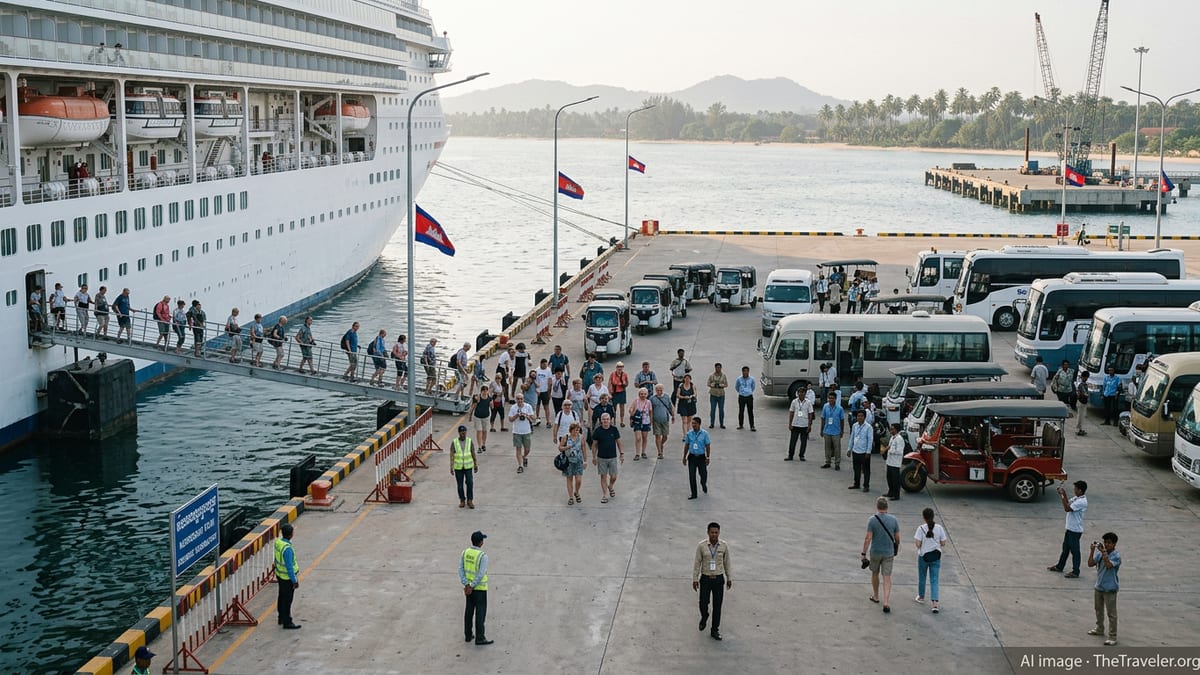
Cambodia’s coastal Sihanouk province has welcomed more than 1,800 international visitors arriving aboard the Norwegian Sun cruise ship, underscoring both the country’s rising profile on global cruise itineraries and the growing importance of port calls to the local economy.
Record Cruise Call Highlights Sihanoukville’s New Momentum
The Bahamas-flagged Norwegian Sun docked at Sihanoukville Autonomous Port after sailing from Vietnam, bringing over eighteen hundred passengers for a one-day stopover that filled coaches, tuk-tuks and beachside cafes across the province. Port authorities reported smooth handling of the 258-metre vessel, a sign of how far Sihanoukville’s infrastructure has come since pre-pandemic days.
Passengers disembarked early in the morning for curated shore excursions to Sihanoukville’s beaches, nearby islands and cultural sites, while independent travelers fanned out to local markets and seafood restaurants. Tour operators said demand for coastal and island trips surged on the day, with Koh Rong and nearby islets among the most requested destinations.
The call by Norwegian Sun follows a series of large-ship arrivals at Sihanoukville this season, including the Westerdam with nearly 2,000 passengers in January 2026 and the Seabourn Encore with more than 500 visitors in late February. Together, these port calls are helping to re-establish Cambodia’s coastline on mainstream cruise routes across Southeast Asia.
Provincial officials framed the visit as a vote of confidence in Sihanoukville’s transformation from a once-sleepy port town into a regional tourism hub, despite well-publicized challenges linked to rapid development and casino-driven investment in the past decade.
Cruise Tourism’s Growing Role in Cambodia’s Recovery
The arrival of Norwegian Sun comes as Cambodia’s broader tourism sector continues a strong rebound. The Ministry of Tourism has reported that international arrivals and receipts in 2024 and early 2025 climbed sharply from pandemic lows, with tourism revenue contributing close to a tenth of national gross domestic product. Cruise tourism, though a relatively small segment, is increasingly seen as a strategic complement to air and land arrivals.
Globally, the ocean cruise industry has returned to robust growth, with passenger capacity in 2025 surpassing pre-2019 levels and major lines redeploying ships across Asia. Industry data show the sector as one of the fastest-growing segments of travel, and Cambodia’s coast is beginning to benefit as itineraries expand beyond traditional regional anchors such as Singapore, Hong Kong and major Thai and Vietnamese ports.
In Cambodia, investments in port and tourism infrastructure have aimed to capture more of this momentum. The opening of the Siem Reap-Angkor International Airport in 2023, testing of Phnom Penh’s new Techo International Airport in late 2025, and the launch of the Kampot International Tourism Port to connect with Vietnam and Thailand are reshaping the kingdom’s connectivity. These upgrades make it easier for cruise passengers to combine coastal calls with overland trips deeper into the country.
The government has also moved to digitize entry procedures, rolling out an electronic arrival card requirement in 2025 designed to streamline airport processing. While cruise passengers generally clear immigration at the port, officials say these broader reforms send a message that Cambodia is modernizing its tourism ecosystem, a factor watched closely by cruise lines planning new deployments.
Immediate Economic Impact on Sihanouk Province
For Sihanouk province, the economic footprint of a single large cruise call is striking. Local tour operators estimate that a one-day visit by a ship carrying more than 1,800 passengers can inject hundreds of thousands of dollars into the coastal economy through tour sales, dining, shopping and transport services.
On the day Norwegian Sun docked, fleets of buses and minivans departed the port for pre-booked excursions, while hundreds of passengers hired local taxis and tuk-tuks to explore independently. Guides, drivers and small business owners reported brisk trade, with beach bars, coffee shops and souvenir stalls along Ochheuteal and Otres beaches experiencing one of their busiest days of the season.
Hoteliers noted a secondary benefit, as some passengers opted to disembark overnight at Sihanoukville and rejoin the ship at its next call, or to return later as land-based visitors after getting a first taste of Cambodia. Industry stakeholders argue that cruise arrivals act as a powerful form of destination sampling, converting day visitors into repeat guests who may spend more nights and travel on to Phnom Penh or Siem Reap.
Provincial authorities have emphasized efforts to ensure that revenue from port calls circulates through local communities, with licensing schemes for independent guides, training programs for small vendors and closer coordination between the port, tourism department and city authorities on crowd management and visitor services.
Infrastructure, Image and Sustainability Challenges
Despite the upbeat numbers, Sihanoukville’s rapid rise as a cruise stop is not without challenges. The city has struggled in recent years with uneven urban development, environmental pressures and international scrutiny over crime and unregulated construction. Local officials acknowledge that improving the visitor experience is essential if cruise lines are to keep Sihanoukville on their itineraries.
Recent initiatives have focused on upgrading roads between the port, popular beaches and the city center, improving signage in multiple languages, and tightening environmental regulations on coastal development. Waste management and beach cleanliness remain priorities as cruise calls increase, with authorities wary of reputational damage in an increasingly competitive regional tourism landscape.
Resident and business groups have also pressed for a more sustainable tourism model that balances economic gains with quality of life. They argue that cruise tourism, which concentrates spending in short bursts, must be integrated with longer-stay strategies on nearby islands and inland destinations such as Kampot to spread benefits more evenly and reduce strain on Sihanoukville’s infrastructure.
Cruise operators, for their part, are paying closer attention to passenger feedback and environmental performance. Industry-wide commitments on emissions reductions, shore power adoption and responsible excursion practices mean ports like Sihanoukville are being evaluated not just on capacity but on sustainability credentials, local partnerships and cultural depth.
Positioning Cambodia on the Regional Cruise Map
With Norwegian Sun’s call joining a roster of high-profile visits this season, Cambodia is increasingly positioning itself as a complementary stop on Southeast Asian cruise loops that link Vietnam, Thailand, Singapore and, in some cases, the Philippines and Malaysia. Itineraries featuring Sihanoukville often highlight its access to white-sand islands, fresh seafood and a gateway to the country’s interior.
Tourism officials are working with cruise lines and regional partners to package Sihanoukville with Kampot’s riverside charm and Kep’s seafood scene, as well as overland connections to Phnom Penh and Siem Reap. The goal is to shift Cambodia’s image from a single-focus Angkor Wat destination to a multi-stop journey where the coast plays a starring role.
Industry analysts say that as global cruise capacity grows and operators look for new ports with cultural appeal and room for expansion, Cambodia stands to gain if it can keep improving its infrastructure and visitor services. The combination of newly built airports, modernized ports and diversified tourism products gives the kingdom an opportunity to capture more high-yield travelers.
For Sihanouk province, the Norwegian Sun’s arrival was both a milestone and a sign of things to come. Each new cruise ship docking at its wharf signals not only a day of bustling commerce but also Cambodia’s broader ambition to anchor itself more firmly on the map of world cruise tourism.