

More news on this day
Mass flight cancellations across New York, Washington and Atlanta in November are rippling through the U.S. air network, igniting fresh anxiety among travelers already bracing for a record holiday rush.
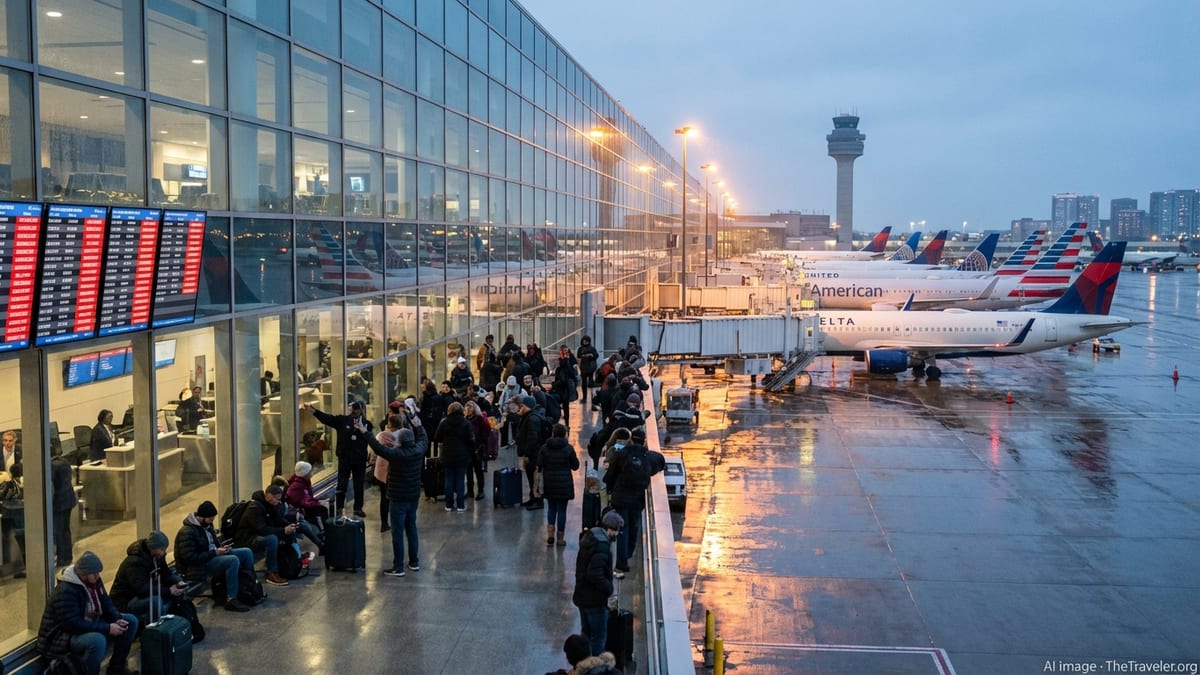
Shutdown-Driven Flight Cuts Collide With Peak Travel Demand
New federal data confirm what passengers felt in terminals throughout November: cancellations surged just as Americans prepared for some of the busiest travel weeks of the year. According to the latest Air Travel Consumer Report from the U.S. Department of Transportation, the nationwide cancellation rate jumped to 2.6 percent in November, more than quadruple October’s 0.6 percent and five times higher than the 0.5 percent recorded in November 2024.
The spike coincided with a 43-day federal government shutdown that began in early November 2025 and forced the Federal Aviation Administration to mandate capacity cuts at 40 of the country’s busiest airports. The directive ordered airlines to progressively trim domestic schedules during peak daytime hours, a move officials said was necessary to preserve safety amid mounting staffing shortages in air traffic control.
For travelers, the timing could hardly have been worse. AAA projected nearly 82 million Americans would travel at least 50 miles from home for the Thanksgiving period, including millions who had booked flights through key hubs such as New York, Washington and Atlanta. As airline operations were throttled back, the resulting wave of cancellations quickly turned into a nationwide test of patience and contingency planning.
Carriers struggled unevenly under the strain. The DOT figures show low-cost Allegiant posting one of the lowest cancellation rates in November, while major network airlines such as American and United saw rates climb above 3 percent, reflecting the outsized impact on large hub operations.
New York Airports Become a Bellwether for National Disruption
Nowhere did the change feel more immediate than in the New York area, where LaGuardia, John F. Kennedy International and Newark Liberty form one of the world’s densest air corridors. LaGuardia in particular was singled out in early November reports as a case study in how even a single-digit cut in scheduled flights can throw a tightly wound system off balance.
On November 7, as the first phase of the FAA’s order took hold, the Department of Transportation confirmed that LaGuardia was among the high-volume airports seeing a 4 percent reduction in flights, set to ratchet up to 10 percent within a week if the shutdown persisted. By midday that Friday, more than 800 flights had been canceled across the United States, including around 20 at LaGuardia alone, according to flight-tracking services widely cited by broadcasters.
Inside terminals, the impact translated into long rebooking lines, rolling gate changes and a pervasive sense of uncertainty as travelers tried to make sense of which flights were protected and which might fall victim to capacity limits. Airlines emphasized that not all cancellations were directly tied to the FAA’s order, pointing to ordinary operational challenges and weather, but acknowledged that the mandated cuts forced them to redraw schedules day by day.
For New York travelers, the core frustration lay in the knock-on effects. With capacity capped during the busiest daytime hours, even minor delays had fewer options for recovery. As aircraft rotated through the network, disruptions in New York rippled outward, contributing to missed connections and overnight stays in cities far from the original shutdown flashpoints.
Washington Hubs Strain Under Policy and Perception Pressures
In the Washington region, where policy decisions and their consequences are often separated by only a few miles of airspace, the November cuts carried symbolic and practical weight. Ronald Reagan Washington National and Washington Dulles International both fall within the group of core high-traffic airports subject to the FAA’s capacity restrictions, placing the capital’s primary air gateways squarely in the middle of the crisis.
As the shutdown dragged on, reports of controllers working without pay, rising fatigue and higher absence rates helped explain why federal officials were reluctant to keep operating at full tilt. Aviation unions repeatedly warned that stretching diminished crews to handle pre-shutdown traffic levels could erode safety margins, lending urgency to the FAA’s decision to lower the ceiling on scheduled flights.
The Washington cancellations created their own feedback loop of public pressure. Lawmakers shuttling between their home states and the capital encountered the same snarled itineraries as their constituents, amplifying political attention on the disruption. Each day that passed with more than 1,000 flights scrapped nationwide, according to industry tallies, added to the narrative of a system under strain and a shutdown whose effects reached far beyond federal office buildings.
For passengers transiting Washington’s hubs, the uncertainty translated into adjusted plans and backup options. Travel advisers urged flyers to build in extra connection time, favor early-morning departures less vulnerable to rolling delays, and keep a close eye on airline apps to track whether an inbound aircraft ever left its prior city.
Atlanta’s World-Busiest Hub Feels the Full Force of Capacity Cuts
In Atlanta, home to Hartsfield-Jackson Atlanta International, the world’s busiest airport by passenger volume, the FAA’s 10 percent capacity reduction order landed with particular force. On November 10, local outlets reported hundreds of delays and cancellations in a single day, with flight-tracking data showing more than 370 delays and more than 200 cancellations by midafternoon.
The structure of Atlanta’s traffic made it especially susceptible to mandated cuts. As a dominant connecting hub for domestic and international routes, even a modest percentage reduction translated into large numbers of individual flights. When airline planners trimmed schedules to comply with the FAA directive, they were forced to make difficult choices about which regional links to pare back, often stranding travelers who relied on single daily departures to smaller cities.
Travel experts advising Atlanta passengers stressed the importance of closely following the specific aircraft assigned to each itinerary. By tracking tail numbers in real time, flyers could get an early indication of trouble if an incoming plane appeared delayed or grounded at a prior station, offering a narrow window to rebook before seats disappeared.
For many, however, those workarounds offered limited comfort. Crowded concourses, rolling cancellations and tight hotel availability around the airport underscored how little slack exists in a network built for efficiency rather than resilience. As one of the central nodes in that network, Atlanta’s struggles served as a visible barometer of stress across the entire system.
Traveler Anxiety Grows as Winter and Future Holidays Loom
Even as airlines and regulators emphasize that November’s cancellation spike was driven by the extraordinary circumstances of a government shutdown and temporary flight caps, the episode has sharpened traveler anxiety heading into future peak periods. The combination of heavier demand, leaner staffing and tighter schedules has raised questions about how well the system can absorb shocks, whether from policy disputes, weather or technical failures.
Industry analysts note that, while the November cancellation rate of 2.6 percent remains well below the worst days of the pandemic or major storm seasons, the rapid jump from October highlights how quickly performance can erode when operational margins narrow. With carriers still working to rebuild crews and ground operations after years of volatility, recovery from large-scale disruptions can be uneven and prolonged.
Travel organizations are responding by urging passengers to adopt more conservative planning habits. Recommendations include booking nonstop flights when possible, choosing morning departures, and avoiding tight connections at pressure-point hubs such as New York, Washington and Atlanta during busy weeks. Some travelers are also shifting to earlier departure days around major holidays in the hope of sidestepping the worst of potential backups.
For millions who endured November’s wave of cancellations, though, the immediate concern remains getting confidence back in the system. Whether that reassurance comes from political compromise, additional staffing or new operational safeguards, the experience in New York, Washington and Atlanta has made clear that America’s busiest hubs are only as reliable as the policies and people that keep their skies moving.