

More news on this day
Nowruz 2026, the Persian New Year that usually fills streets and homes from Tehran to Iraqi Kurdistan with flowers, fire and family gatherings, is unfolding this year under the shadow of runaway inflation, war-related anxieties and an unprecedented security crackdown that has left celebrations muted and deeply politicized.
Get the latest news straight to your inbox!
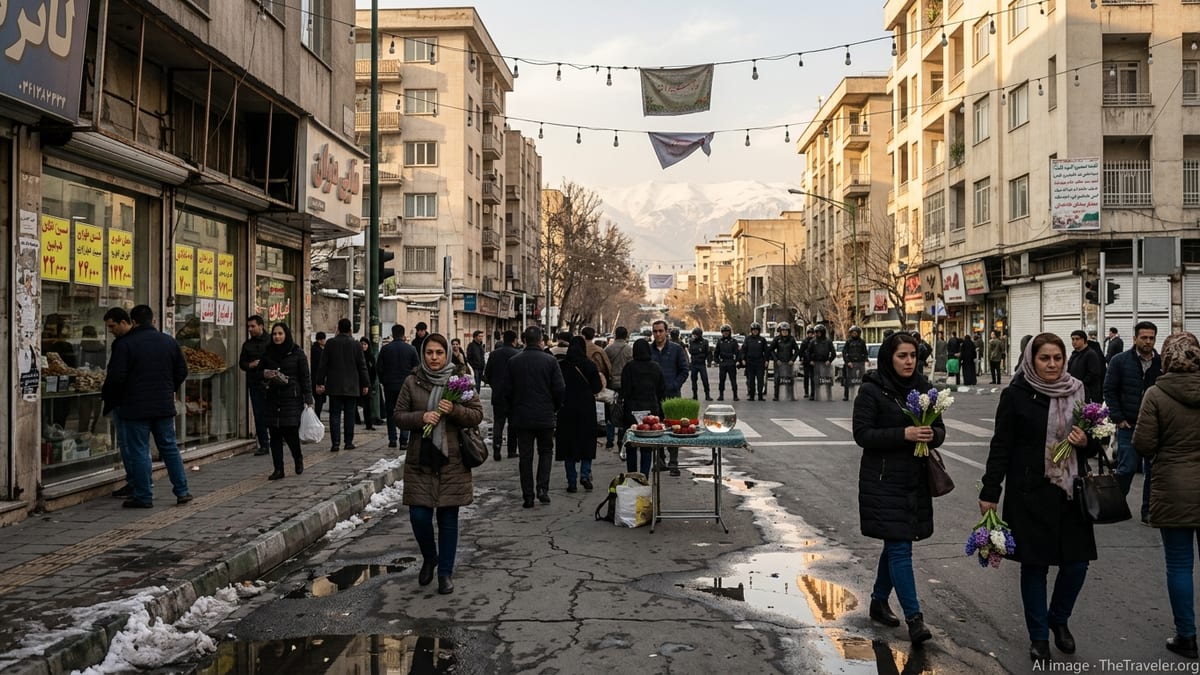
A New Year Arrives Amid War and Economic Freefall
This year’s Nowruz comes just weeks after some of the deadliest phases of the 2025–2026 protest wave in Iran and during an ongoing regional war that has helped push prices to historic highs. Publicly available economic data show point-to-point inflation in Iran above 68 percent in February 2026, with food costs nearly double what they were a year earlier, hollowing out household budgets just as families traditionally stock up on sweets, nuts, new clothes and gifts.
Reports from inside Iran describe shoppers in Tehran’s once-bustling bazaars thinning out in the run-up to New Year, with many households scaling back the ceremonial Haft-Seen table or skipping nonessential items altogether. Commentaries by Iranian and diaspora media indicate that even modest Nowruz staples, from pistachios to green herbs, have become luxury goods for large parts of the population.
The pressure is compounded by a steep devaluation of the rial since mid-2025 and the economic disruption of the Iran war, which has driven up energy costs and further shaken investor confidence. Analysts note that stagnating growth, high unemployment and a long-running crisis of mismanagement have collided with new sanctions and war-related shocks, leaving the country’s middle and working classes with little room to participate in the usual holiday spending.
For many Iranians, the traditional symbolism of Nowruz as a time of renewal and hope now contrasts sharply with daily realities of unpaid wages, rising rents and shrinking access to basic goods. Social media posts and diaspora reporting describe a widespread sense that this new year feels less like a fresh start and more like a continuation of crisis.
Security Clampdown and a Muted Public Holiday in Tehran
Alongside economic strain, Nowruz 2026 is shaped by a heavy security presence across Iran’s major cities. The 2025–2026 protest movement, which began over economic grievances and quickly broadened into a challenge to the political order, has been met with a lethal crackdown documented by human rights groups and international organizations. Thousands have been killed and tens of thousands detained in recent months, according to rights-monitoring tallies cited in global media coverage.
Authorities have in previous years treated seasonal gatherings as potential flashpoints for dissent, and this year appears no different. Online reports and leaked circulars shared by activists suggest that police and paramilitary units have been deployed near popular parks, squares and bridges in Tehran where families typically gather for picnics, fireworks and public festivities during the holiday period.
New restrictions on cultural heritage sites underscore the tense mood. In recent days, Iran-focused monitoring channels have circulated statements from cultural officials announcing the closure of prominent historical complexes and museums to Nowruz ceremonies in 1405 on the Iranian calendar, citing the “current situation of the country.” Among the locations mentioned are iconic tourist draws such as the Tomb of Hafez in Shiraz and Persepolis, sites that in calmer years are focal points for New Year visits and domestic tourism.
The closures effectively remove some of the country’s most symbolic public stages for shared national celebration, while a lingering nationwide internet blackout and rolling connectivity disruptions, imposed in January and maintained in varying forms since, limit Iranians’ ability to share images of any remaining festivities or organize collective events.
Newroz in Iraqi Kurdistan: Celebration in the Shadow of Crackdowns
Across the border in northern Iraq, Kurdish communities are marking their own New Year, Newroz, with bonfires, traditional dress and mass gatherings in the mountains and on city outskirts. Photo reportage from the Kurdistan Region of Iraq shows large crowds turning out in Erbil and other cities, even as celebrations unfold against the backdrop of the regional war involving Iran, the United States and Israel.
For many Kurds, Newroz is both a spring festival and a symbol of resistance and cultural identity. Rights organizations and diaspora groups have long documented arrests and intimidation of Kurds inside Iran for participating in similar Newroz events, including detentions of cultural and language activists. Recent monitoring by Kurdish-focused outlets highlights that dozens of Kurds from Iran’s western provinces have been killed in the security forces’ response to the broader protest movement over the past year.
This contrast is particularly stark in 2026. While Kurds in Iraqi cities light fires and carry flags relatively openly, Kurdish-majority regions inside Iran face intensified surveillance and tighter controls on travel and assembly around the holiday period. Commentators note that cross-border family ties mean many households in Iraqi Kurdistan are celebrating while also mourning relatives or friends affected by repression just over the frontier.
Travel within the wider region is also constrained by the war and economic instability, limiting the usual flows of visitors between Iran, Iraq and neighboring countries for New Year breaks. Tourism operators in Iraqi Kurdistan have promoted domestic Newroz packages, but industry observers suggest that uncertainty over security and the conflict’s trajectory is dampening demand from international travelers.
Diaspora Communities Balance Tradition and Solidarity
Outside the region, Iranian and Kurdish diaspora communities from Los Angeles to London and Toronto are marking Nowruz and Newroz with a mix of grief and determination. Coverage by international outlets describes smaller or more somber gatherings than in previous years, alongside charity drives and political rallies aimed at drawing attention to the situation in Iran.
Many established community events abroad, including large city-sponsored festivals and concerts, have been reframed as opportunities to highlight human rights concerns. Organizers emphasize that while music, dance and the Haft-Seen are still present, programming increasingly includes moments of silence for those killed in protests, fundraising for medical and legal support, and speeches by activists and relatives of detainees.
At the same time, diaspora reporting suggests a strong desire to protect the essence of the holiday for younger generations. Families continue to prepare traditional dishes, exchange gifts and visit parks, seeking to maintain continuity with cultural practices even as they follow unfolding news from Iran. For some, celebrating Nowruz this year is described in public commentary as an act of cultural resilience rather than simple festivity.
Travel from the diaspora back to Iran for the holiday has been sharply curtailed, according to travel-industry observers, due both to safety concerns and to the practical impact of sanctions, currency volatility and flight disruptions linked to the Iran war. Many instead choose to gather in exile hubs, where Nowruz markets and pop-up stalls attempt to recreate the sensory landscape of a holiday that, in Iran itself, feels profoundly altered.
What Travelers and Observers Should Know in 2026
For international travelers, Nowruz has traditionally been a prime opportunity to experience Iran’s landscapes, historic cities and hospitality at their most welcoming. In 2026, however, multiple layers of risk and restriction reshape that picture. Governments in North America and Europe continue to advise against travel to Iran due to the war, the internal security situation and the risk of arbitrary detention, while many regional air routes have been reduced or rerouted.
Within Iran, closures of key cultural heritage sites during the Nowruz period, heightened security checks and possible flashpoints around protest anniversaries make independent tourism particularly challenging. Travelers and travel companies monitoring the situation point to the combination of internet disruptions, fuel price volatility and localized clashes as factors that can rapidly affect internal movement.
In Iraqi Kurdistan, Newroz festivities are still drawing domestic and regional visitors, especially to areas around Erbil, Duhok and Sulaymaniyah. Yet the proximity to conflict zones and the broader uncertainty created by the Iran war mean that security conditions can change quickly. Analysts recommend that any prospective visitors closely track official travel advisories and local media, and consider that even where celebrations are vibrant, they take place in a tense geopolitical environment.
For observers following from afar, Nowruz 2026 offers a window into how economic hardship and political repression are reshaping everyday life across Iran and among its neighbors. The spring equinox still arrives on schedule, and families still gather where they can. But this year, the holiday’s ancient themes of renewal, justice and the triumph of light over darkness carry an especially pointed resonance for those struggling simply to celebrate at all.