

More news on this day
Federal investigators are focusing on runway safety technology, air traffic control procedures, and ground vehicle movements after an Air Canada regional jet collided with an airport fire truck while landing at New York’s LaGuardia Airport, killing the two pilots and injuring dozens of people.
Get the latest news straight to your inbox!
What Investigators Have Confirmed So Far
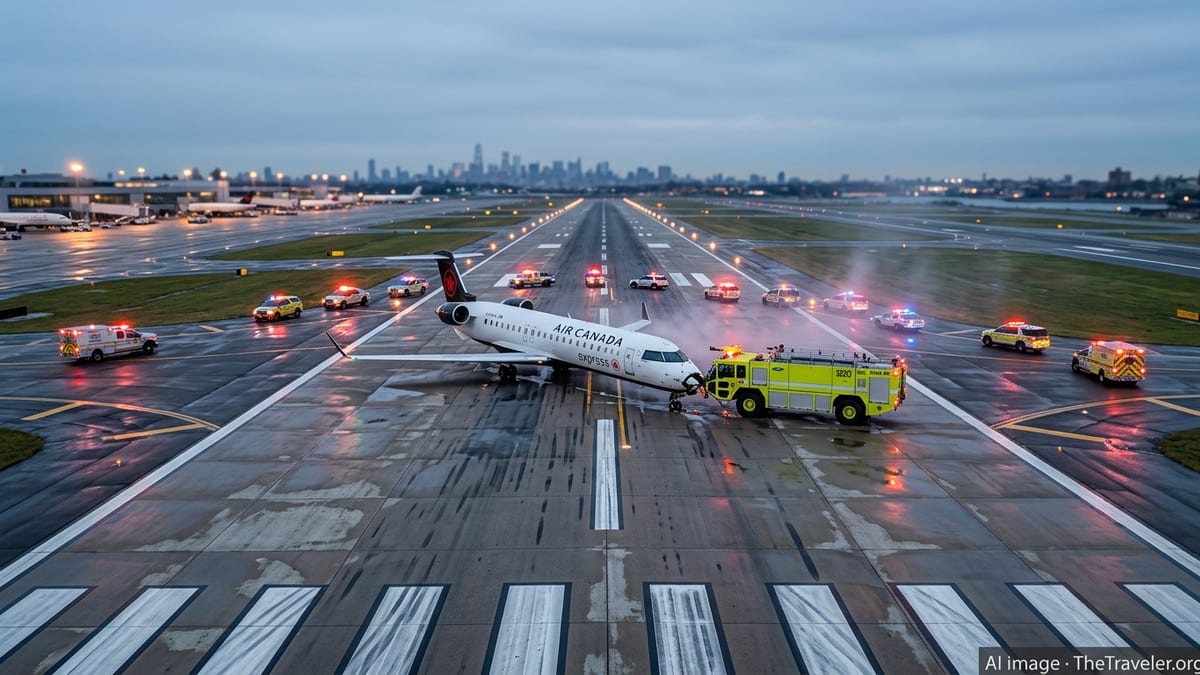
The collision occurred late on Sunday, March 22, when an Air Canada Express flight operated by Jazz Aviation from Montreal to New York struck an airport fire truck as it landed on Runway 4 at LaGuardia. Publicly available information indicates that the Bombardier CRJ900 was carrying more than 70 people when its nose section impacted the fire vehicle, destroying the cockpit and front galley.
Reports describe a chaotic scene as the aircraft skidded along the runway after the impact, with debris scattered across the touchdown zone and the forward fuselage crumpled around the fire truck. The two pilots were killed in the crash, while the cabin crew and passengers managed to evacuate using emergency slides amid smoke, fuel odors, and flashing emergency lights on the darkened airfield.
According to published coverage, at least several dozen occupants of the aircraft and the two people in the fire truck were transported to hospitals with a range of injuries. Many were treated and released within hours, while others remained under observation for fractures, burns, or internal trauma associated with high energy deceleration and the emergency evacuation.
Early summaries from aviation databases identify the occurrence as a ground collision involving Air Canada Express Flight 8646 and an aircraft rescue and firefighting vehicle that had entered the active runway shortly before the jet’s touchdown. The event is being noted as LaGuardia’s first fatal airliner crash in more than three decades and a rare example of a modern passenger jet colliding with an emergency vehicle on landing.
NTSB Briefing Highlights: Runway Warning System Under Scrutiny
At an initial briefing, the National Transportation Safety Board outlined several early findings that are shaping the direction of the investigation. Public statements from the agency indicate that LaGuardia’s runway status warning system did not provide an alert in the seconds before the aircraft and fire truck collided, despite both being on a collision course on Runway 4.
According to open reporting on the briefing, investigators believe the system failed to generate a warning because the fire truck was not equipped with the necessary transponder that would allow airport surface radar and related software to detect and track the vehicle on the runway. Without that electronic visibility, the system did not recognize the presence of a ground vehicle in the jet’s landing path.
Publicly available information from the briefing further indicates that one air traffic controller cleared the fire truck to cross the runway about 20 seconds before the collision, at a moment when the Air Canada jet was already descending through roughly 100 feet on final approach. Investigators are examining the sequence of radio calls, controller workload, and team coordination in the tower during the minutes leading up to the crash.
NTSB officials have also confirmed that the flight data recorder and cockpit voice recorder were recovered by cutting into the upper fuselage of the wrecked aircraft. These devices are expected to provide a detailed timeline of the jet’s speed, configuration, and crew actions, as well as cockpit conversations and radio transmissions that may illuminate how aware the pilots were of the ground vehicle ahead.
Focus on Ground Vehicles, Transponders, and Airport Procedures
The collision has quickly intensified attention on how ground vehicles are managed on busy runways and taxiways at major airports. Public safety and aviation experts quoted across multiple outlets are pointing to the lack of a transponder on the fire truck as a critical factor that limited both technological and human awareness of the vehicle’s exact position.
Runway incursion prevention systems rely increasingly on transponder signals from aircraft and equipped ground vehicles to generate alerts when something enters an active runway without proper clearance or remains there longer than expected. Without that signal, controllers may need to depend entirely on visual observation, radar returns that are not optimized for small vehicles, and the accuracy of verbal readbacks from drivers and flight crews.
According to published coverage, the NTSB is examining airport rescue and firefighting protocols, including how and when emergency vehicles are dispatched across active runways to respond to other incidents. Investigators are also expected to review training, route planning, and communication procedures that guide fire crews as they move rapidly across the airfield during time sensitive responses.
The investigation will likely consider whether it should become standard practice for all vehicles that operate near runways, including maintenance trucks and emergency equipment, to carry transponders compatible with airport surface surveillance systems. While such equipment represents an added cost, aviation safety specialists cited in public reports note that it could significantly reduce the risk of dangerous runway incursions in low visibility, at night, or during periods of high traffic.
Passenger Accounts and Operational Impact at LaGuardia
Passengers have begun sharing accounts of the moments after impact, describing the force of the collision, the smell of burning materials, and the rush to exit the cabin. According to reporting from major news outlets, some travelers unlatched overwing exits or moved toward the rear doors as soon as the aircraft came to a halt, while flight attendants attempted to direct people away from damaged areas at the front of the jet.
Publicly available information indicates that at least one flight attendant was thrown from the aircraft during the collision, highlighting the intensity of the deceleration forces experienced in the nose section. Other crew members reportedly assisted passengers who had fallen on the slides or were struggling to move across the debris scattered around the aircraft on the runway.
The crash forced the closure of LaGuardia’s Runway 4 for an extended period while investigators documented the wreckage, collected perishable evidence, and arranged for the removal of the destroyed nose section and the damaged fire truck. Data from flight tracking services cited in news reports show that roughly one quarter of the airport’s flights were canceled or significantly delayed the following day, with some departures experiencing multi hour waits.
Despite the disruption, operations continued on other runways, and airlines began rerouting aircraft and crews to stabilize schedules. Travelers connecting through LaGuardia or arriving in the New York area faced longer journey times and last minute rebookings, adding to a broader pattern of travel frustration tied to winter weather, high demand, and infrastructure constraints at major hubs.
Broader Safety Context and What Comes Next
The LaGuardia accident comes against a backdrop of heightened concern about ground collisions and runway incursions in North American aviation. In recent years, the NTSB has opened multiple investigations into low speed impacts between taxiing aircraft at LaGuardia, as well as serious landing accidents at other airports involving similar regional jet models. These events have raised questions about controller workload, airport geometry, and the reliability of safety nets designed to prevent conflicts on the ground.
Aviation analysts note that while fatal accidents involving scheduled passenger flights in the United States and Canada remain rare, a cluster of high profile near misses and ground incidents has led to renewed scrutiny of how airlines, regulators, and airport operators manage risk. The LaGuardia collision is expected to become a central case study in that wider conversation, particularly because it involves both an airliner and an emergency vehicle performing a critical safety role.
The NTSB typically takes many months to move from an initial briefing to a comprehensive factual report and eventually to a set of formal safety recommendations. In this case, publicly available NTSB statements indicate that investigators will be looking closely at air traffic control communications, the configuration and maintenance of runway warning systems, vehicle transponder policies, crew training, and the decision making that led to a fire truck being cleared onto an active runway as a jet was landing.
For travelers, the investigation is a reminder that the safety architecture behind every takeoff and landing relies on layers of technology, procedure, and human judgment. As LaGuardia returns to a more normal operating rhythm, the findings from this crash are expected to influence how airports worldwide think about integrating ground vehicles into the same tightly controlled environment that governs the movements of commercial aircraft.