


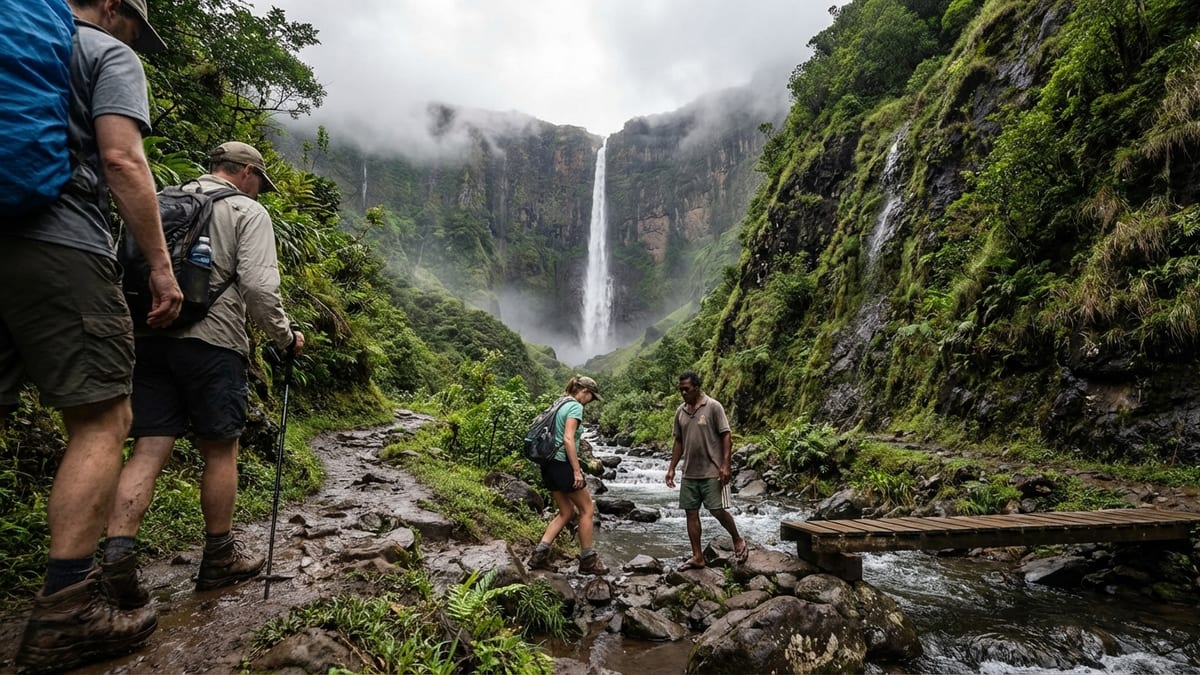
Nuku Hiva is the kind of place that still feels like the edge of the map. The largest of the Marquesas Islands in French Polynesia, it is a cathedral of basalt cliffs, drowned calderas and valleys so deep that waterfalls pour from the clouds. Here, nature remains firmly in charge.
Trails are little more than old footpaths, waterfalls boom inside narrow canyons, and small villages sit at the mouths of valleys that can only be reached by boat or on foot. For travelers willing to trade convenience for raw beauty, Nuku Hiva’s waterfalls and valleys offer one of the wildest landscapes in the Pacific.
A Land Shaped by Volcanoes and Ocean
Nuku Hiva rises abruptly from the Pacific like the broken rim of a colossal bowl. The island is the remnant of an ancient volcano whose caldera collapsed and flooded, leaving behind a double ring of mountains and a maze of valleys that radiate towards the sea. Sheer cliffs guard the coastline, cut only by steep-walled bays such as Taiohae and Hakatea. Inland, knife-edge ridges divide humid valleys where streams gather into cascades and waterfalls.
There are no coral lagoons and broad resort beaches here. Instead, the island’s drama comes from verticality. Basalt walls soar to more than 800 meters, their faces streaked with seasonal falls and cloaked in dense tropical vegetation. Ravines funnel clouds from the trade winds, making the interior surprisingly lush despite the island’s latitude. When heavy rain sweeps in from the east, waterfalls ignite almost everywhere, turning the valleys into amphitheaters of moving water.
This volcanic architecture shapes everything about how you explore Nuku Hiva. Roads follow the ridges, not the coast, and many of the finest valleys are accessible only by boat. Hiking routes often trace ancestral trails that once linked villages and ceremonial sites. To understand Nuku Hiva’s waterfalls is to understand how Marquesan communities have always navigated this raw and vertical world.
Vaipo Waterfall and the Mystery of Hakaui Valley
No feature embodies Nuku Hiva’s wildness more completely than Vaipo Waterfall, often cited as the highest waterfall in French Polynesia at about 350 meters. It plunges in a single horsetail drop at the closed end of Hakaui Valley on the island’s southwest coast, springing from a basalt cliff and dissolving into mist long before it reaches the boulder field below. On most days, you see Vaipo first as a white thread suspended between the amphitheater walls and the sky.
Hakaui itself is a deep, Y-shaped valley that cuts into the island’s double caldera. Steep green slopes hem in a narrow floor where breadfruit, banana, mango and taro grow around small family homes and archaeological remains. The valley opens seaward at Hakatea and Hakaui Bays, often collectively referred to as Daniel’s Bay, a sheltered anchorage that has long been a favorite of sailors and, more recently, small expedition ships.
Reaching Vaipo is part river trek, part cultural immersion. The hike is usually described as a moderately difficult to challenging out-and-back of roughly 8 to 9 kilometers, with multiple stream crossings and sections that can become muddy and slippery after rain. You follow a footpath shaded by banyan, mango and mape (Tahitian chestnut) trees, with the valley walls rising almost vertically on either side. As you walk, the soundscape shifts from surf and boat engines at Hakatea Bay to the layered calls of birds, cicadas and the distant thrum of water against rock.
The waterfall’s character changes with the seasons. During the wetter months, Vaipo can be a thundering column, filling the cirque with spray and echo, while in drier periods it may diminish to a slender veil that sometimes even dries up for stretches of the season. Either way, the setting is almost theatrical: basalt cliffs gleaming with moisture, ferns and mosses clinging to the walls, and clouds snagging on the rim high above.
On the Trail: How to Experience Hakaui and Vaipo
Most travelers begin their journey to Vaipo from the main village of Taiohae, where boats depart in the morning across the open bay and along the rugged southern coast. The ride, about 30 minutes in typical conditions, is part of the adventure. You pass vertical cliffs streaked with greenery, sea caves and the occasional blowhole before entering the narrow mouth of Hakatea Bay. Swells flatten as you slip behind protective headlands into a calm basin ringed by dark sand, jungle and improbably steep ridges.
From the landing spot, often a simple concrete steps or a stony beach depending on conditions, a path leads through coconut groves and lowland vegetation to the hamlet at the base of Hakaui Valley. This is more than just a trailhead; it is a living community. Many guided hikes are run by local families who welcome visitors onto their land, share stories and often offer lunch in simple open-air pavilions. Respectful behavior here is not optional but essential: you are crossing private and ancestral property, and informal permissions matter as much as any written rules.
Beyond the village, the path narrows as you enter the inner valley. The trail alternates between forest track and riverside route, requiring you to wade or rock-hop across the stream several times. Footbridges may appear or vanish depending on recent floods, and tree roots and stones can make footing tricky, particularly after recent rain. This is not a technically difficult hike for fit walkers, but it demands attention, proper footwear, sufficient water and a realistic sense of your own limits.
Near the head of the valley, the canyon closes in and the walls rise almost sheer. The trail may include brief sections where you scramble over boulders or skirt pools in the riverbed. At some point, the main path branches towards the viewpoint for Vaipo. Local guides are quick to explain where it is safe to go and where rockfall risk is too high. Most advise strongly against going directly under the waterfall or into the narrowest part of the amphitheater, especially in or after heavy rain, because of the danger of falling rocks and sudden surges of water.
Other Valleys and Hidden Cascades of Nuku Hiva
Although Vaipo takes much of the spotlight, Nuku Hiva is a network of valleys, many with their own streams, cascades and character. From the central plateau of Tovii, rainwater works its way down the flanks of old calderas into radial valleys that meet the ocean on every side of the island. Each valley has its own mix of ancient sites, small settlements and wild corners where water shapes the land in quieter, more intimate ways than Vaipo’s grand spectacle.
To the north, the road from Taiohae crosses the island’s interior and drops towards Hatiheu Bay, a deep indentation framed by jagged basalt pinnacles. Here, side valleys provide access to smaller waterfalls and freshwater pools favored by locals, especially in the hotter months. The combination of dramatic coastline and the sound of unseen falls higher on the slopes gives the area a particular intensity. Many guided excursions combine visits to Hatiheu with hikes into neighboring valleys, weaving together viewpoints, archaeological sites and short river walks.
Further east, the remote coast around Anaho Bay introduces yet another facet of Nuku Hiva’s hydrology. Reached by a steep footpath from the road above Hatiheu, Anaho is better known for its natural anchorage and sweeping beach, but freshwater streams filter down through the valley behind the coconut groves. After heavy rain, thin seasonal cascades appear on the back wall of the bay, briefly transforming the cliffs into a curtain of silver lines. They may not rival Vaipo in scale, yet the sense of being enclosed in a huge natural amphitheater filled with transient water is just as powerful in its own way.
On the western and southern coasts, lesser-known valleys such as Hakaui’s neighbors hide waterfalls that see far fewer visitors. Some are accessible only with local guides who know the unmarked paths and the shifting riverbeds. Others require multi-hour or multi-day treks that venture deep into the island’s interior, crossing saddle passes and ridgelines with vast views over the sea. For travelers used to established national-park style trail networks, Nuku Hiva’s system can feel improvised, but this is part of the allure: you are following routes that evolved from daily life and ancestral travel, not laid out for tourism.
Cultural Layers in the Valleys
The valleys of Nuku Hiva are not just natural corridors; they are also cultural landscapes dense with history. Long before European contact, Marquesan communities carved out flat platforms, known as paepae, in the valley floors and lower slopes as foundations for houses and meeting places. They built meae, sacred ceremonial sites, raised stone tikis and used caves for burials and spiritual practices. Water was central to that life, both as a practical resource and as a symbolic force connecting the highlands, the ancestors and the sea.
On the hike to Vaipo, and in several other valleys, you pass remnants of this layered past. Moss-covered platforms emerge beside the path, ancient walls thread through the undergrowth, and basalt tiki figures appear at the edges of clearings. Local guides often point out these features and explain their significance, turning what could be a purely scenic walk into an encounter with a living culture. Even seemingly simple details, such as the location of a breadfruit grove or the alignment of a terrace, can reveal generations of adaptation to the valley’s rhythms of water and soil.
Today, many families in the valleys combine subsistence agriculture and fishing with carving, tattooing and hosting visitors. Waterfalls play a practical role in irrigation and freshwater supply, but they also attract outsiders whose presence must be balanced against daily life. This is one reason why respectful conduct along the trails is so emphasized. Asking before photographing people, staying on agreed paths, accepting that some places are not open to visitors and supporting locally owned guiding services are all part of traveling responsibly through these valleys.
Religious practices in the Marquesas have woven together Catholic influence and older belief systems. In some valleys, shrines and crosses sit near pre-contact ceremonial sites, and it is not unusual to hear stories that blend saints and ancestral spirits. Waterfalls can be associated with both danger and blessing: places where rockfall and flash floods remind people of nature’s power, but also where land remains fertile and cool even in the hotter season. Listening to how locals talk about these places is often as memorable as the physical sight of the falls.
Climate, Seasons and Safety Considerations
Nuku Hiva sits in a tropical, oceanic climate zone, with temperatures generally hovering in the upper 70s and low 80s Fahrenheit throughout the year. The pattern that matters most to waterfall seekers is rainfall. Broadly, the wetter months bring more dramatic flows in waterfalls and greener valley walls, but they also increase the risk of slippery trails, swollen rivers and rockfall; the relatively drier periods often mean easier hiking conditions but may reduce some falls to fine veils or, in the case of Vaipo, cause them to be intermittent or even temporarily dry.
Regardless of season, weather can change quickly in the valleys. Clouds can gather over the interior while the coast remains bright, and rain swept in from the open Pacific can transform a gentle stream crossing into something more serious within an hour. When planning a hike, it is wise to talk with local guides or hosts the day before, ask specifically about trail conditions and heed advice to cancel or modify plans if the rivers are running high or if there is concern about landslides.
On the trail, simple precautions go a long way. Solid footwear with good grip is essential; the mix of mud, wet rock and roots makes basic sandals a poor choice for most valley hikes. Carry more water than you think you will need, along with sun protection and insect repellent, and avoid relying on untreated stream water even if it looks pristine. River crossings should be approached calmly and carefully, using trekking poles or a sturdy stick for balance where needed, and never attempted if the water is opaque, fast rising or higher than mid-thigh for the weakest member of the group.
Perhaps the most important safety principle is to respect the limits set by local knowledge. In Hakaui, guides have good reasons for advising visitors not to stand directly beneath the main drop of Vaipo: the amphitheater is confined, the rock walls shed debris, and even small rockfall can be lethal. Similarly, some side canyons and ledges may be considered unstable or culturally sensitive. Treat such advice not as optional caution but as part of the conditions of entry to these valleys.
Planning Your Trip: Logistics for Reaching the Wild
Because of its remoteness, Nuku Hiva rewards travelers who plan ahead while staying flexible on the ground. The island is served by flights from Tahiti via the small airport at Nuku Hiva’s interior plateau, followed by a curving drive down to Taiohae Bay, the island’s main settlement. Small guesthouses, pensions and a handful of hotels cluster in or near Taiohae, making it the natural base for excursions into the surrounding valleys and across the island.
Boat transfers are the key to reaching some of the most dramatic waterfall valleys. For Hakaui and Vaipo, arrangements are generally made the day before with boat operators based out of Taiohae’s fishing port. Seats can fill up when small cruise ships or sailing rallies are in port, so advance bookings through your accommodation or a local guiding company can reduce uncertainty. Travel light for the boat ride; sea conditions at the harbor mouth can be bumpy, and you will be stepping out onto a basic dock or beach at the other end.
Elsewhere on the island, a combination of four-wheel-drive vehicles and hiking opens up other valleys. Some travelers rent vehicles to explore the ridge roads independently, but many choose to join excursions run by residents who know not only the roads but the weather patterns, land ownership and current accessibility of specific trails. This is important, because a path that was easy a month ago may now cross a new landslide or a rerouted river channel after a storm.
Given the limited banking infrastructure in the Marquesas, it is prudent to arrive with enough local currency to cover excursions, meals and incidental expenses beyond what you have prepaid. Taiohae has a bank and cash machine, but smaller villages and individual guides may rely on cash payments only. For travel insurance and emergency planning, remember that Nuku Hiva hosts the main hospital of the archipelago, yet evacuation to Tahiti may be necessary for complex cases, so medical coverage that includes remote islands is advisable.
The Takeaway
Nuku Hiva is not a destination you simply check off a list; it is a place that asks you to slow down, adjust your expectations and accept a degree of unpredictability. Trails may be muddy, waterfalls may roar or whisper depending on the week, and plans may shift with the weather or the availability of a boat. Yet for those who give it time and attention, the island offers an immersion into a Pacific landscape that still feels unfiltered and deeply rooted in local life.
The waterfalls and valleys that pattern Nuku Hiva are more than geographical features. They are living corridors where water, culture and history converge, from the towering plume of Vaipo in its basalt amphitheater to the quieter streams and seasonal cascades hidden in less visited ravines. Walking through these spaces, often alongside local guides for whom each bend in the river carries a story, you begin to sense how the island’s vertical cliffs and flowing water have shaped both daily survival and spiritual imagination.
If you are willing to trade polished infrastructure for authenticity, and beach-bar sunsets for the shadowed light of deep valleys, Nuku Hiva can feel like the Pacific at its most elemental. Here, nature is at its wildest not in the sense of being untouched by people, but in the way that human presence and rugged environment still negotiate with each other on equal terms. For many travelers, that balance lingers long after the boat ride back to Taiohae and the flight out over the broken rim of the ancient caldera.
FAQ
Q1. How difficult is the hike to Vaipo Waterfall in Hakaui Valley?
The hike is generally rated as moderate to challenging, depending on your fitness and recent weather. Expect several hours of walking, multiple stream crossings, muddy sections and some uneven, rocky terrain. It is suitable for reasonably fit walkers who are comfortable on natural trails but not recommended for those with serious mobility issues.
Q2. Do I need a guide to visit Hakaui Valley and Vaipo Waterfall?
While very experienced hikers might attempt the route independently, going with a local guide is strongly recommended. The trail crosses private land, conditions change with floods and storms, and guides provide cultural context, safety advice and access arrangements with valley residents that you would not have on your own.
Q3. When is the best time of year to see Nuku Hiva’s waterfalls at their most impressive?
Waterfalls are generally fuller during wetter periods, when valley walls turn especially green and cascades increase in volume. However, those same months can bring heavier rain, muddier trails and higher rivers. If you prefer more stable hiking conditions, shoulder times between the wetter and drier phases can offer a good compromise, with sufficient flow and more reliable paths.
Q4. Can Vaipo Waterfall dry up?
Yes, Vaipo can diminish significantly or even temporarily dry up during prolonged dry spells. The valley remains a rewarding destination throughout the year because of its scenery, cultural sites and the experience of traveling there, but travelers should understand that the waterfall’s appearance varies with recent rainfall.
Q5. Are there other accessible waterfalls on Nuku Hiva besides Vaipo?
Yes, several other valleys on Nuku Hiva hold smaller waterfalls and cascades, some reachable by shorter hikes from coastal roads or combined with visits to bays such as Hatiheu and Anaho. Many of these routes are informal and best explored with local guides who know current access conditions and landowner permissions.
Q6. What should I wear and bring for a valley and waterfall hike on Nuku Hiva?
Wear sturdy hiking shoes or trail sandals with good grip, lightweight quick-drying clothing and a hat. Pack sufficient drinking water, sun protection, insect repellent, a light rain layer, snacks and, if possible, trekking poles for river crossings and steep sections. A dry bag or waterproof pouch is useful for protecting phones and cameras during boat transfers and stream wades.
Q7. Is it safe to swim near the waterfalls?
Swimming in pools along the valley can be pleasant in suitable conditions, but caution is essential. Never swim directly under tall waterfalls where rockfall is possible, avoid entering fast-moving currents and stay out of rivers during or just after heavy rain, when flash flooding can occur. Always follow your guide’s advice about where and when it is safe to enter the water.
Q8. How do I arrange a boat to Hakaui or other remote valleys?
Most travelers book boat transfers through their guesthouse, hotel or a local guiding company based in Taiohae. Boats typically depart from the fishing port in the morning and return in the afternoon. Because the number of boats and seats is limited, especially when small cruise ships are in port, reserving at least a day in advance is recommended.
Q9. What kind of physical condition should I be in to explore Nuku Hiva’s valleys?
To enjoy the main waterfall and valley hikes, you should be comfortable walking several hours on uneven ground, climbing short but sometimes steep sections and crossing shallow rivers. If you hike occasionally at home and can manage trails with roots, stones and modest elevation change, you will likely adapt well, provided you take your time and stay hydrated.
Q10. How can I visit Nuku Hiva’s waterfalls responsibly and respectfully?
Choose locally owned guides and services, ask permission before photographing people or homes, stay on established paths and heed requests regarding areas that are off-limits or sacred. Carry out all trash, minimize noise, avoid picking plants or disturbing archaeological remains, and remember that you are a guest in both a powerful natural environment and a living cultural landscape.