

More news on this day
New York City awoke Monday to an eerie quiet as a historic blizzard transformed the world’s busiest air corridor into a no-fly zone, shuttered streets under a sweeping travel ban and left millions of residents and visitors stranded in place, watching and waiting for the storm to loosen its grip.
Air Travel Collapse as Storm Hernando Slams the Northeast
By Monday, February 23, Winter Storm Hernando had effectively shut down New York City’s air gateways, with John F. Kennedy International, LaGuardia and Newark Liberty operating in name only as nearly all commercial flights were canceled. Flight tracking data showed that more than 10,000 flights across the United States had been scrapped through Tuesday, with New York, Boston and Philadelphia bearing the brunt of the disruption as the blizzard intensified along the Northeast corridor.
At LaGuardia, cancellations approached a virtual standstill, with close to 100 percent of departures and arrivals wiped from the boards as plows fought to keep runways and taxiways clear of fast-accumulating, wind-driven snow. John F. Kennedy International was only marginally better, with close to nine in ten flights canceled and crews focused on emergency operations and de-icing rather than routine passenger service. Newark Liberty reported similar numbers, effectively closing off the region’s tri-state air network to all but essential and diversion traffic.
Airlines moved quickly to extend weather waivers, allowing passengers to rebook trips into late February without change fees, but that did little to help those already en route. With snow bands dumping up to 3 inches an hour and crosswinds gusting past safe operating thresholds, pilots and controllers had little choice but to keep aircraft on the ground. Aviation analysts warned that the hangover for travelers would stretch well beyond the last snowflake, as equipment and crews displaced by the storm ripple through tightly choreographed schedules for days.
International carriers also pulled back sharply. Air India canceled all flights to and from New York and Newark for both February 23 and 24, citing heavy snowfall, poor visibility and severely constrained airport operations. Other foreign airlines followed suit with broad suspensions and schedule thinning, underscoring how a single weather system over the Northeast can reverberate through global networks from Europe to South Asia.
City Streets Fall Silent Under Rare Travel Ban
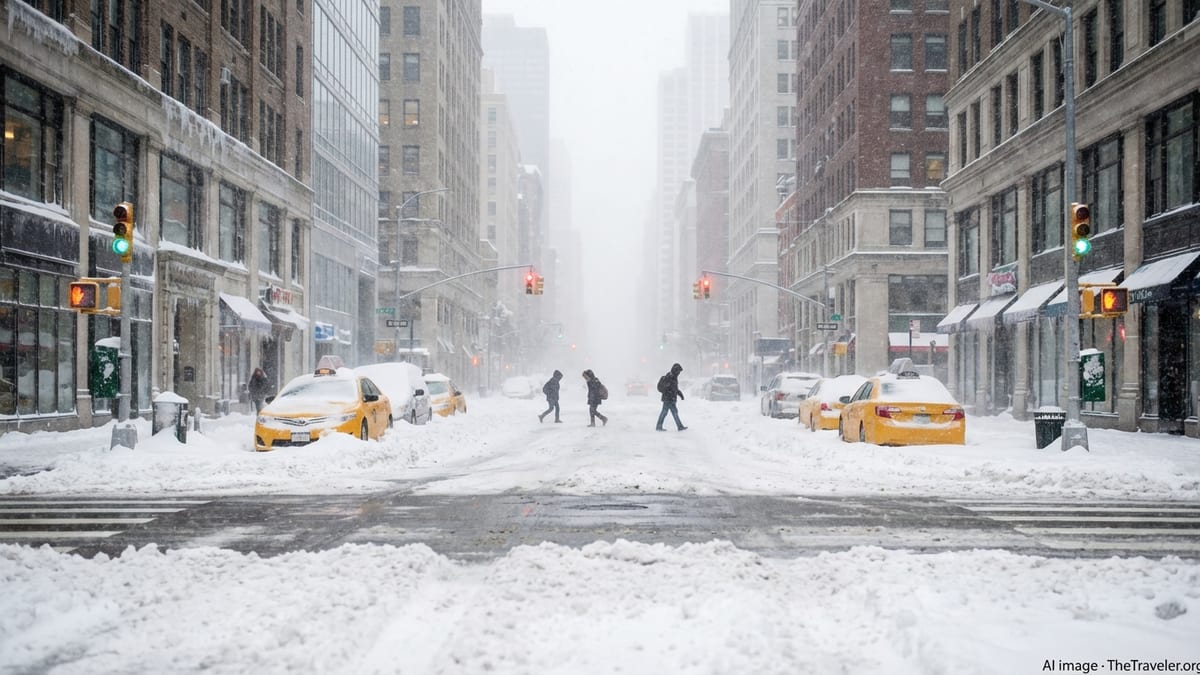
On the ground, New Yorkers confronted a city that felt more like a closed movie set than a global capital. Shortly after the first heavy snow bands began to wrap around the metropolitan area on Sunday evening, Mayor Zohran Mamdani declared a local state of emergency, followed by a sweeping ban on non-essential vehicle travel on city streets, highways and most bridges. The order took effect at 9 p.m. Sunday and was kept in place until shortly after midday on Monday, cutting road traffic to a trickle of emergency vehicles and snowplows.
The travel ban emptied iconic thoroughfares that are rarely still, even in the depths of winter. Overnight, Times Square’s neon shimmered onto nearly deserted sidewalks, as police cruisers and sanitation trucks became the only moving lights in the snow. Along Broadway and Fifth Avenue, wind-whipped drifts swallowed crosswalks and curb cuts, while parked cars disappeared under growing white mounds. For many residents, it was the quietest the city had sounded in years, broken only by the scrape of plow blades and the occasional wail of a distant siren.
Officials framed the restrictions as a life-saving measure designed to keep ambulances and fire engines moving and to reduce the risk of multi-car pileups on slick expressways. With visibility plunging in whiteout squalls and snow quickly outpacing even aggressive plowing operations, transportation leaders warned that any non-essential trip risked becoming a rescue mission. The city’s Department of Transportation reported scattered incidents of stranded vehicles early in the storm, but the travel ban helped prevent the kind of full-scale roadway gridlock that has accompanied past major snowfalls.
As the ban lifted, authorities urged residents to stay close to home unless absolutely necessary, noting that side streets and outer-borough arterials would take hours, if not days, to fully clear. Sidewalk conditions varied block by block, with some property owners out early shoveling and salting, and others still buried. The sense across the five boroughs was of a city hit with a forceful pause: no honking traffic jams, no gridlocked cabs, just the muffled sound of people slowly digging out.
Millions Stranded in Transit Hubs and Hotel Lobbies
The sudden halt in movement rippled through every layer of the travel ecosystem, trapping visitors in hotels, airport terminals and train concourses from Sunday night onward. At LaGuardia and JFK, passengers who had already checked in watched gate displays flip repeatedly from delayed to canceled, then finally to blank as airlines scrubbed entire waves of departures. Many hunkered down on terminal benches and gate-area floors, wrapped in winter coats and airport blankets, their plans reduced to monitoring power outlets and public address announcements.
With so many flights grounded simultaneously, nearby hotels filled quickly, leaving late-arriving travelers to reconfigure their itineraries on the fly. Some chose to claim their baggage and retreat into the city to wait out the storm, only to find limited taxi and ride-hail service and long lines at subway entrances. Others stayed airside, hoping to be among the first rebooked once aircraft could safely take off again. Airline call centers and apps were overwhelmed as customers across multiple time zones tried to secure alternative routes.
The rail and bus networks, often a safety valve when aviation seizes up, were also under strain. Amtrak curtailed service along parts of the Northeast Corridor as blowing snow and drifting reduced visibility and buried track switches. Several intercity bus operators suspended departures from the Port Authority Bus Terminal, leaving travelers who had hoped to bypass airport chaos facing their own round of cancellations. For many, the blizzard turned what should have been routine business trips, family visits or winter getaways into open-ended layovers with no clear departure time.
Inside the city, subway service operated at reduced frequencies on multiple lines as crews battled ice accumulation on elevated tracks and cleared snow from station entrances. Commuter railroads temporarily halted some branch lines into the suburbs during the heaviest bands, further complicating efforts for travelers trying to reach friends or relatives beyond the five boroughs. Transit officials emphasized that even once regular schedules resume, crowding and residual delays could persist as the system recovers from the shock.
Schools, Offices and Daily Life Put on Hold
The storm’s timing, hitting its peak as the workweek began, forced a broad shutdown of daily routines. City public schools were closed for what the mayor described as the first “old-school snow day” in several years, with remote learning largely bypassed in favor of a full pause. Many private and parochial schools followed suit, leaving playgrounds, campuses and college quads coated in untouched powder while children turned side streets and small parks into impromptu sledding hills.
Corporate offices across Manhattan and the outer boroughs leaned on remote-work infrastructure developed during the pandemic era. Major financial firms, law offices and media companies told staff to log in from home, easing pressure on the skeletal public transit service that continued to run. Smaller businesses with no such flexibility, particularly in hospitality, retail and food service, faced tough decisions about whether to open at all amid treacherous commutes and reduced foot traffic.
The hospitality and tourism sectors, already in their seasonal lull, were hit with a fresh setback as sightseeing tours, museum visits and Broadway performances were postponed or canceled. Visitors who had come to see a bustling winter cityscape instead found shuttered attractions and snow-clogged sidewalks. Yet in some neighborhoods, that same standstill created its own fleeting charm: neighbors gathered outside apartment buildings to share shovels and coffee, and the usually crowded waterfront promenades took on a calm unfamiliar to longtime residents.
City agencies expanded outreach to vulnerable residents, opening warming centers and increasing shelter capacity as temperatures stayed low and wind chills made prolonged outdoor exposure dangerous. Nonprofit organizations coordinated check-ins for older adults and those with limited mobility, many of whom were effectively homebound as long as sidewalks remained only partially cleared.
Power Outages, Coastal Flooding and a Region on Edge
Beyond the visual drama of towering snowbanks and silent avenues, the storm delivered tangible risks across the broader region. Strong winds and heavy, wet snow combined to topple trees and weigh down power lines from coastal New Jersey through Long Island and into southern New England. By Monday evening, hundreds of thousands of customers across the Northeast were without electricity, forcing utilities to dispatch repair crews into difficult and often hazardous conditions.
Along the shoreline, the blizzard arrived as a classic nor’easter, pushing water into bays and inlets and raising concerns over coastal flooding. Low-lying neighborhoods, particularly in parts of Queens, Staten Island and southern Brooklyn, saw rising tides lap at seawalls and spill across some local roads, even as snow piled up on nearby sidewalks. Emergency managers warned residents that while snowdrifts might be the most visible threat, a combination of storm surge and blocked storm drains could quietly flood basements and street-level businesses.
Hospitals and critical care facilities across the metropolitan area activated emergency protocols, ensuring backup generators were fueled and transport routes were coordinated with city agencies. Ambulance crews navigated narrowed streets and hidden patches of ice, while fire companies contended with buried hydrants and slowed response times. Officials repeated a familiar winter safety message: avoid using outdoor grills or generators indoors, check on neighbors, and limit time outside as wind chills approached dangerous levels.
Across the Mid-Atlantic and New England, governors declared states of emergency and requested federal assistance as forecasts pointed to continued blizzard conditions into Tuesday for some areas. For people in the path of the storm, the shared priority was simple but urgent: stay warm, stay inside and wait for conditions to improve enough for cleanup to truly begin.
How Long Will It Take Travel to Recover?
Even as skies begin to brighten, the travel system is likely to remain in disarray well beyond the last snow showers. Airlines face the complex task of repositioning aircraft and crews scattered by days of cancellations, rebuilding schedules while contending with gate and runway congestion at airports still in cleanup mode. Industry observers expect rolling delays and seat shortages to persist throughout the week, especially on heavily traveled routes along the East Coast and across the Atlantic.
Carriers have advised passengers not to head to the airport without confirmed, updated itineraries and have encouraged the use of mobile apps and text alerts to track last-minute changes. Many travelers, particularly those on long-haul or multi-leg journeys, are likely to accept re-routes through cities less affected by the storm, stretching already thin capacity at hubs in the Midwest and South. For those whose trips were time-sensitive, from business meetings to family milestones, the cost of the disruption will be measured in missed opportunities as much as in rebooking fees.
On the ground, the city’s own transportation network will also need recovery time. The Metropolitan Transportation Authority has warned that full service on commuter railroads and bus routes may not resume for several days, as crews focus first on clearing priority corridors and inspecting infrastructure for weather damage. Roadway authorities expect to face lingering patches of black ice and narrowed lanes even after the bulk of the snow is plowed, particularly on local streets lined with parked cars.
Travel experts say the storm is likely to reignite discussions around climate resilience in transportation planning, as severe weather events increasingly disrupt corridors once considered reliable. From hardened airport infrastructure and upgraded rail signaling to better real-time communication with travelers, Monday’s blizzard has underscored how quickly a modern, globally connected city can be thrown off schedule when nature asserts itself.
What Travelers Need to Know Right Now
For those currently in New York City or trying to reach it, the advice from officials and airlines is to plan for continued uncertainty. Prospective passengers are urged to verify the status of any flight before leaving home and to be prepared for long wait times on customer service lines as carriers work through a backlog of rebookings. Flexible itineraries and a willingness to accept alternate airports or dates can greatly improve the chances of getting moving again once operations restart.
Travelers already in the city are being encouraged to treat the enforced pause as an unexpected layover rather than a complete derailment. Hotels have reported a rise in extended stays, and some cultural institutions that are able to open safely are offering limited hours once travel bans lift. Local tourism officials note that, when conditions permit, New York under fresh snow offers a rare visual experience, from a white-blanketed Central Park to quiet side streets in neighborhoods usually packed with pedestrians.
Those with essential reasons to travel by road are advised to pack emergency supplies including warm clothing, water, nonperishable food and a fully charged phone, along with a shovel and traction aids in case of becoming stuck. Authorities stress that conditions can change abruptly as wind reshapes drifts and plows push snow back toward curbs and parked vehicles, making once-clear paths difficult to navigate within hours.
For millions of others, the safest and only option is patience. As plows, utility crews and airport workers labor in overlapping shifts to restore normal life, New Yorkers and visitors alike are left to watch from apartment windows, hotel lobbies and terminal seats. The city that rarely sleeps has, for a brief and disorienting moment, been forced into stillness, waiting for the engines to spin and the streets to fill again once the blizzard finally passes.