

More news on this day
Thousands of travelers were stranded at New York’s LaGuardia Airport on Monday as a historic blizzard forced the cancellation of 1,034 flights and the near-total shutdown of air traffic across the New York region and other major U.S. cities, disrupting operations for Delta Air Lines, American Airlines, United Airlines, Southwest and other carriers.
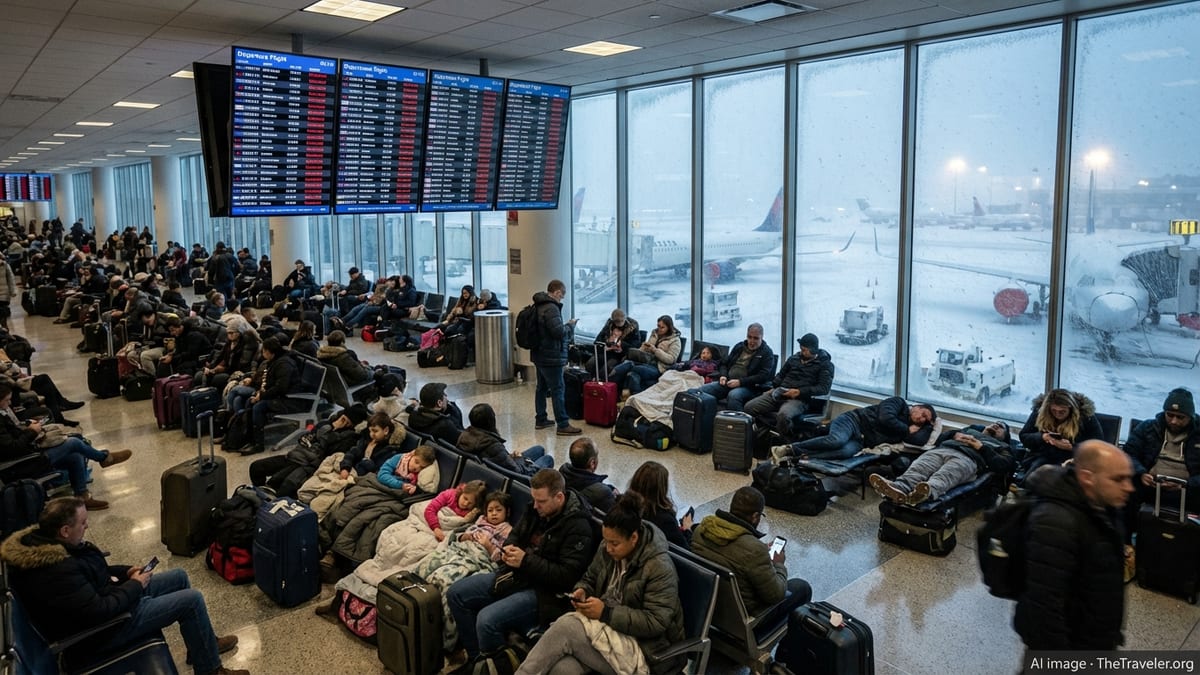
LaGuardia Becomes Epicenter of Nationwide Flight Chaos
New York’s LaGuardia Airport emerged as one of the hardest-hit hubs in the country as a powerful nor’easter, named Winter Storm Hernando, buried the city in heavy snow and high winds on February 23, 2026. Aviation data showed that 1,034 flights linked to LaGuardia were cancelled, with almost all remaining departures and arrivals scrubbed or already grounded as visibility dropped and runway conditions deteriorated.
Inside the terminal, rows of stranded passengers lined concourses as departure boards flipped steadily from scheduled to cancelled. Many had already spent the night on terminal floors or in chairs after preemptive cancellations on Sunday, only to learn on Monday morning that they would not be leaving New York any time soon. Airport staff rolled out extra cots and blankets, but food lines stretched around the concourses as concessionaires struggled to keep up with demand.
Port Authority officials said LaGuardia’s runways technically remained open, but described a situation in which severe crosswinds, rapidly accumulating snow and poor visibility made it unsafe for most aircraft to take off or land. Crews worked continuously to plow taxiways and de-ice parked planes, yet many aircraft remained frozen in position while operations teams focused on safety over schedule.
By midday, LaGuardia’s shutdown had rippled across the national network. Because the airport is a key domestic and short-haul hub, particularly along the busy Northeast corridor, the collapse of its schedule triggered secondary delays and cancellations from Chicago and Atlanta to Miami and Dallas as planes and crews failed to arrive where they were needed.
Major U.S. Airlines Halt Schedules and Activate Waivers
Delta Air Lines, American Airlines, United Airlines, Southwest Airlines and JetBlue all reported major disruptions as the storm intensified over New York and neighboring states. At LaGuardia, Delta and American saw the bulk of their Monday schedules effectively wiped out, while United and Southwest redirected or cancelled flights that would normally connect through New York and other snowbound hubs including Boston, Newark and Philadelphia.
Airlines moved quickly to activate large-scale travel waivers for customers booked to and from the Northeast. Delta, American and United offered passengers the option to change their itineraries without fees, often waiving fare differences for near-term rebookings, while Southwest and JetBlue allowed customers to shift travel dates or destinations across broad swaths of the storm-affected region. In many cases, travelers also had the option to cancel and request full refunds if their flights were cancelled outright or significantly delayed.
Operationally, carriers opted for mass cancellations instead of incremental delays, a strategy they have increasingly adopted in the post-pandemic era during severe weather. By cancelling flights a day or more in advance, airlines aimed to avoid situations in which passengers boarded aircraft only to sit through hours-long tarmac delays. The approach also helps protect crew schedules and aircraft positioning, though it leaves airports like LaGuardia looking eerily quiet despite being filled with stranded travelers.
Even airlines less exposed to the New York market were not spared. Southwest, which has a stronger presence at Baltimore, Chicago Midway and Denver, reported widespread knock-on delays as ground stops and air traffic flow restrictions in the Northeast forced national schedule adjustments. Low-cost and regional carriers faced similar challenges, with some suspending operations entirely at New York area airports until conditions improved.
Blizzard Conditions Turn New York Region Into a No-Fly Zone
The cascade of cancellations at LaGuardia unfolded against the backdrop of a powerful winter storm that forecasters had warned could be one of the most significant blizzards to hit the Northeast in years. By early Monday, blizzard warnings extended from the mid-Atlantic through New England, with New York City seeing snowfall rates of 2 to 3 inches per hour at times and wind gusts in excess of 35 miles per hour.
City officials declared a state of emergency over the weekend, imposing a temporary travel ban on nonessential vehicles that lifted only around midday Monday. Even as roads slowly reopened, authorities urged residents to stay home, warning that whiteout conditions and drifting snow continued to make travel hazardous. At the airports, those same conditions left snowplows and de-icing crews locked in a race against the weather as snow quickly refilled cleared areas.
Across the wider region, the storm brought near-record disruption. John F. Kennedy International Airport and Newark Liberty International Airport each recorded hundreds of cancellations, with some reporting that virtually all flights were halted for large parts of the day. Boston Logan and Philadelphia International, key connecting hubs for both domestic and transatlantic routes, also saw a majority of scheduled flights scrubbed.
Nationally, flight-tracking services reported that more than 5,000 flights within, into or out of the United States were cancelled by late morning, with thousands more delayed. That total continued to climb into the afternoon as airlines extended their shutdowns at LaGuardia and other Northeast airports and preemptively cancelled Tuesday morning services in anticipation of lingering snow, ice and high winds.
Stranded Travelers Face Long Lines, Limited Options
For passengers at LaGuardia and other New York airports, the statistical totals translated into an exhausting, often confusing ordeal. Families with young children napped on coats spread across terminal floors, business travelers searched for power outlets to keep phones and laptops charged, and international visitors tried to navigate a flurry of changing flight statuses and rebooking notices on airline apps.
Many travelers learned of cancellations only after arriving at the airport, despite repeated warnings from airlines and the Port Authority to check flight status before leaving home or hotels. Once inside, customer service counters for Delta, American, United and other carriers quickly filled, with some passengers reporting wait times of several hours to speak with an agent in person. Phone helplines and online chat channels were similarly overwhelmed as rebooking demand surged nationwide.
Hotel rooms near LaGuardia and other area airports quickly sold out or became prohibitively expensive, leaving a significant number of passengers to camp overnight in terminals. Airport staff distributed blankets and worked with concessionaires to keep food service operating into the night, but many travelers said they faced long lines for basic items. While some nearby hotels operated courtesy shuttles through the storm, many suspended service during the worst of the conditions, limiting options for stranded visitors unfamiliar with the area.
With airlines warning that it could take days to fully restore schedules and reposition aircraft and crews, some passengers chose to abandon air travel altogether, renting cars or booking seats on trains and long-distance buses. However, those alternatives were constrained as well, with icy highways, reduced train frequencies and weather-related bus cancellations limiting capacity for last-minute travelers.
Ripple Effects Felt Across Major U.S. Cities
Because LaGuardia functions as a crucial link in the domestic aviation network, Monday’s shutdown quickly sent shockwaves through airports far from the storm center. Short-haul flights connecting New York with Washington, D.C., Boston, Chicago, Atlanta and numerous mid-sized cities along the East Coast and in the Midwest were among the first to be cancelled, knocking out connections for travelers whose journeys neither began nor ended in New York.
At Chicago O’Hare and Atlanta’s Hartsfield–Jackson, two of the country’s busiest hubs, arrival banks from the Northeast thinned dramatically as aircraft bound from LaGuardia, JFK, Newark and Boston never departed. That forced airlines to consolidate passengers onto remaining flights and, in some cases, cancel onward legs that depended on incoming aircraft. Travelers in warm-weather destinations such as Orlando, Tampa and Miami also saw New York-bound flights cancelled, as carriers sought to avoid sending planes into airports they knew could not accept them.
The disruption extended beyond the continental United States. Some transatlantic services that typically route through New York or Boston were delayed or rerouted through alternative hubs such as Toronto, Montreal or Washington Dulles. In a few cases, carriers cancelled flights entirely, advising passengers to rebook on later departures once ground operations in the Northeast could safely resume.
Industry analysts noted that while large-scale winter weather events have always been a challenge for airlines, the increasingly interconnected nature of modern route networks amplifies the impact. A single day of cancellations focused on LaGuardia and neighboring airports can reverberate through the system for several days, particularly when aircraft and crews are stranded out of position.
Airlines and Regulators Emphasize Passenger Rights
As frustration mounted in terminals, officials urged travelers to understand their rights when flights are delayed or cancelled. Under U.S. Department of Transportation regulations, passengers are entitled to a full refund if their flight is cancelled and they choose not to travel, even if the cause is severe weather rather than an airline-controlled issue. This applies not only to the base fare but also to ancillary fees such as seat selection and baggage charges for the cancelled trip.
Consumer advocates reminded passengers that they are not required to accept vouchers in place of cash refunds, although many airlines promoted travel credits as a flexible option for customers who intend to fly at a later date. For those able to reschedule, airline-issued waivers allowed changes without typical penalties, while some travel insurance policies and premium credit cards offered coverage for unexpected expenses such as additional hotel nights, meals and ground transportation.
Regulators and airport authorities also highlighted safety considerations as the primary driver of the mass cancellations. With blizzard conditions making runway surfaces difficult to keep clear and crosswinds exceeding aircraft limits, the Federal Aviation Administration implemented a series of traffic management initiatives that slowed or halted arrivals and departures into the New York region and other affected hubs. These measures, officials stressed, are designed to prevent more dangerous scenarios, such as aircraft being forced to divert mid-flight or circle in poor weather while waiting for a landing slot.
Despite those reassurances, many stranded travelers expressed frustration over communication gaps, particularly around rolling estimates for when operations might resume. Some reported receiving text messages or app notifications indicating that flights were still on time, only to see them cancelled minutes later, complicating efforts to plan alternative arrangements.
Slow Recovery Expected as Storm Moves Offshore
Meteorologists forecast that the heaviest snow bands would move offshore late Monday, with winds gradually easing overnight into Tuesday. However, aviation experts warned that passengers should not expect immediate relief once the skies clear. Snow and ice left on taxiways, runways and aircraft will require extensive cleanup, and airlines must navigate crew duty-time limits that restrict how long pilots and flight attendants can work in a given period.
At LaGuardia, airport managers signaled that a cautious, phased ramp-up of operations is more likely than a sudden return to normal. Early departures on Tuesday will likely be prioritized for aircraft and crews already on the ground in New York, with later flights added only as conditions and staffing allow. Travelers booked on early-week departures were urged to monitor their flight status closely and consider rebooking later in the week if their plans are flexible.
Across the broader U.S. network, carriers face the complicated task of repositioning aircraft that were stranded away from their usual bases when the storm swept through. Planes parked in the South and Midwest must be ferried back to the Northeast, while crews displaced by cancellations need to be reassigned and, in many cases, rested to comply with safety regulations. That process, experts said, can easily stretch for several days beyond the end of the storm itself.
For now, the thousands of travelers stuck at LaGuardia and other affected airports remain in a holding pattern of their own, watching departure boards and weather maps with equal intensity. How quickly they are able to resume their journeys will depend not only on the pace of snow removal and aircraft de-icing, but also on the ability of one of the world’s most complex air travel systems to reset after a rare, regionwide shutdown.