

More news on this day
Three of America’s most iconic destinations, New York City, Las Vegas and Honolulu, are entering 2026 under growing strain as booming visitor demand collides with limited space, stressed infrastructure and increasingly vocal residents, raising fears that a full-blown overtourism crisis is taking shape on U.S. soil.
Get the latest news straight to your inbox!
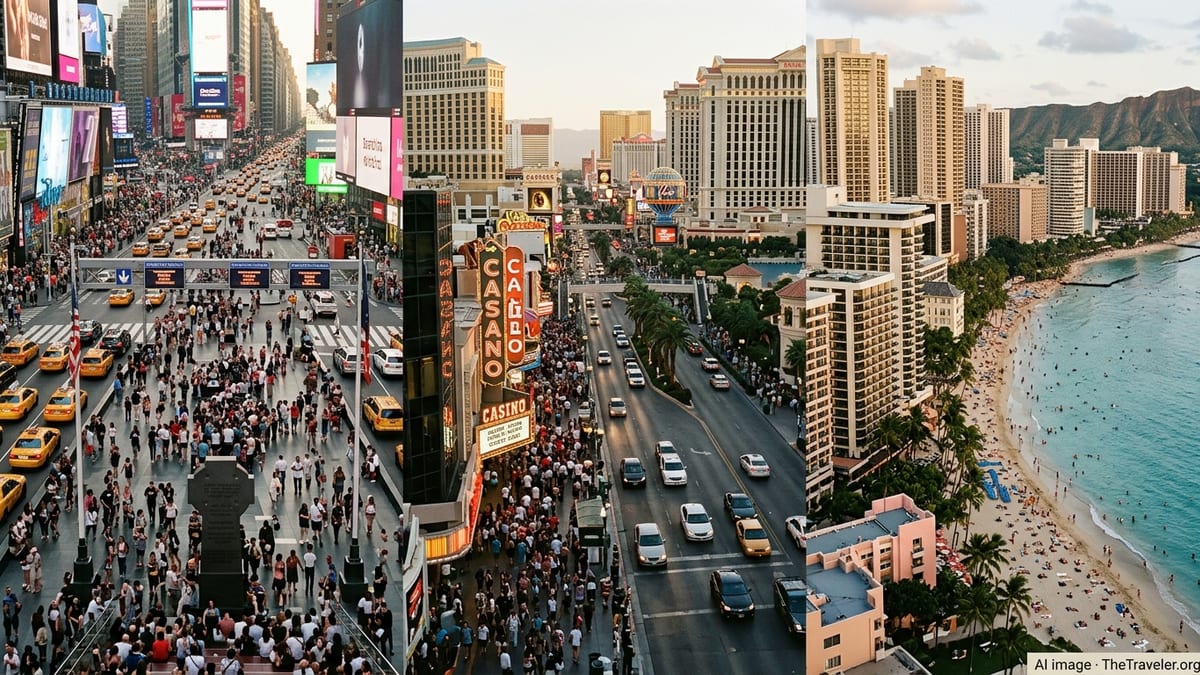
Record Crowds Meet Strained Streets and Services
For years, New York City, Las Vegas and Honolulu have chased visitor growth as a pillar of local economies. Pre-pandemic baselines were routinely used as a benchmark for success, and each destination has spent heavily on marketing, new attractions and hotel development. As international travel recovered and domestic leisure trips surged, all three cities again found themselves near or above previous peaks in visitor numbers, even as local infrastructure struggled to keep pace.
In New York City, tourism agencies reported that visitor volumes rebounded sharply by 2024 and 2025, with Midtown corridors such as Times Square returning to some of the densest pedestrian levels in the country. Publicly available information shows that the district remains one of the most visited urban attractions in the world, funnelling millions of people each year into just a handful of subway stations and sidewalks. Local coverage describes crowding on major avenues, persistent subway delays and pressure on sanitation and policing services as daily features of life in the core tourism zone.
Las Vegas has followed its own volatile trajectory. Visitor counts surged with the return of large-scale conventions, sporting events and new megaresorts, then softened in mid-2025 as higher travel costs and broader economic jitters set in. Reports from the Las Vegas Convention and Visitors Authority indicate that, even in months when arrivals temporarily dip, the Strip remains among the most heavily trafficked tourist corridors in the United States, with high hotel occupancy on weekends and major events packing casinos, sidewalks and ride-hailing queues.
Honolulu’s visitor numbers have trended steadily upward since travel restrictions eased, according to state tourism and airport statistics. Waikiki, with its dense strip of oceanfront towers, remains the focal point. Publicly available data and local reporting describe hotel occupancy rates that leave little slack in peak seasons, intensifying competition for road space, beach access and parkland between tourists and residents.
Policy Experiments: Congestion Pricing, Caps and Visitor Management
Against that backdrop, New York City has become a test case for managing intense visitor and commuter pressure in a tightly packed urban core. In January 2025, the city launched the country’s first full congestion pricing scheme, charging most vehicles entering Manhattan at or below 60th Street. Analyses by transportation researchers and economic institutes suggest that the program reduced peak-hour traffic volumes and raised average speeds in key corridors while generating billions of dollars in dedicated transit funding.
One year into the program, transportation and business trade coverage indicates that travel times into central Manhattan are down and bus trips have become more reliable. Environmental and health commentators have pointed to early signs of improved air quality near major arteries. At the same time, lawsuits from neighboring states and continued political debate show that the measure remains contentious, particularly among suburban drivers and outer-borough residents who see the tolls as unfair.
Honolulu has been experimenting with a different toolkit. Hawaii’s state and county governments have introduced and debated a mix of targeted visitor fees, stricter short-term rental enforcement and new reservation systems for popular natural sites. Local news reports describe pilot programs for managed access at beaches and hiking trails, along with higher parking fees at certain state parks. The intention, according to published coverage, is to limit the most intensive forms of day-use tourism, redirect visitors across a wider range of sites and secure new revenue to fund conservation and infrastructure.
Las Vegas faces a more complex balancing act. Nevada’s tourism machine has historically been oriented around volume, with the Strip only functioning profitably at large scales of foot traffic. Yet recent policy discussions in Carson City and Clark County have included measures to disperse crowds, address public safety and diversify the regional economy. Legislative debates over specialized courts for offenses on the Strip, as well as new investments in off-Strip attractions and sports facilities, suggest a shift toward managing the social and spatial impacts of mass visitation rather than simply maximizing head counts.
Local Backlash Grows as Residents Confront Daily Impacts
As visitor numbers surged back, residents in all three destinations increasingly voiced frustration over crowding, noise and rising costs. Neighborhood associations and community advocates in Manhattan’s core tourism districts have complained about packed sidewalks, tour buses idling on narrow streets and a sense that daily life is being reshaped around transient visitors. Opinion pieces in New York media have framed congestion pricing not just as a traffic measure but as a partial rebalance of space and resources away from private vehicles serving tourists and commuters.
In Honolulu, tensions have been especially visible in coastal communities outside Waikiki, where social media campaigns and grassroots groups have asked visitors to avoid certain areas at peak times or respect community-led guidelines. Public meetings documented in local coverage show long-term residents associating tourism growth with higher rents, displacement of local businesses and strain on limited freshwater and waste systems. The state’s moves to crack down on illegal vacation rentals and explore broader visitor management tools have been driven in part by this persistent community pressure.
Las Vegas presents a different set of complaints. While the Strip’s visitor density is high, many locals live in outlying neighborhoods and interact with the resort corridor primarily as workers or occasional visitors. Reports from Nevada-based outlets and civic groups highlight concerns over housing affordability, rising utility costs and infrastructure wear that residents link to the demands of a year-round tourism and events economy. At the same time, the city’s dependence on visitor spending for tax revenue and employment means that proposals to actively limit tourism face stiff resistance from business groups.
Across all three markets, a common theme is the perception that the benefits of tourism are unevenly distributed. Workers in hospitality and service sectors may see wages lag behind rising living costs, while small businesses away from the busiest strips sometimes feel overshadowed by global brands and large-scale developers that dominate visitor spending.
Climate, Infrastructure and the Limits of Growth
Climate stress is adding an extra layer of urgency to overtourism debates. Honolulu sits at the frontline of sea-level rise and coastal erosion, and state reports have warned that some of its most famous beaches are narrowing or require costly nourishment to remain usable. Popular hiking trails and marine ecosystems are also under strain from high visitor numbers, prompting scientists and conservationists cited in public summaries to call for tighter controls, seasonal closures or stricter enforcement of environmental rules.
Las Vegas, meanwhile, faces fundamental questions about water and energy in a desert environment. Regional water authorities along the Colorado River have spent years negotiating usage cuts, and although Las Vegas has made strides in indoor water efficiency and recycling, growth in visitor-serving pools, fountains and cooling demand continues to raise questions about long-term sustainability. Published assessments from regional planning agencies describe a need for transit upgrades, shade infrastructure and heat-mitigation strategies if the city is to safely host large numbers of outdoor events during hotter, longer summers.
New York City’s overtourism challenges are more closely tied to aging infrastructure and extreme weather. High subway ridership amplified by visitors places additional pressure on a system that already requires extensive capital investment. Heavy rains and coastal storms have produced recurring flash floods and disruptions that, according to municipal reports, are expected to worsen with climate change. Efforts to harden critical assets, elevate entrances and create new drainage capacity are being funded in part by revenues from congestion pricing and tourism-related taxes, but planners warn that timelines are long and costs are high.
In all three cities, the convergence of tourism growth and climate risk is prompting local governments and planning bodies to revisit long-standing assumptions about capacity. Rather than treating visitor numbers as an endlessly expandable metric, recent reports and strategy documents increasingly reference carrying capacity, resilience and quality of life as equal priorities.
The 2026 Question: Can Popularity Be Made Sustainable?
As 2026 unfolds, New York City, Las Vegas and Honolulu are emerging as case studies in whether major U.S. destinations can pivot from volume-driven tourism to a model that actively manages demand. Tourism boards continue to market aggressively, yet planning documents, academic research and civic debates now regularly entertain tools once considered politically unthinkable, from dynamic road pricing to hard visitor caps at sensitive sites.
Analysts writing in transport, urban planning and hospitality outlets note that the policy experiments under way are being watched closely by other U.S. destinations grappling with seasonal crowding, including national parks, coastal resort towns and fast-growing Sun Belt cities. If congestion pricing in Manhattan remains durable, or if Honolulu can successfully implement targeted fees and access limits without deterring higher-spending, longer-stay visitors, similar strategies may migrate elsewhere.
At the same time, advocates caution that overtourism is not just a technical problem to be solved with new tolls or ticketing systems. Underlying issues of housing affordability, labor conditions and environmental justice run through the debates in all three cities. Without addressing these deeper structural questions, critics warn that new rules could simply redistribute burdens from one group of residents to another.
For now, New York City, Las Vegas and Honolulu remain magnets for travelers from around the world, even as they test the boundaries of how many visitors their streets, ecosystems and communities can comfortably absorb. The choices they make over the next few years are likely to shape not only the visitor experience in these marquee destinations, but also the broader global conversation about what sustainable tourism really looks like in an era of climate and economic uncertainty.