

More news on this day
New York City ground to a near standstill Sunday night as Mayor Zohran Mamdani ordered nonessential vehicles off the roads and declared a local state of emergency, warning that a “potentially historic” blizzard could bury the nation’s largest city under up to two feet of snow and bring whiteout conditions through Monday.
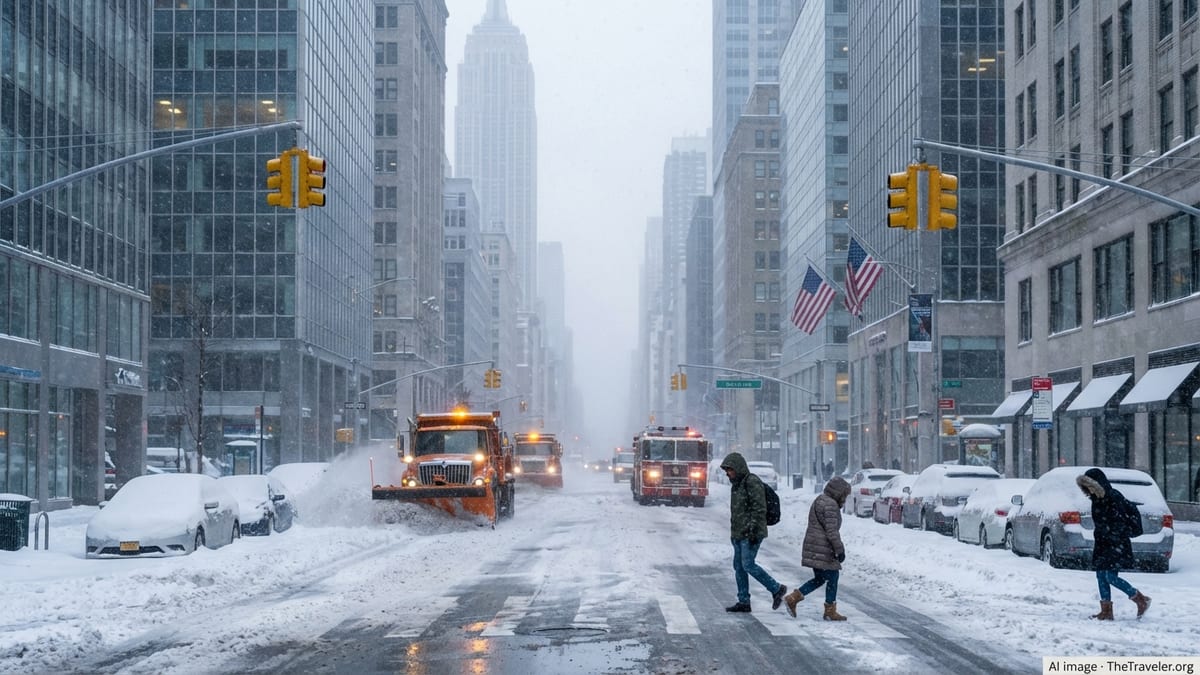
Citywide Travel Ban Freezes Traffic in a City That Never Stops
Under the emergency order, New York City streets, highways, bridges and tunnels are closed to almost all vehicular traffic from 9 p.m. Sunday, February 22, until at least 12 p.m. Monday, February 23. Officials say the unprecedented restrictions are designed to keep roads clear for ambulances, fire trucks, police and snowplows as the storm peaks overnight and into the morning rush.
The ban applies to private cars as well as most commercial vehicles, including trucks, delivery vans, scooters and e-bikes. Only emergency vehicles, public transportation, essential service deliveries such as food, fuel and medical supplies, and workers traveling to critical jobs in health care, utilities, transit, media and other designated sectors are exempt.
Violations of the travel ban are punishable as a Class B misdemeanor, city officials have warned, underscoring that New Yorkers who choose to drive without authorization during the restricted hours could face fines or arrest. “We need every lane open for the people whose job it is to keep everyone else safe,” Mamdani said at a Sunday briefing, urging residents to stay home and check on vulnerable neighbors by phone rather than venturing outside.
City offices are closed to the public on Monday, and nonessential municipal employees have been instructed to work remotely where possible. The travel restrictions could be extended beyond midday Monday if conditions fail to improve, officials said, though any such decision will depend on updated forecasts and conditions on the ground.
Forecast: Up to Two Feet of Snow, Fierce Winds and Whiteout Conditions
The travel ban comes as meteorologists warn that a rapidly intensifying nor’easter off the mid-Atlantic coast is poised to strengthen into a powerful bomb cyclone as it moves northward overnight. Blizzard warnings blanket New York City and much of the metropolitan region, with forecasters expecting 18 to 24 inches of snow across the five boroughs, and locally higher amounts possible in narrow bands where snowfall rates may briefly exceed 5 centimeters per hour.
Snow began in the city Sunday afternoon and is expected to intensify sharply from late evening through Monday morning, when the heaviest bands pivot over the I-95 corridor. Forecasters expect the worst conditions between roughly 10 p.m. Sunday and late Monday morning, when near-zero visibility, falling and blowing snow, and sustained winds of 40 to 50 miles per hour with higher gusts could make travel “extremely dangerous to impossible.”
Along with deep snow, the system is forecast to bring wind gusts approaching 70 miles per hour in exposed coastal locations, raising the risk of scattered power outages, downed tree limbs and coastal flooding in low-lying neighborhoods. Officials warned that even short trips on foot or by car could turn hazardous as drifting snow obscures curbs, medians and intersections.
Regional forecast centers describe the storm as potentially the most intense blizzard to hit the New York area in more than a decade, surpassing many of the major winter events of the 2010s and early 2020s. With more than 30 million people across the Northeast under blizzard or winter storm warnings, the nor’easter is already reshaping travel, commerce and daily life from Washington to Boston.
Schools Go Classic Snow Day as City Seeks to Avoid Past Mistakes
In a move with major consequences for families, Mayor Mamdani ordered all New York City public school buildings closed on Monday, declaring what he called a “full classic snow day” for roughly one million students. There will be no in-person classes or remote instruction, and all after-school activities and evening programs are canceled.
The decision marks a sharp departure from recent years, when city administrations attempted to preserve instructional time by pivoting to online learning when snow made travel unsafe. That strategy drew sharp criticism during a crippling January storm earlier this winter, when technical glitches and unequal access to devices and broadband left many students unable to log on.
Officials said the city had secured a waiver from the state’s 180-day instructional requirement, allowing the snow day to proceed without forcing schools to extend the academic year into late June. Facilities teams are working in shifts to clear entrances, steps and surrounding sidewalks so that buildings can reopen safely once the storm passes, and several schools designated as warming centers will remain accessible for residents who need a safe place indoors.
“We listened to parents, teachers and students,” Mamdani said. “On a day like this, the safest place for our kids is at home, and the best thing we can do is focus on safety, not on forcing a patchwork of remote logins in the middle of a blizzard.”
Transit Stays as the City’s Lifeline While Roads Fall Silent
While private vehicles are largely sidelined, New York’s mass transit system is being kept running as a critical lifeline for essential workers and residents who must travel for emergencies. The Metropolitan Transportation Authority has suspended scheduled track work and is running most subway lines on local service, with crews deployed to keep switches, signals and platforms clear of snow and ice.
Officials warn that subway service could still see localized delays and temporary suspensions on outdoor stretches if snow drifts onto the tracks or winds become too severe. Riders are being told to expect longer waits, colder platforms and to build extra time into any essential trip, as crews move through the system shoveling stairs and de-icing entrances.
Bus operations are likely to be among the storm’s biggest challenges. The MTA has swapped out its longer articulated buses for standard 40-foot vehicles equipped with chained tires, but warns that routes could be curtailed or suspended entirely in neighborhoods where streets become impassable. Paratransit and Access-A-Ride will prioritize critical medical trips and dialysis appointments.
On the bridges and tunnels that connect New York’s boroughs and suburbs, restrictions on empty tractor-trailers and tandem trucks have been introduced to reduce the risk of jackknifed vehicles blocking key crossings. Staten Island Ferry service is shifting to reduced overnight schedules, and private ferry operators along the East River and New York Harbor are watching conditions closely in case high winds and rough waters force temporary suspensions.
Airports Paralyzed as Thousands of Flights Are Canceled
The brunt of the storm is also being felt in the air, with the three major New York-area airports among the hardest hit travel hubs. Airlines had already preemptively canceled or rescheduled thousands of flights by Sunday afternoon, effectively wiping out large portions of the Monday schedule at John F. Kennedy International, LaGuardia and Newark Liberty International as carriers reposition aircraft and keep crews out of the worst conditions.
Terminal departure boards on Sunday evening showed wave after wave of red as airlines consolidated remaining flights into earlier or later windows, warning passengers that operations would remain severely constrained even after the snow stops falling. Travelers were urged not to head to the airport without confirmed rebookings and to expect long hold times on customer service lines as call centers deal with a surge in queries from across the Northeast.
Officials said runway plow teams are standing by to begin clearing operations as soon as visibility and crosswinds allow, but full restoration of service could take days, especially if the region’s broader aviation network remains snarled by the storm’s sprawling footprint. Crews must not only clear snow from runways and taxiways, but also de-ice aircraft and secure safe staffing levels among ground handlers, air traffic controllers and security personnel who themselves must navigate dangerous roads or delayed trains to reach work.
For would-be visitors, the timing is particularly disruptive, arriving at the tail end of the busy Presidents Day and winter school break travel period. Many domestic and international tourists bound for New York’s museums, theaters and restaurants instead found themselves stranded at connecting airports or forced to cancel trips outright.
Emergency Shelters, Warming Buses and Outreach for the Most Vulnerable
As the blizzard intensifies, city agencies are mounting a coordinated effort to protect residents most vulnerable to cold and storm impacts, including older adults, people with disabilities and New Yorkers living unsheltered on the streets and in the subway system. A network of warming centers has been activated in all five boroughs, using community centers, hospital facilities and selected school buildings to provide heated indoor space, hot beverages and basic supplies.
The Department of Social Services has deployed mobile warming buses to key locations, outfitted with heat, blankets and outreach staff who can offer transportation to shelters or warming centers. Under the city’s Code Blue protocols, shelter intake rules have been relaxed so that anyone seeking refuge from the cold is admitted, regardless of normal eligibility criteria, and outreach teams are making repeated passes along known encampment sites and transit hubs.
Public hospitals and clinics have shifted many nonurgent appointments to telehealth visits, freeing staff and resources to prepare for possible storm-related injuries such as slips and falls, hypothermia and carbon monoxide poisoning from unsafe indoor heating. Health officials urged residents using space heaters to plug them directly into wall outlets, keep them at least three feet from curtains and bedding, and never to run cars inside enclosed garages for warmth.
The city has also moved to crack down on price gouging during the state of emergency, directing consumer protection officials to monitor complaints about spikes in the cost of essential goods such as food, bottled water, shovels and ice melt. Residents who suspect unfair practices are being urged to report them by phone rather than attempting to confront store owners in person during hazardous travel conditions.
From Sidewalks to Skyscrapers: How New Yorkers Are Preparing
In the hours leading up to the travel ban, New Yorkers, tourists and small businesses rushed to make last-minute preparations for what could be a once-in-a-generation storm. Supermarkets and corner bodegas reported brisk sales of bread, milk, canned goods and batteries, while hardware stores saw shelves of shovels and rock salt emptied by midafternoon Sunday.
Hotel operators in Midtown and Lower Manhattan said they were fielding a surge of same-day bookings from suburban commuters and airline passengers eager to secure a room close to transit hubs before roads closed. At the same time, many Broadway theaters and smaller venues opted to cancel Sunday night performances or Monday matinees, citing safety concerns for cast, crew and audiences and the difficulty of moving set pieces and costumes through blowing snow.
Property managers and building supers have had crews out since first flakes began to fall, focusing on clearing and salting the most trafficked entrances, loading bays and access ramps before conditions deteriorate. In dense commercial districts, skyscraper owners are also monitoring rooftop equipment and construction sites, securing loose materials, cranes and scaffolding against the forecast high winds.
Despite the gravity of the warnings, the impending “classic snow day” has also stirred a familiar mix of dread and anticipation across the city. Parents scrambled to arrange last-minute child care or reorganize remote work schedules, while many children and college students looked ahead to sledding in Central Park or neighborhood streets once conditions are safe enough to venture out.
Travel Chaos Across the Region and What It Means for Visitors
Beyond the five boroughs, the travel ban in New York City is amplifying disruptions across a broader corridor stretching from coastal New Jersey to southern New England. Officials in neighboring counties, including parts of Long Island and Westchester, have announced their own travel restrictions, while governors in New York and New Jersey have declared statewide emergencies to free up resources and streamline storm response.
Major interstates, including portions of I-95, I-78 and I-87, are expected to see periods of near-zero visibility and heavy drifting, even in stretches where roads remain legally open. Long-haul truckers have been advised to seek safe parking well in advance of the storm’s most intense phase, with some rest areas and service plazas overflowing by Sunday afternoon as drivers waited out the weather.
For travelers whose itineraries include train journeys, Amtrak and regional rail operators have reduced service and warned that additional cancellations may be announced with little notice if conditions worsen. Coastal branches are particularly vulnerable to drifting snow and high winds, and some commuter lines have introduced speed restrictions or shifted to modified weekend schedules.
Tourism officials, mindful of the images of deserted avenues and blinding snow already circulating on social media, stressed that New York would soon be open again for visitors. But they urged would-be travelers to treat the storm with respect, rebook for later in the week where possible, and avoid attempting to “storm chase” for dramatic photos during the height of the blizzard, when emergency responders will already be stretched thin.