

I had wanted to see Selous, and by the time I finally went it had been rebadged as Nyerere National Park, expanded, and heavily marketed as Tanzania’s new big wilderness destination. I arrived with high expectations of raw, uncrowded safari, and a niggling worry that the rebrand meant higher prices and more polish than personality.
What I actually found was a park that is genuinely wild and beautiful, but also logistically clunky, more limited in big-game drama than the northern circuit, and often more remote in feeling than in sightings. It was a memorable trip, but not quite the safari experience most glossy brochures promise.
Getting There: Romantic Notions vs Bumpy Reality
I started in Dar es Salaam, which is the natural gateway. On paper, Nyerere is one of the easiest major parks to reach from the city. Daily small-plane flights from Julius Nyerere International Airport take about 45 to 60 minutes and land at airstrips such as Mtemere or Kiba. The convenience is real, but so are the costs: I paid in the upper end of the typical 250 to 350 US dollars one way range, and luggage weight limits were strict enough that I had to leave some camera gear in a left-luggage office. It felt like a steep premium for such a short hop.
On my way out I tried the road route back to Dar, mostly to see how realistic it would be for a future self-drive. The first part is smooth tarmac, but the last stretch towards Mtemere Gate quickly degenerates into corrugations and dust. It took almost six hours including a short stop, in a proper 4x4 that my lodge arranged. Looking at the rutted sections and the lack of clear signage close to the park, I decided that self-driving here is possible but not for a casual visitor; this is not the Serengeti with big signs and convoys of vehicles. In the rains, locals warned me, those last unpaved stretches can become treacherous or even impassable.
There is also the famous TAZARA railway that passes near the park, with stations like Fuga and Kisaki that can connect you to the northern Matambwe Gate. I did not take it this time, largely because everyone I asked repeated the same caveat: scenic, cheap, and chronically unreliable on schedules. For a short holiday where a missed day really matters, I was not prepared to gamble eight hours on a train that might or might not turn up roughly on time.
First Impressions: A Park That Feels Genuinely Wild
My first game drive was late afternoon, out of a lodge near the Rufiji River. Driving through open woodland that slowly gave way to thicker miombo forest, I was struck by how quiet the park felt. It was not just the lack of other vehicles; the soundscape itself was different from the northern parks I knew. There was more birdsong, more insect noise, and long stretches where we saw absolutely nothing bigger than an impala. At first I found this oddly disappointing. I had grown used to the Serengeti rhythm of lion, cheetah, and elephant appearing within an hour of entering the gate.
By the second day, the slower tempo started to make sense. Nyerere is huge, over 30,000 square kilometers, and the park’s new boundaries still feel more conceptual than fully developed. Unlike the more managed feel of the northern circuit, Nyerere really does feel like a massive piece of mostly intact wilderness. The habitat shifts from wide open floodplains along the Rufiji to dense woodlands and patches of palm-fringed wetlands. It felt much less manicured and less driven by set routes, especially away from the main gateways.
The trade-off is clear: the wilderness feeling is strong, but it also means long hours of driving without any major sightings. If your idea of a safari is constant action and close-up cat encounters, this can be frustrating. There were drives that I would politely describe as meditative, where the most notable encounter was a lone giraffe in the distance and a brief flash of a kudu vanishing into the bushes.
Wildlife Viewing: Excellent Diversity, Inconsistent Drama
Nyerere has a reputation for strong predator numbers, especially lions and African wild dogs, and a huge diversity of plains game. On paper, it ticks all the boxes. In practice, my wildlife experience was very dependent on location, season, and patience. I visited in the late dry season, when roads are at their best and animals tend to concentrate around water. That choice felt right. We had clear, dust-hazed skies, and the Rufiji shrunk enough to pull elephants, buffalo, and hippos into relatively tight areas along its banks.
The highlight, without question, was seeing a pack of wild dogs on an early morning drive. They were resting in a shady patch not far from one of the smaller lakes, and for nearly half an hour we had them completely to ourselves. That sort of sighting is what Nyerere is rightly known for, and I understand why serious safari-goers put the park on their list for this reason alone. However, that was also my only wild dog sighting in several days, despite the guides’ best efforts.
Lions were present but elusive. We saw two males at a distance on one morning, already bedding down in the shade by the time we found them, and heard roars several nights from camp. Compared with the northern parks, where lion sightings can begin to feel almost routine, Nyerere made me work harder for predators, and I did not see any leopards at all. Part of that is the structure of the park: there is thick vegetation in many areas, and off-road driving is limited to specific zones, so even with excellent tracking by my guides, visibility simply is not as good as in the classic open plains of the Serengeti.
On the herbivore side, the park performed well. Large herds of buffalo grazed the floodplains, and elephants were a frequent presence along the river and in the woodlands. Giraffes, zebras, wildebeests, and several antelope species were common, though usually more dispersed than I expected. Birders would be very happy here; even as a casual observer I was impressed by the sheer number of species, especially around water. I could see why some travelers prioritize the green wet season for migratory birds, even if it means struggling more with mud and flooded tracks.
Boat Safaris on the Rufiji: A Genuine Standout
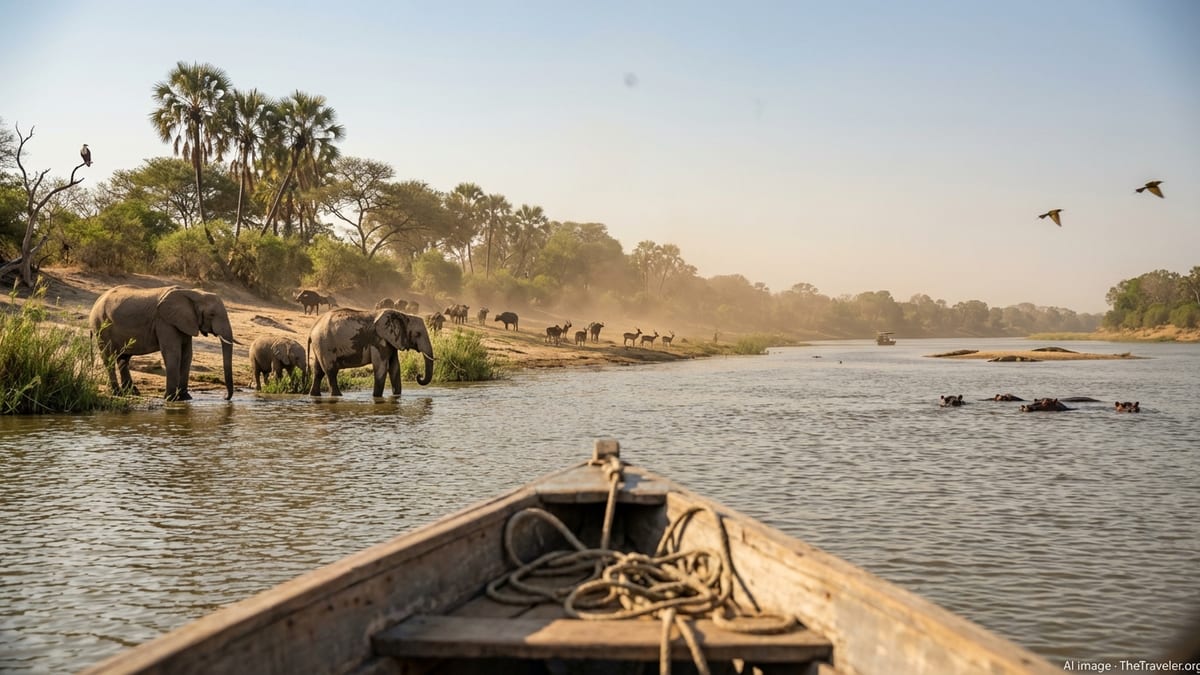
If the game drives were occasionally uneven in excitement, the boat safaris on the Rufiji River more than compensated. Being on the water at sunset, drifting past sandbanks stacked with crocodiles and watching hippos surface and snort meters away, felt like the most distinctive part of the Nyerere experience. It is one of the few major parks in Tanzania where you can do regular motorboat trips alongside vehicle safaris, and it shows.
The perspective from the river changes everything. On land, the dense vegetation can make it difficult to see animals, but on the water the landscape opens out, and birds, elephants, and even the occasional lion on the banks become much easier to observe. I was initially worried that boat cruises might be over-commodified, a sunset box to be ticked with snacks and drinks as the main attraction. In practice, the operators I used kept it surprisingly low-key. We did bring drinks, but the tone was focused on wildlife, with guides quietly pointing out fish eagles, bee-eaters, and the subtle behaviour of hippos rather than blasting music or turning it into a party.
There are still compromises. In the busy dry-season weeks, you can see a line of boats heading out at the same hour, and there were moments when the river environment felt almost as trafficked as a road in another park. The noise of multiple motors also occasionally undercuts the illusion of solitude. That said, I never felt it was out of control, and there are long stretches where your boat peels away into quieter channels and you regain that sense of being entirely alone in a big landscape.
Accommodation, Costs, and Practical Realities
Nyerere offers the full range of accommodation, from simple camps outside the gates to high-end lodges inside the park. I stayed inside the park, partly for the convenience of dawn starts and night-time soundscapes. The experience was excellent, but it was not cheap. Once you factor in park entrance fees of around 50 to 70 US dollars per adult per day for non-residents depending on the specific authority and timing, plus daily concession fees for staying inside the park, the total adds up quickly. Those headline safari-package prices of 600 to 1,200 US dollars per person per day for midrange options suddenly make sense when you see all the line items.
In terms of value, I felt slightly conflicted. The service and food at my camp were very good, and the location on the river was superb. Staff were attentive without being intrusive, and the guiding was generally strong, particularly on the river. At the same time, I could not ignore the fact that, compared with some northern circuit camps at similar price points, the infrastructure here felt a little more basic: occasional issues with hot water, limited Wi-Fi, and generator power schedules that required some planning. None of this ruined my stay, but it is worth understanding that you are paying for remoteness and wilderness, not polished luxury.
Another practical reality is the limited choice if you want to keep costs down. There are some budget camps and public campsites, and park fees are payable on a daily basis, usually by card at the gates. But the spacing of affordable options is sparse, and the distances involved make it hard to move around spontaneously without a pre-arranged itinerary. This is not a place where you casually drive in, look around, and pick a camp that afternoon. In hindsight, I would have spent more time researching and perhaps mixing one or two nights inside the park with cheaper accommodation just outside to manage costs.
Seasonality: The Park Changes Drastically With the Rains
Timing matters more in Nyerere than in many parks I have visited. The dry season from roughly June to October is the obvious choice for most travelers. Road conditions are best, vegetation is thinnest, and animals are forced to congregate around reliable water sources. This is when I went, and it felt like the right balance of accessibility and sightings. Even then, some more remote tracks were closed or discouraged when the guides deemed them too rough.
The wet season, which runs from around November to May with especially heavy rains from March to May, is effectively a different park. The same roads that felt mildly rough when I visited can become muddy or impassable, and certain areas, such as the Beho Beho Hills and more remote parts of the park, are sometimes cut off. Several camps close entirely for part of this period, and boat safaris can become more limited when waters are dangerously high or fast. On the other hand, birdlife explodes, the park is transformed into a vivid green, and some of the more interesting predator behaviour, particularly wild dogs, can be more commonly seen around certain wetlands.
If I go back, I would be tempted to plan two shorter visits in different seasons rather than one long one. Failing that, I would at least build in extra buffer days if traveling at the edges of the long rains, in case local access is disrupted. Nyerere is open year-round, usually from 6 am to 6 pm daily in terms of gate hours, but that does not mean every part is realistically reachable at all times of year.
Logistics, Rules, and Small Frustrations
One thing that quickly became clear is that Nyerere is still settling into its redefined role as a national park. The rebranding from Selous Game Reserve brought stricter rules, different fee structures, and some changes in permitted activities. Walking safaris, for example, are still possible with armed rangers and qualified guides, and they remain one of the most atmospheric ways to experience the bush here. But off-road driving is generally more restricted now, which I support from a conservation standpoint yet occasionally cursed when an interesting sighting disappeared into dense brush just off the track.
Park rules are clear on paper: no driving outside designated hours, no leaving vehicles in undesignated areas, no feeding wildlife, and no speeding. In practice, enforcement felt variable. I saw one vehicle from another operator drive far too close to a group of elephants, and there were moments on the river when boats bunched up in a way that clearly stressed hippos. Guides I spoke to acknowledged that, as tourism increases, managing behaviour across many operators will be a challenge.
There were smaller irritations as well. Payment systems at the gate are mostly electronic, which is convenient when they work but maddening when networks are patchy. On one arrival, we sat for nearly an hour while staff tried to coax a card terminal back to life so I could pay the remaining park fees. Signage is basic, so without a guide who actually knows the network of tracks, it would be easy to get lost. In fairness, this is part of what makes the park feel wild, but it also underlines that this is not yet a slick, hyper-organized destination.
Who Nyerere Is Really For
By the end of my stay I realised that Nyerere National Park is not a straight swap for the Serengeti or Ngorongoro, and treating it as such is a recipe for disappointment. It does certain things extremely well: river-based safaris, a sense of space and remoteness, strong chances of unusual sightings like wild dogs, and an atmosphere that feels much more like being in a vast living ecosystem than in an open-air zoo. When the park is on form, especially around the Rufiji at dusk, it is magical.
Where it falls short, at least for a first-time visitor expecting nonstop big-cat action, is in consistency. The thick vegetation, huge size, and road network mean that you can easily spend long stretches seeing very little. Sightings often depend on a combination of luck, guide skill, and seasons. If you are coming here for a once-in-a-lifetime safari and you have been told to expect the same drama as the northern parks, you might walk away slightly underwhelmed.
If I were planning again, I would treat Nyerere as a complementary stop in a longer itinerary rather than a stand-alone destination. A few days here combined with a northern park or Ruaha would give variety in both landscape and wildlife experience. I would also be more careful about budgeting for flights and internal transfers, which eat into the overall value more than I had anticipated.
The Takeaway
Looking back, I am glad I visited Nyerere National Park, but my appreciation for it is more nuanced than instant love. It is a place where the intangible qualities of wilderness, quiet, and scale matter as much as the number of lions you can tick off in your notebook. I had some unforgettable moments on the Rufiji, a rare wild dog sighting that will stay with me for a long time, and evenings in camp that felt as remote as anywhere I have been in East Africa.
I also had long, hot game drives with few sightings, logistical hiccups with payments and transfers, and a lingering sense that I paid a significant premium for an experience that was sometimes more potential than payoff. The rebrand from Selous to Nyerere has raised the park’s profile and, in places, its prices, but the supporting infrastructure and guiding standards are still uneven from one operator to another.
For travelers who can afford the internal flights, are realistic about the trade-offs, and choose their season and operator carefully, Nyerere National Park offers something increasingly rare: the feeling that the bush still has more control over your days than the tourism industry does. That, to me, was ultimately worth the effort and the imperfections.
FAQ
Q1: Is Nyerere National Park a good choice for a first-time safari?
For a very first safari, I would say it depends on your expectations. If you want guaranteed frequent big-cat sightings and a highly polished experience, it might not be ideal as a stand-alone choice. If you are comfortable with quieter drives and value wilderness over spectacle, it can still work, especially when combined with another park.
Q2: How many days should I spend in Nyerere?
I found that three to four nights felt like a sensible minimum. That gave me enough time for a couple of boat safaris and several game drives, with a reasonable chance of seeing a range of wildlife. Less than that and you risk hitting an unlucky patch of quiet days.
Q3: Is it better to fly or drive from Dar es Salaam?
Flying is faster and more comfortable but noticeably more expensive. The flight takes under an hour, while the drive can take five to seven hours depending on road conditions and gate. After doing both, I would fly in to save time and energy, and only consider driving if cost is a major factor and I had a robust 4x4 and some patience.
Q4: What is the best time of year to visit?
I would aim for the dry season, roughly June to October, when roads are firmer and wildlife is more concentrated around water. The wet months, particularly March to May, bring lush scenery and great birding but also muddy tracks, possible closures, and more challenging game viewing.
Q5: Are the park fees and extra costs high?
Yes, especially for non-residents. Daily park entrance and concession fees add a significant amount on top of accommodation and activities. It is important to factor these into your budget from the beginning so the final bill does not come as a shock.
Q6: Is Nyerere suitable for children and families?
It can be, but I would be selective. Long, hot drives with relatively few animals for stretches can test children’s patience, and some camps have age limits for walking or boat safaris. Families who have already done a more action-packed park and are comfortable with a slower pace may enjoy it more.
Q7: How remote does it really feel once you are there?
In camp and out on drives, it felt genuinely remote to me, especially away from the busier river sections. Vehicle traffic is far lighter than in the northern parks, and there were drives where I did not see another vehicle at all. The remoteness is one of Nyerere’s strongest selling points.
Q8: What kind of accommodation did I find, and did it feel worth the price?
I stayed in a lodge inside the park with comfortable tents, good guiding, and excellent river views, but with some intermittent hot water and limited Wi-Fi. Overall I felt the experience was good, though slightly expensive for the level of infrastructure compared with similar-priced camps in the north.
Q9: Do I need a guide or can I self-drive?
Technically you can self-drive if you have a suitable vehicle and pay the required fees, but I would strongly recommend a professional guide. The track network is confusing, signage is sparse, and knowing where animals are likely to be makes a huge difference in such a large, partly wooded park.
Q10: Would I go back to Nyerere, and what would I do differently?
I would go back, but as part of a longer Tanzania itinerary rather than a single destination. I would plan for at least one dedicated day on the river, be even more precise about timing my visit in the dry season, and budget more realistically for flights and park fees so I could relax and enjoy the wilderness without constantly calculating costs in the back of my mind.