

More news on this day
Once a cherished overnight journey for backpackers, families and business travelers, the rail routes that stitched Odesa to the rest of Ukraine are falling ominously quiet in 2026 as warfare and infrastructure damage force key lines to suspend or sharply curtail service.
Get the latest news straight to your inbox!
A Strategic Lifeline Stalled by War
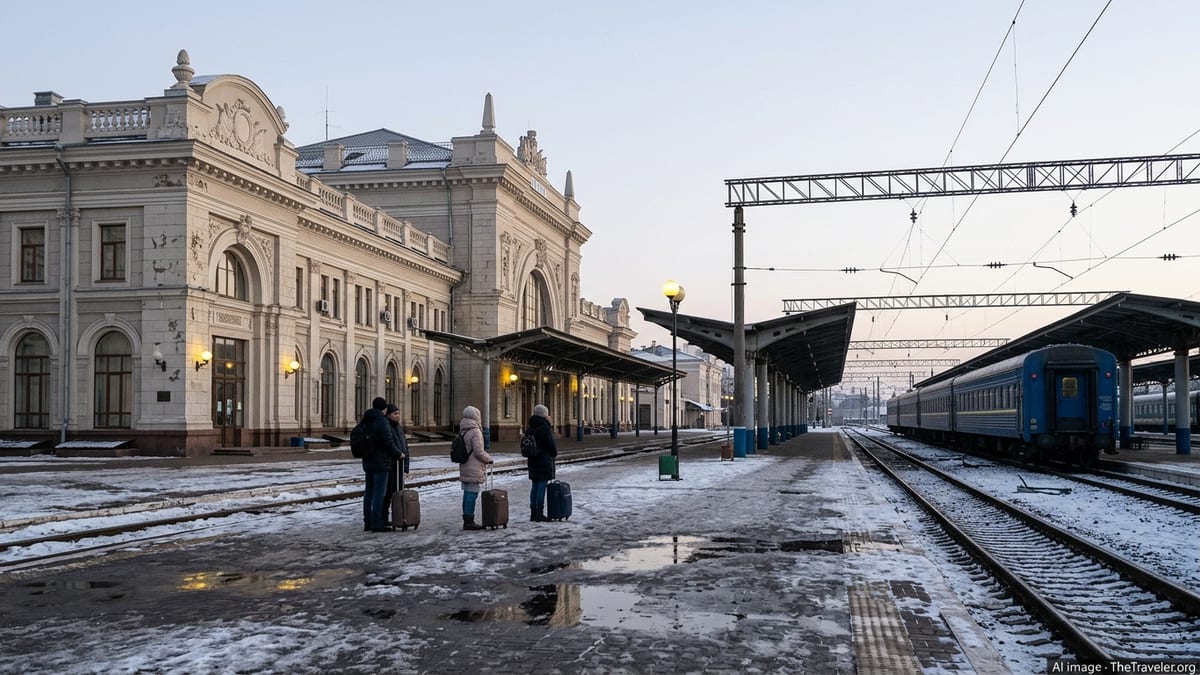
For decades, Odesa’s grand central station symbolized effortless movement between the Black Sea port and the country’s major cities. In 2026, that symbol has been shaken as repeated strikes on rail infrastructure, energy facilities and depots across Odesa region and central Ukraine interrupt what was once one of the country’s most reliable transport networks.
Publicly available information shows that since late 2025 Russian attacks have increasingly targeted railway assets, from depots and traction substations around Odesa to key junctions deeper inland. Damage to power supply lines and tracks has forced dispatchers to halt trains on vulnerable stretches, re-route long distance services or cancel departures altogether, gradually thinning the timetable that used to anchor Odesa’s connectivity.
Reports from Ukrainian and international outlets describe a pattern of strikes that has made continuous rail operations in the south ever harder to sustain. While Ukrzaliznytsia, the national rail operator, continues to stress that the network remains functioning, the cumulative impact of drone and missile attacks, emergency repairs and rolling blackouts has turned what was once predictable travel into a patchwork of delays, detours and silent platforms.
The disruption carries particular weight for Odesa because rail was the city’s safest mass-transport option once commercial flights largely disappeared from Ukraine’s skies. With key routes curtailed or rerouted, the psychological blow for travelers is significant, reinforcing a sense that the country’s famed Black Sea gateway is more isolated than at any time in recent memory.
From Detours to Suspensions: How Routes Unraveled
The unraveling of rail access to Odesa did not happen overnight. Through much of 2024 and 2025, Ukrzaliznytsia responded to attacks and construction bottlenecks by introducing detours rather than outright cancellations. Trains linking Odesa with eastern hubs such as Kharkiv, for example, were periodically rerouted through alternative corridors in central Ukraine when infrastructure near Kremenchuk or in Kirovohrad region was damaged.
These adjustments kept passengers moving, though at the cost of significantly longer travel times and irregular schedules. Night trains increasingly ran on indirect paths to skirt exposed nodes, and some daytime services were shifted to less vulnerable hours. For travelers, the change meant leaving earlier, arriving later and planning for last minute timing changes as dispatchers responded to fresh damage and air alerts.
By early 2026, however, the compounding effects of repeated strikes and strained repair crews were visible. Regional media and rail advisories indicated that certain long distance and cross country services touching Odesa were first heavily restricted and then quietly suspended on some days, especially when power supply to traction substations was interrupted. In parallel, safety protocols that require trains to halt during intense air raid risks made it harder to guarantee end to end journeys within a single night.
The result is that entire stretches which once carried a steady flow of sleeping cars to and from Odesa now sit idle for prolonged periods. To many travelers inside Ukraine and in the wider region, the practical effect feels like a partial shutdown, even when some shorter routes or irregular services continue to appear on electronic boards.
Travelers Caught Between Safety and Mobility
For passengers, the silencing of vital rails is less an abstract logistics problem and more a series of missed reunions, cancelled holidays and stalled work trips. Publicly available accounts from Ukrainian outlets and social media show would be visitors arriving at stations to find overnight trains heavily delayed, truncated partway along their route, or taken off sale with little warning as strikes damaged infrastructure or triggered extended air alarms.
New security procedures introduced across the national network underline the tension between safety and mobility. When air defense radars detect incoming drones or missiles near a line, trains may now stop in open country or at small intermediate stations, with passengers instructed to leave carriages and move to safer areas until the risk subsides. While these measures have saved lives, they also make it harder for rail operators to maintain predictable timetables, particularly on the long southern approaches to Odesa.
Families who once relied on overnight sleepers for relatively comfortable, low cost trips to the coast now face a calculus of uncertainty: whether to accept hours of delays and the possibility of an unplanned overnight stop, or to abandon plans entirely. For international travelers who imagined rail as the most responsible way to reach Ukraine’s Black Sea, the reality of suspended or unreliable services has been a sobering reminder of how deeply the war reaches into everyday mobility.
In many cases, passengers who do arrive in Odesa do so after intricate multimodal journeys involving buses, private cars and occasional rail segments that still run under modified schedules. This fragmentation erodes one of the city’s quieter attractions of peacetime: the ease of stepping aboard a single train in Kyiv, Lviv or Kharkiv and waking up within walking distance of Odesa’s historic streets.
Tourism Dreams Deferred Along the Black Sea
The rail slowdown is particularly painful for Ukraine’s embattled tourism sector. Even amid conflict, Odesa retained an emotional pull for domestic travelers, with some attempting carefully timed summer visits when security conditions briefly improved. Rail links were central to those plans, offering a perceived balance of safety, affordability and relative environmental responsibility for those unwilling or unable to travel by road convoys along exposed highways.
As 2026 unfolds, travel planners and tourism commentators describe rail uncertainty as a decisive factor in shrinking visitor numbers. Hotels and guesthouses that once counted on predictable waves of arrivals from long distance trains are seeing more erratic bookings, with many potential guests postponing trips until rail timetables stabilize or seeking alternative destinations in western Ukraine that remain easier to access by train.
Business travel is also affected. Odesa’s role as a logistics and maritime services hub depends on regular movement of staff, inspectors, seafarers and consultants between the port city and inland economic centers. When overnight rail options vanish from booking systems for security or technical reasons, companies often turn to slower, more expensive road journeys, adding time and cost to already fragile supply chains.
For would be foreign tourists looking ahead to postwar itineraries, the reports of damaged depots, unreliable power and silent platforms risk reshaping perceptions of the city itself. The romance of arriving in Odesa by train, stepping into a station famed for its monumental architecture and then drifting down to the seafront, is being replaced by images of shuttered ticket offices, boarded windows and schedules dominated by caveats and warning notices.
Adapting Routes and Expectations in a Time of Uncertainty
Despite the grim headlines, Odesa is not entirely cut off. Public data from Ukrzaliznytsia and independent monitoring groups indicate that many rail lines elsewhere in Ukraine are still operating, and that dispatchers, engineers and construction crews continue to reopen damaged stretches after repairs, sometimes within days of an attack. The country’s experience restoring traffic through other heavily hit junctions illustrates a capacity for resilience that could, over time, help revive more reliable access to the Black Sea hub.
Yet the current phase suggests that travelers will need to adapt their expectations. Travel experts emphasize that anyone planning a journey involving Odesa in 2026 should treat timetables as provisional, monitor advisories closely and prepare backup options by bus or car share. Flexible tickets, additional buffer days and a willingness to re-route through comparatively safer western corridors are becoming standard elements of Ukraine travel planning.
Within Ukraine, the partial silencing of Odesa’s rails has also renewed debate about the country’s long term transport strategy. Analysts point to the need for more decentralized power supplies for traction, hardened depots and redundant routes that can keep at least basic passenger services running even when specific nodes are hit. Discussions about aligning more of Ukraine’s rail network with European standards, including gauge changes, now intertwine with urgent questions about how to protect what already exists.
For now, the heartbreak is felt most keenly by those who have long associated Odesa with the gentle rhythm of overnight travel. As trains that once arrived and departed with clockwork regularity now fall silent for days at a time, the silence itself has become a powerful measure of how the war has transformed not only Ukraine’s infrastructure, but also the fundamental experience of moving across the country.