

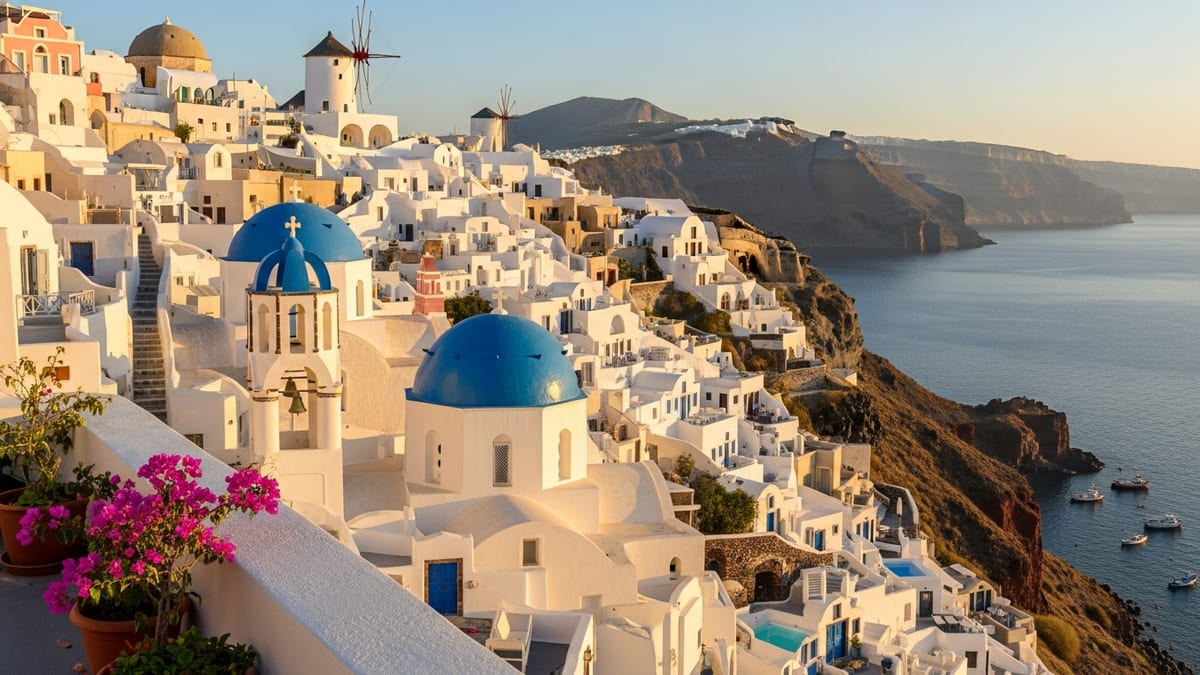
Perched at the northern tip of Santorini, Oia is the village that has come to define the Greek island dream. Whitewashed houses spill down volcanic cliffs, blue-domed churches glitter above the caldera and every evening crowds gather to watch the sun sink into the Aegean.
Beautiful as it is, Oia is also busy, compact and expensive, which makes smart planning essential. This guide covers what to see and do, when to come, how to navigate the crowds and the key things to know before you go, so you can enjoy Oia at its best.
Getting Oriented in Oia
Oia is a small, mostly pedestrian village stretched along the northern rim of Santorini’s caldera. The main marble pathway runs roughly east to west, lined with boutiques, jewelry shops, galleries and cafés, with smaller alleys dropping down the cliff toward cave houses and suites carved into the rock. The village does not have a traditional beach; instead, its drama comes from vertiginous views over the flooded volcanic crater and neighboring islands. This layout means views are magnificent but walking often involves steps and steep sections.
The heart of Oia is the area around the main square and Panagia Platsani Church, from which most visitors fan out toward the sunset viewpoints and the famous blue-domed churches. To the northwest, paths lead toward the ruins of the old Byzantine castle, the most photographed sunset spot in Santorini. Below the village, down several hundred steps, lies Ammoudi Bay, a tiny fishing port with waterfront tavernas and swimming spots. Understanding this simple geography helps you plan your days and anticipate how long it will take to move between viewpoints.
Oia’s character changes dramatically over 24 hours. Before 9 in the morning, the streets are quiet and mostly populated by overnight guests and photographers. Late morning and afternoon bring in day-trippers and cruise ship excursions from Fira, with crowds peaking from late afternoon through sunset. After dark, the village softens again, its alleys glowing with lantern light, restaurants buzzing and most day visitors gone. Planning your activities around these daily rhythms will shape your experience more than almost anything else.
Top Sights and Experiences
The classic Oia experience starts with simply wandering. Allow time to stroll the main marble walkways and dip into smaller alleys framing blue domes, bell towers and bougainvillea-draped doorways. The blue-domed churches of Agios Spyridonas and Anastasis in the Monastiri district are the postcard-perfect icons of Santorini, though reaching their viewpoints involves navigating a maze of lanes and small staircases. Early morning is the best moment to photograph them in softer light before the area turns into a slow-moving queue of people waiting for their turn at the railings.
The Byzantine castle ruins at the western tip of the village form Oia’s most famous viewpoint. In the hour before sunset, hundreds gather here to watch the village glow pastel pink and gold. Even if you do not stay through sunset, visiting during late afternoon lets you appreciate the architecture cascading down the cliffs and the windmills at the far edge of town. On quieter days or outside peak months, this is also a spectacular sunrise vantage point, with light hitting the facades from behind you and far fewer people around.
Below Oia, Ammoudi Bay offers a welcome contrast to the polished streets above. You can walk down roughly 250 to 300 stone steps from near the castle or arrive by car or taxi via a winding road. At the bay, small fishing boats bob in the harbor and tavernas line the water’s edge, serving freshly grilled seafood. A short walk along the rocky shoreline beyond the restaurants leads to a popular area for cliff jumping and swimming in deep, clear water. Many visitors combine a late lunch or early dinner in Ammoudi with a boat excursion or simply watch the aftermath of sunset from sea level.
For active travelers, the Fira to Oia trail is one of Santorini’s great experiences. This approximately 10-kilometer clifftop hike links Santorini’s capital to Oia along the caldera edge, passing through Firostefani and Imerovigli. Depending on your pace and photo stops, it typically takes between two and four hours. Much of the route is on a mix of paved paths and dirt tracks with limited shade, so set out in the early morning, carry plenty of water and wear sturdy footwear. Arriving in Oia on foot after following the curve of the caldera gives you a deeper sense of the island’s geography than any drive can offer.
Sunset in Oia: Strategy and Alternatives
Oia’s sunset is the island’s biggest attraction and also its biggest challenge. From May through October, thousands of people converge on a village that is essentially a collection of narrow lanes and stairways. The main sunset hotspot at the castle fills up 60 to 90 minutes before sunset in high season, and at the height of summer some visitors now arrive two to three hours in advance to secure a front-row spot on walls and ledges. By the time the sun touches the horizon, people are standing shoulder to shoulder, cameras raised, and when the last sliver of sun disappears there is often applause followed by a dense, slow-moving exodus.
If you want to experience this signature moment once, go prepared. Check the sunset time for your travel dates, arrive well in advance and bring water, a hat and something to sit on if you plan to wait on stone walls. Be patient, expect people to edge into your line of sight and keep an eye on footing as you leave, since stairs and pathways become crowded in low light. Avoid planning tight dinner reservations immediately after sunset, as it can take longer than expected to move away from the viewpoint or up from Ammoudi Bay if you watched from below.
An increasingly popular alternative is to reserve a table at a restaurant or bar with a sunset view. Many caldera-facing venues in Oia base their dinner seatings around sunset, with minimum spends or set menus at premium prices for front-row tables. If you choose this route, book as far ahead as possible during June, July and August and specify that you are requesting a sunset view rather than an interior seat. The experience can be more relaxed than standing in the crowds, with the added bonus of wine and dinner as the village lights come on.
Another way to enjoy Oia’s famous light without the congestion is to focus on sunrise or golden hour before sunset rather than the exact moment of sundown. The early morning light is soft and flattering, and streets are largely empty apart from a few photographers. Shoulder season travel in April, May, September and October also noticeably reduces the intensity of the crowds while preserving pleasant weather. Finally, consider watching the sunset from other caldera villages such as Imerovigli or even on a late-afternoon catamaran cruise, then visiting Oia in the early morning instead. You will still see Santorini’s legendary glow, just with more space to breathe.
When to Visit and How Long to Stay
The best time to visit Oia depends on your priorities. For warm weather and long days, June through early September deliver that classic Mediterranean summer, but they also bring the largest crowds and the highest prices. July and August in particular see heavy cruise ship traffic and packed buses from Fira. If you choose these months, book accommodation and key experiences well in advance and build early starts and midday breaks into your schedule.
For many visitors, the sweet spot is the shoulder season from late April to early June and from September through October. During these periods, sea temperatures are generally swimmable, most hotels and restaurants are fully open, but visitor numbers are significantly lower than in high summer. Evenings can be cooler and you may encounter an occasional windy or overcast day, but you gain more relaxed streets and easier restaurant reservations. Sunset times in these months are also reasonable for families, typically around 7 to 8:30 in the evening depending on the exact date.
Winter in Oia from November through March is a different experience altogether. The light can be beautiful, sunsets often vivid and the village far quieter. However, many hotels, particularly pool suites and luxury cave accommodations, close for the season or undergo renovations, and a portion of restaurants and shops shut their doors. Ferry schedules are reduced and some boat tours cease operating. If you come in winter, do so for tranquility rather than nightlife, and check that your chosen hotel and any must-do activities are running on your specific dates.
In terms of trip length, Oia can be visited as a half-day highlight from elsewhere on Santorini, but staying at least one or two nights in the village gives you access to early mornings and late evenings without commuting. A three or four-night stay allows time for a caldera cruise, the Fira to Oia hike, a day at one of Santorini’s beaches and a leisurely exploration of the island’s wineries while still returning to Oia as your base. If your budget allows, consider spending at least one night in a caldera-view room, then moving to a more economical location elsewhere on the island for the remainder of your stay.
Practicalities: Getting There, Getting Around and Costs
Most visitors reach Santorini by air into the island’s small international airport or by ferry from Athens and other Cycladic islands. From both the airport and the main ferry port at Athinios, Oia is roughly a 30 to 40-minute drive. You can arrange private transfers, use pre-booked shuttles or take a taxi, though taxis are limited in number in peak season and queues can form at arrival times. Public buses connect the port and airport to Fira, and from there you change to the Fira–Oia line, which runs regularly throughout the day and evening in high season.
If you rent a car, be aware that Oia itself is effectively car-free, with vehicles restricted to the roads skirting the top of the village. Several parking areas serve Oia near the entrance to town, with a mix of paid and limited free spaces, and they fill quickly in the late afternoon. Local police enforce no-parking zones and yellow lines with fines. In high season, driving into Oia near sunset can mean getting stuck in slow traffic queues. Whenever possible, arrive earlier in the day, park once and explore on foot. Many travelers now opt to stay within walking distance of the center and use buses or taxis when venturing elsewhere on the island.
Within Oia, expect to walk almost everywhere. The main street is paved and relatively level, but many of the most scenic accommodations, cafés and viewpoints are accessed via stepped lanes that can be steep, uneven and sometimes slippery in smooth marble sections. Comfortable flat shoes with good grip are essential. Oia is not particularly wheelchair or stroller friendly, and anyone with limited mobility should choose accommodation on or near the main level rather than far down the cliff.
Oia is one of the most expensive places in Greece. Room rates for caldera-view suites with private plunge pools can easily reach high four-figure amounts per night in peak season, though more modest guesthouses and rooms on the non-caldera side are available at lower but still premium prices. Food and drink follow suit, with cocktails and dinners in view-heavy spots costing substantially more than similar meals in less famous Greek islands or in Santorini’s inland villages. To manage costs, mix one or two special-view meals with simpler lunches, bakeries and gyros stands, and consider pairing a night or two in Oia with more budget-friendly stays elsewhere on the island or in the Cyclades.
Where to Stay and Eat in Oia
Choosing where to stay in Oia shapes your experience as much as when you visit. Caldera-view cave hotels offer the archetypal Santorini fantasy of whitewashed terraces, infinity pools and direct sunset or sunrise views. These properties generally cluster along the cliff edge between the main square and the western end of the village, with rooms reached by stairways that descend multiple levels from the pedestrian path. If you value views above all and are comfortable with steps, this is where you should focus your search, but book well in advance from May to October.
Travelers who prefer easier access, lower prices or a bit more privacy often choose accommodations set slightly back from the caldera or on the inland side of the main street. Many of these still offer rooftop terraces, partial sea views or glimpses of village domes, but with less foot traffic passing directly in front of your door. Families and visitors who find continuous stairs challenging may appreciate these locations more. A growing number of small villas and suites on the outskirts of Oia also provide quieter stays within a 10 to 15-minute walk of the center.
Oia’s dining scene ranges from simple bakeries and souvlaki counters to tasting-menu restaurants with dramatic terraces. Fresh seafood is a highlight, particularly at the waterfront tavernas in Ammoudi Bay, where you can linger over grilled fish and local white wine as waves lap nearby. In the village itself, many restaurants specialize in modern Greek or Mediterranean dishes that pair well with the local Assyrtiko wines. Reservations are strongly recommended in high season for anywhere with caldera views, especially around sunset, and increasingly advisable even for popular spots without a direct sunset angle.
To balance indulgence and budget, consider having a lighter breakfast from a bakery, a casual midday meal from a gyro or salad spot and then investing in one sit-down dinner with views. Alternatively, reverse the order and enjoy a relaxed, view-filled lunch after the main rush while having a simpler picnic supper later. Remember that food and drink cost more at the most photographed terraces; a similar glass of wine will be considerably cheaper a few alleys back from the rim. Regardless of where you dine, look for local specialties such as fava, tomato fritters and dishes featuring Santorini’s distinctive cherry tomatoes.
Culture, Etiquette and Responsible Travel
Despite its international visibility, Oia remains a small Greek village with year-round residents who live and work alongside a heavy tourist presence. Showing respect for the community is key to being a welcome guest. Many of the most photogenic corners of Oia are in fact residential doorways, small chapels and private terraces. Do not step onto rooftops, walls or property that is clearly marked as private, even if others appear to be doing so. Avoid leaning over or sitting on church domes, and honor any posted signs restricting photography or drone usage.
Noise carries easily in Oia’s bowl-like topography. Voices, music and pool gatherings that seem moderate at one level can echo into neighboring patios and rooms below. Keep volume down late at night and early in the morning and be mindful that some people are sleeping just a few feet away, separated only by a wall and open terrace. If your accommodation has a plunge pool or hot tub, use it considerately and follow any house rules regarding hours.
Dress codes in Oia are relaxed but practical. Lightweight, breathable fabrics and layers work best, with a light jacket recommended for breezy evenings in shoulder seasons. Because many paths and steps are polished from heavy foot traffic, flat sandals or shoes with textured soles are far safer than heels. Sun is strong from late spring through early autumn, so hats, sunglasses and sunscreen are not optional. Santorini’s infamous winds can be intense on certain days, making long, floaty skirts and unsecured hats less practical than they appear in photos.
As visitor numbers have grown, so have conversations about over-tourism and environmental impact. You can travel more responsibly by visiting outside peak months where possible, supporting locally owned businesses, using refillable water bottles where tap water is safe or refilling stations are available and avoiding single-use plastics when you can. Consider taking at least part of your island exploring by foot, public bus or small-group tours rather than multiple short private car trips. Small choices like these help preserve the charm that draws people to Oia in the first place.
The Takeaway
Oia is a place of vivid contrasts. It can be both enchanting and overwhelming, serene at dawn and nearly frenetic at sunset. With clear expectations and thoughtful planning, you can tilt that balance toward magic. Time your visit for the shoulder seasons if you can, wake early to explore empty alleys, and treat the famous sunset as one moment among many rather than the sole purpose of your trip.
Give yourself at least a couple of days to sink into Oia’s rhythms instead of rushing through on a short excursion. Wander beyond the main path, linger in a quiet café, swim in the clear waters of Ammoudi Bay and, perhaps most importantly, build in space to simply sit and look out over the caldera. In the end, the most lasting memories of Oia tend to come not from the most crowded viewpoints, but from the quieter instants when the village feels briefly like it is yours alone.
FAQ
Q1. How many days do I need in Oia?
Most travelers find that one to two full days is enough to see Oia’s key sights, enjoy a sunset and visit Ammoudi Bay. If you want to hike from Fira, take a caldera cruise and explore wineries while using Oia as a base, plan on three to four nights.
Q2. What is the best month to visit Oia for fewer crowds but good weather?
The shoulder months of May, early June, September and early October usually offer warm weather and open businesses with noticeably fewer crowds than July and August. Sea temperatures are generally pleasant, and securing restaurant reservations and photo spots is much easier.
Q3. Is Oia suitable for families with young children?
Oia can be challenging with strollers or toddlers because of its many steps, narrow paths and lack of railings along some edges. Families often prefer to stay in more level areas of Santorini and visit Oia for a half-day. If you do stay in Oia, choose accommodation on or near the main walkway and keep a close eye on children near drop-offs.
Q4. Do I need a car to visit Oia?
You do not need a car to enjoy Oia itself. The village is compact and best explored on foot, and frequent buses connect Oia with Fira and other parts of the island in high season. A car can be useful if you plan to visit beaches and inland villages independently, but parking in Oia is limited and often crowded around sunset.
Q5. How early should I arrive for sunset at Oia Castle?
In peak summer, plan to arrive at least 60 to 90 minutes before sunset to secure a reasonable viewing spot at the castle. During shoulder seasons you may find space with a shorter lead time, but arriving early still improves your chances of an unobstructed view and a less stressful experience.
Q6. Can I swim anywhere near Oia?
There is no beach directly in the village, but you can swim at Ammoudi Bay below Oia. After descending the steps, follow the rocky path past the tavernas to reach a popular area for cliff jumping and deep-water swimming. Wear sturdy shoes for the rocks and be cautious of waves and boat traffic.
Q7. Is Oia very expensive compared to the rest of Santorini?
Yes, Oia is generally the most expensive area on the island for accommodation, dining and drinks, especially at venues with caldera views. Prices tend to be lower in Fira, Firostefani, Imerovigli and the beach towns. You can manage costs by staying in a less expensive village and visiting Oia on day trips or by choosing non-view rooms and simpler eateries within the village.
Q8. Are drones allowed in Oia?
Drones are heavily restricted around Oia due to safety, privacy and noise concerns. Many areas, especially near churches and private properties, are marked with signs prohibiting drone use. In addition, Greek aviation regulations apply. Unless you have explicit permission and have checked local rules, it is best to leave the drone at home.
Q9. What should I pack specifically for Oia?
Prioritize comfortable walking shoes with good grip, lightweight clothing, sun protection such as a hat and sunscreen and a light layer for breezier evenings. If you plan to swim at Ammoudi Bay or take boat trips, bring water shoes or sandals that handle rocks well, plus a quick-drying towel. A reusable water bottle is also useful in the summer heat.
Q10. Is it worth getting up for sunrise in Oia?
Sunrise in Oia is often just as beautiful as sunset and far less crowded. The village is quiet, the light is soft and you can photograph popular spots like the blue domes and castle viewpoints without jostling for position. For travelers who dislike crowds or are visiting in the busy months, a sunrise walk can be one of the most rewarding experiences in Oia.