

More news on this day
A renewed spike in global oil prices is pushing up the cost of greener jet fuel just as airlines face binding clean-fuel mandates, amplifying a price shock that threatens to raise ticket costs and complicate aviation’s path to net zero emissions.
Get the latest news straight to your inbox!
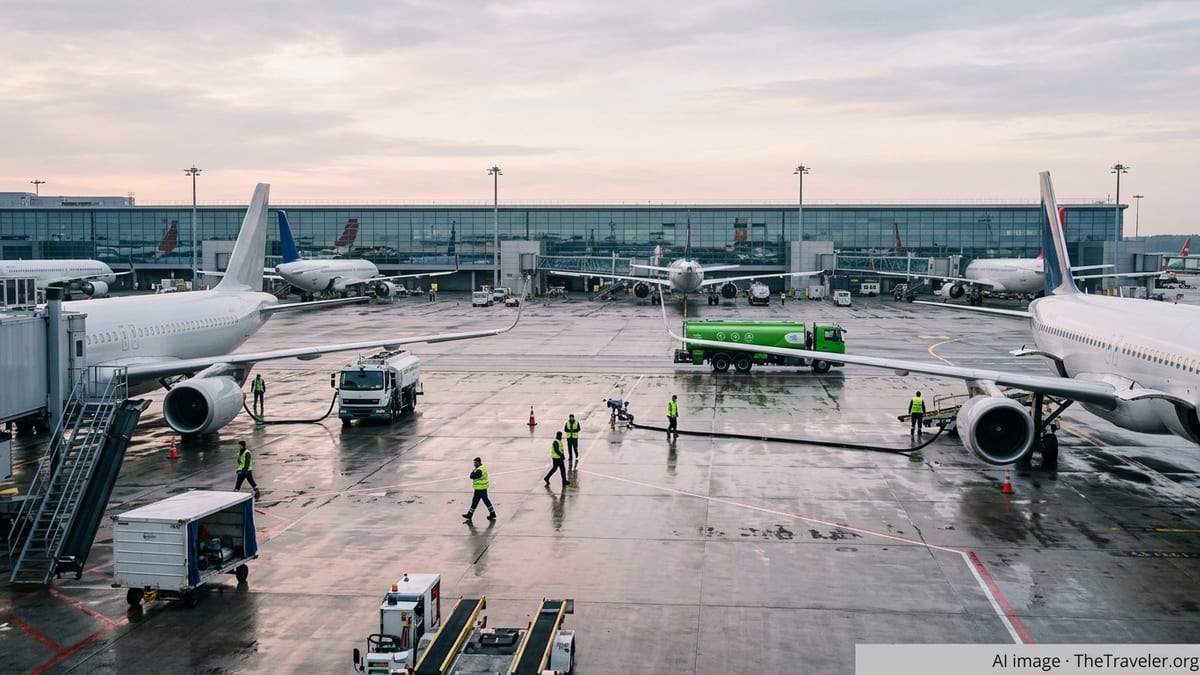
Oil Rally Collides With Premium-Priced Sustainable Fuel
The latest rise in crude oil and conventional jet fuel prices is rippling into the small but fast-growing market for sustainable aviation fuel, or SAF. Publicly available market assessments indicate that SAF in key mandated regions is trading at roughly two to five times the price of fossil jet fuel, a premium that becomes more painful when the underlying oil price climbs.
Industry analyses suggest that global SAF production could reach close to 2 million metric tons in 2025, still less than 1 percent of projected airline fuel consumption. Even at that modest share, forecasts compiled by aviation bodies point to billions of dollars in additional fuel costs for airlines this year and next, driven largely by the steep SAF price premium.
In Europe, policy papers and consultancy estimates put recent indicative SAF prices in the range of about 2,000 euros per metric ton, compared with substantially lower spot prices for conventional jet fuel. As oil benchmarks strengthen, that euro figure has stayed high, effectively widening the absolute cost gap per ton of fuel even if the multiple over fossil kerosene narrows slightly.
The result is a double squeeze for airlines. Higher base fuel prices increase operating costs across the board, while the requirement to blend in a small but rising share of far more expensive SAF magnifies the total fuel bill at a time when margins remain thin and competition on many routes is intense.
Mandates in Europe and Asia Lock In Exposure
Regulatory mandates are ensuring that demand for greener jet fuel will keep rising, regardless of the price environment. Under the European Union’s ReFuelEU Aviation rules, aviation fuel suppliers at EU airports must ensure that at least 2 percent of fuel supplied from 2025 is sustainable, with the target set to increase in stages through 2050. National and regional authorities are preparing monitoring systems and technical reports that will check whether these obligations are being met.
Parallel measures in the United Kingdom require a similar initial share of sustainable fuel, with higher targets later in the decade. Recent coverage in European business media notes that many carriers already anticipate higher operating costs as they secure supply for these mandates, particularly at hub airports where SAF availability is highest and competition for volumes is strongest.
Mandate-style policies are now spreading to Asia as well. Singapore has introduced what is described in press reports as the region’s first dedicated SAF levy, adding between a fraction of a dollar and several dozen dollars to tickets depending on cabin class and distance. The levy is earmarked to fund the purchase of sustainable fuel for flights from Changi Airport, effectively baking a green fuel cost component into ticket prices on routes across Southeast Asia and beyond.
Together, these regional initiatives mean airlines cannot fully step back from the SAF market even during an oil shock. On the contrary, the share of their fuel mix tied to greener, higher-priced product is locked in and set to grow, exposing carriers to a structural cost uplift that is difficult to offset through efficiency gains alone.
Tax Credits and Incentives Struggle to Keep Pace
On the other side of the Atlantic, the United States is attempting to cushion the cost of greener jet fuel through tax incentives introduced under the Inflation Reduction Act. Guidance published by the Internal Revenue Service explains that a dedicated sustainable aviation fuel credit is available for qualifying SAF used in fuel blends sold between the start of 2023 and the end of 2024, while a broader clean fuels production credit is scheduled to apply from 2025.
Policy analyses by environmental groups and think tanks indicate that these credits can be worth around 1.25 to 1.75 dollars per gallon for SAF that meets strict lifecycle emissions thresholds. The intention is to close part of the price gap with fossil jet fuel, encourage investment in new production capacity and stimulate long-term offtake agreements between airlines and fuel producers.
Yet as oil prices and SAF feedstock costs rise together, there are growing signs that these incentives may not fully neutralize the premium. Briefings from tax specialists highlight that the current SAF credit is temporary, and sector reports warn that uncertainty over what will replace it after 2024 could delay final investment decisions on large-scale projects in the middle of the decade.
Without a stable and predictable support framework, producers face volatile returns and may be slow to bring capacity online. That in turn keeps supply tight, limiting competition and leaving airlines dependent on a relatively small group of suppliers with strong pricing power whenever fossil fuel markets tighten.
Airlines Pass Costs to Travelers and Rethink Networks
The immediate consequence of the green fuel cost shock is beginning to show up in surcharges and ticket pricing. Public announcements by several European airline groups and logistics providers indicate that sustainable aviation fuel surcharges are being introduced or expanded on both passenger tickets and air freight shipments, often as a separate line item tied to SAF uptake.
Industry observers suggest that network planners are increasingly factoring local SAF availability and price into route decisions. Long-haul services that rely heavily on hubs in mandated markets such as the European Union or Singapore may see sharper cost increases than routes that can be scheduled through jurisdictions with weaker SAF requirements, raising questions about future competitive advantages between airlines based inside and outside strict regulatory zones.
Low cost carriers appear particularly vulnerable. Analyses published by European economic and aviation outlets argue that their business models, which rely on very low fares and high aircraft utilization, leave less room to absorb the rise in fuel costs. Any need to pass on a significant portion of the SAF premium could erode their price edge over legacy airlines, especially on routes with high rail or ferry competition.
Some carriers are exploring voluntary green fares and corporate SAF programs, offering passengers and business clients the option to pay extra for a greater share of sustainable fuel. While these schemes can help finance SAF purchases and burnish environmental credentials, market data suggests they currently cover only a fraction of total fuel needs and are sensitive to broader economic conditions and traveler willingness to pay.
Uncertain Outlook for SAF Prices as Investment Lags
Looking ahead, analysts are divided over whether the current price shock will accelerate or delay the transition to greener jet fuel. On one hand, higher fossil fuel prices can make SAF comparatively more attractive over time, especially if learning curves and economies of scale reduce production costs for advanced biofuels and synthetic e-fuels.
On the other hand, several recent market outlooks warn that high upfront costs, complex certification requirements and patchy policy support are slowing investment in new plants. International aviation organizations have cautioned that global SAF supply growth could decelerate around 2026, even as mandates and voluntary commitments continue to ratchet up, setting the stage for a prolonged period of tight supply and elevated premiums.
Travelers may feel the effects most keenly on intercontinental routes, where airlines have fewer options to substitute lower carbon transport modes. Any sustained combination of strong passenger demand, firm oil prices and costly SAF requirements is likely to keep upward pressure on long-haul ticket prices through the second half of the decade, according to recent industry forecasts.
For now, the delicate balance between energy markets, climate policy and airline economics remains in flux. What appears clear is that the interaction between oil price swings and structurally expensive green fuel is becoming a central variable in the cost of global air travel, and a critical factor in how quickly aviation can cut its climate impact without grounding growth in passenger demand.