

More news on this day
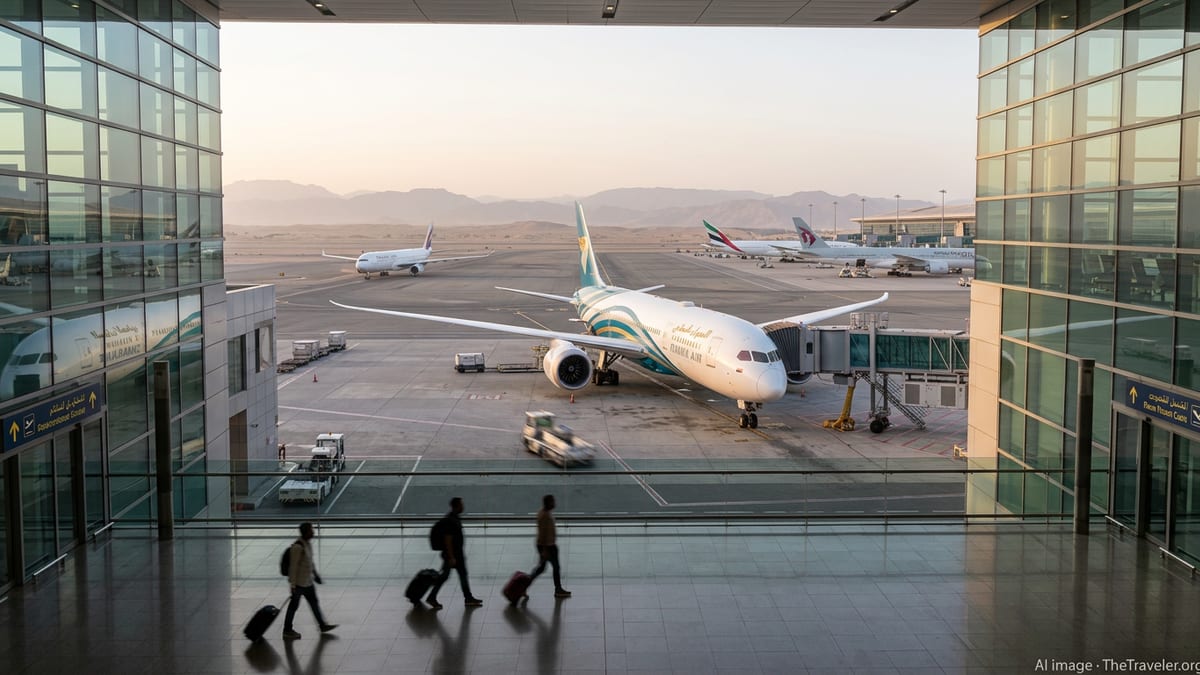
Oman Air is bolstering capacity on key routes from Muscat to London, Istanbul, Bangkok and Mumbai between 7 and 16 March 2026, adding short-term frequencies that aim to keep passengers moving and underscore Oman's growing role as a stable aviation hub during a period of wider regional disruption.
Short-Term Capacity Boost on High-Demand Routes
The additional Oman Air services are concentrated on high-demand corridors linking Muscat with London Heathrow, Istanbul, Bangkok and Mumbai, coinciding with a period when several Gulf carriers have curtailed or reshaped operations due to temporary airspace closures. Industry updates indicate that Oman Air is layering these extra rotations on top of its regular schedule, effectively increasing seat supply at short notice to absorb displaced travellers and pent-up demand.
Operational notices published this week show that extra London Heathrow flights are planned across 7 to 16 March, with additional services to Istanbul from 9 to 16 March and to Bangkok from 8 to 15 March. Mumbai is seeing extra Oman Air capacity on 7 and 8 March, aimed particularly at Indian nationals seeking onward connections. While exact flight numbers and timings are being managed dynamically, the pattern reflects a focused effort to reinforce Muscat’s connectivity with major European and Asian gateways.
Travel analysts note that these short-lived capacity additions, even when framed as limited run or relief-style flights, can significantly ease pressure on fares and availability at a time when seats on alternative carriers are scarce. For many passengers whose original itineraries were disrupted elsewhere in the region, the extra Oman Air frequencies offer one of the most immediate paths out of the Gulf and back onto global networks.
Muscat Emerges as a Strategic Transit Hub
Oman’s airports authority has stressed that Muscat International Airport remains fully operational around the clock, without the slot constraints currently affecting some neighboring hubs. That operational flexibility is central to Oman Air’s ability to ramp up flying quickly on trunk routes and accommodate re-routed traffic from airlines that are temporarily reducing schedules.
By channeling additional flights into London, Istanbul, Bangkok and Mumbai, Oman Air is reinforcing Muscat’s position as a connecting point between Europe, the Indian subcontinent and Southeast Asia. London Heathrow serves as a key entry point for Europe and North America, Istanbul provides onward links across Europe and Central Asia, Bangkok connects to wider Southeast Asia and the Pacific, while Mumbai remains one of the busiest gateways for travel between the Gulf and India.
Airport officials and local tourism stakeholders say the short-term schedule expansion demonstrates how Muscat can absorb surge volumes both for point-to-point traffic and for passengers merely transiting the Sultanate. In practice, that means more same-day or near-same-day options for stranded travelers, as well as improved connectivity for Oman residents and visitors whose journeys might otherwise have been delayed for days.
Supporting Passengers Amid Regional Airspace Challenges
The move to increase frequencies comes against the backdrop of a complex operating environment in parts of the Middle East, where temporary airspace restrictions have forced carriers to cancel, reroute or consolidate services. While Oman’s own airspace and airports remain open, the knock-on effects elsewhere have left thousands of passengers seeking alternative ways to reach Europe and Asia.
Oman Air’s additional flights are being marketed as supplementary options for customers whose plans have been disrupted, including those connecting from neighboring Gulf states by road or short-haul services into Muscat. The airline has advised passengers to arrive early, particularly those crossing land borders to catch their flights, to allow for congestion at checkpoints and check-in counters during the busy travel window.
Travel agents in the region report strong demand for the extra Oman Air services, especially to London and Mumbai, where students, migrant workers and tourists are eager to secure seats before the situation evolves further. The airline is encouraging customers to monitor official communication channels for real-time updates on schedules, as operational plans may still be adjusted in response to changing airspace conditions and demand patterns.
Signal of Confidence in Oman's Aviation Growth Strategy
Although the additional frequencies between 7 and 16 March are time-limited, aviation analysts view Oman Air’s response as aligned with the Sultanate’s broader ambition to expand its role in regional and long-haul connectivity. The carrier has been gradually rebuilding and rebalancing its network, with particular emphasis on premium long-haul markets such as London and popular leisure and labor corridors including Bangkok and Indian metros.
The short-term lift in capacity highlights Oman Air’s ability to deploy its long-haul fleet flexibly in response to market shocks, while also showcasing Muscat International Airport’s capacity to function as a reliable alternative hub. That combination of airline agility and airport resilience is increasingly seen as a competitive advantage in a region where geopolitical events can rapidly reshape aviation flows.
For Oman’s tourism and wider economy, maintaining strong air links to major origin markets is critical. London remains a key source of high-spending visitors, Istanbul and Bangkok are both important for two-way leisure and business flows, and Mumbai is central to the flows of workers, families and trade between Oman and India. Even a temporary surge in flights can help sustain those relationships and reinforce the perception of Oman as a safe, stable and well-connected gateway at a sensitive moment for regional travel.
Broader Implications for Regional Aviation Recovery
The decision by Oman Air to add capacity while some neighboring carriers pull back underscores the uneven nature of aviation recovery and resilience across the Middle East. Airlines with flexible networks and unconstrained home hubs are better placed to step in when disruptions occur, winning market share and customer loyalty in the process.
Industry observers say the period from 7 to 16 March will serve as a test of how effectively Muscat and Oman Air can handle elevated transit volumes while maintaining service standards. Smooth operations could translate into repeat business later in the year, especially from passengers who discover Muscat as a viable alternative transit point to more congested hubs.
Looking ahead, the experience gained in rapidly adding flights to London, Istanbul, Bangkok and Mumbai may inform Oman Air’s future contingency planning and network strategy. Even once regional airspace fully normalizes, the airline’s role during this short window is likely to be remembered as an example of how a mid-sized Gulf carrier can contribute to keeping global air corridors open, while advancing its own growth objectives in the competitive aviation landscape.