

More news on this day
Oman Air is expanding its footprint in the Russian market with a new direct Muscat–Sochi service, a move aimed at tapping rising leisure demand and reinforcing Oman’s ambitions as a fast-growing tourism and aviation hub.
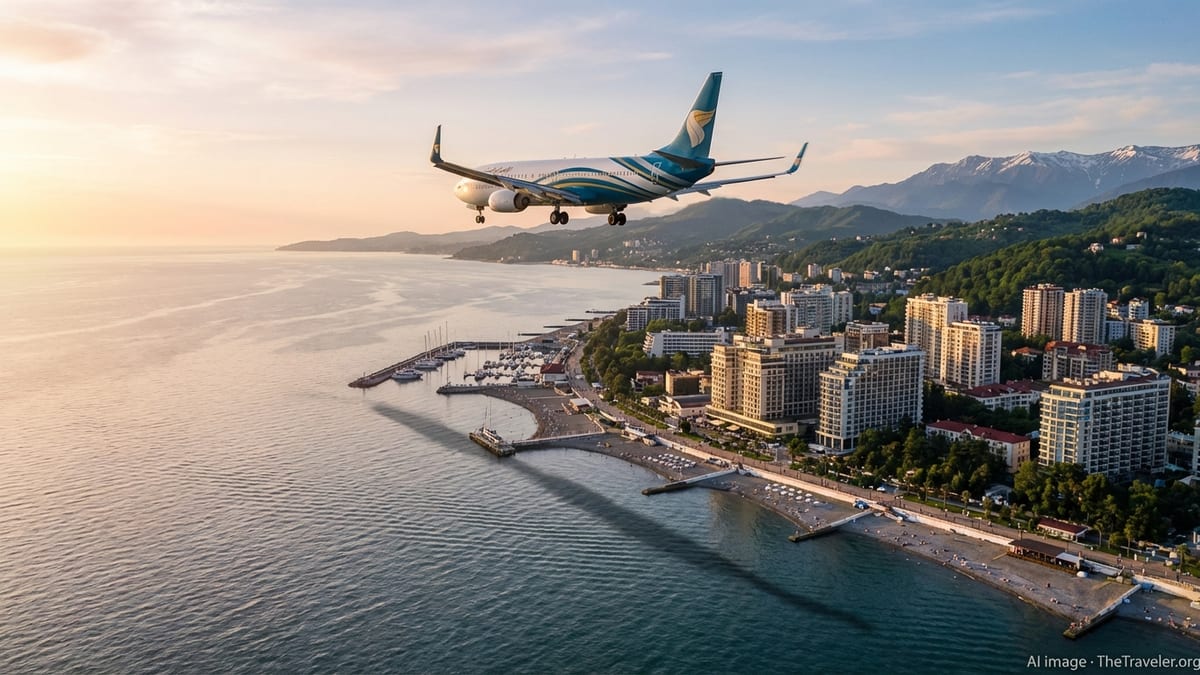
New Route Connects Muscat to Russia’s Black Sea Coast
The national carrier of Oman announced this month that it will launch a direct weekly flight between Muscat and Sochi, Russia’s largest Black Sea resort city. The service is scheduled to commence on 2 July 2026 and will operate year-round, providing a continuous link between the Gulf state and one of Russia’s most important leisure destinations.
The Muscat–Sochi route will be operated with Oman Air’s Boeing 737-8 aircraft, offering both Business and Economy cabins. The flight is designed to plug Sochi directly into Oman’s growing network, giving Russian travelers access not only to the sultanate’s beaches and desert landscapes but also to onward connections across the Middle East, Asia and parts of Africa.
The launch highlights the airline’s strategy of selectively adding high-potential markets rather than chasing rapid capacity growth. By focusing on destinations that can deliver strong point-to-point traffic while feeding its Muscat hub, Oman Air is positioning itself to benefit from shifting tourism flows and evolving demand patterns in the wider region.
The new Sochi service follows a period of route experimentation and seasonal operations between Oman and the Russian resort city. Industry data show Oman Air previously mounted a summer-only Muscat–Sochi operation, while Russian carrier Red Wings secured approval in 2025 to operate a weekly Muscat–Sochi flight, helping to test market appetite and build visibility for the route.
Strengthening a Fast-Growing Russia Network
The Sochi announcement comes as Oman Air deepens its broader presence in the Russian market. The airline already serves Moscow’s Domodedovo Airport from Muscat with up to 11 weekly flights in peak periods, a route that was upgraded to year-round operation in 2025 on the back of strong performance and rising passenger numbers.
Oman Air has also invested in charter services tailored to Russian leisure demand. In December 2025, it launched a seasonal Moscow–Salalah program, bringing visitors directly to the lush Dhofar region in southern Oman during the winter sun season. That operation is supported by a strategic partnership with leading Russian tour operator Fun & Sun, which is packaging flights with hotel stays and excursions.
Together, the Moscow, Salalah and Sochi links are turning Oman into a familiar name among Russian travelers looking for winter warmth, year-round beach options and new cultural experiences. For the airline, Russia has emerged as one of its most promising inbound tourism markets, with capacity carefully aligned to seasonal peaks and charter demand.
By layering Sochi onto an already established Russia portfolio, Oman Air is also improving connectivity for Omani and Gulf-based travelers heading north. The Muscat hub allows passengers from the Middle East, India and Southeast Asia to reach Sochi via a single connection, expanding the catchment area for Russia’s Black Sea coast beyond its traditional European and domestic feeder markets.
Sochi’s Appeal as Russia’s “Riviera”
Sochi, often dubbed the Russian Riviera, offers a mix of subtropical coastline, mountain scenery and modern resort infrastructure that has helped it retain its status as the country’s preeminent Black Sea destination. The city gained widespread international attention when it hosted the 2014 Winter Olympics, a milestone that brought long-term investment in hotels, transport and leisure facilities.
Today, Sochi’s appeal rests on its dual identity as both a seaside escape and a gateway to the Caucasus Mountains. Visitors can swim in the Black Sea in summer, hike or bike in nearby national parks, or head into the mountains for cooler temperatures and alpine landscapes. In winter and spring, the ski areas around Krasnaya Polyana draw domestic and regional tourists seeking snow sports combined with spa and wellness stays.
The city’s climate, often milder than many parts of Russia, supports a long holiday season, while its resort strip is lined with family-friendly hotels, upscale beach clubs and Soviet-era sanatoriums that have been refurbished for modern wellness tourism. For Omani and Gulf travelers, Sochi offers a markedly different environment and cultural backdrop from traditional European beach destinations, yet with comparable infrastructure.
For Russian tourists, meanwhile, the new Muscat–Sochi link opens a two-way flow of traffic. Travelers can pair a Black Sea holiday with an onward journey to Oman, or begin their trip in Muscat and return to Russia via Sochi, taking advantage of seasonal packages that might combine desert experiences, mountain escapes and coastal stays in a single itinerary.
Boost for Oman’s Tourism and Vision 2040 Goals
The Sochi service is closely aligned with Oman’s national tourism strategy, which seeks to raise visitor numbers and diversify the economy under the country’s Vision 2040 framework. Authorities view aviation as a critical enabler of those objectives, with Oman Air charged with driving more direct point-to-point arrivals while supporting the growth of Muscat and Salalah as regional hubs.
Oman Air’s leadership has repeatedly highlighted that point-to-point traffic to Oman has surged since the airline began a transformation program focused on commercially viable routes, tighter connectivity and strong partnerships with tour operators. Additional visitors are expected to generate tens of millions of Omani rials in incremental economic activity each year, supporting jobs in hospitality, retail, transport and cultural attractions.
Opening a direct link from Sochi plays into this strategy by tapping a market where Oman is still relatively new but increasingly visible. Russian travelers are drawn by the sultanate’s combination of safety, accessible nature, authentic heritage and year-round sunshine. The airline and local tourism bodies have been working with Russian travel agents and media to position Oman as both a standalone destination and a multi-stop option in combination with Gulf neighbors.
The new route also complements investments in airport infrastructure, including upgrades at Muscat International Airport and Salalah Airport, which are designed to handle rising passenger volumes and larger transfer flows. Greater air connectivity supports Oman’s aspiration to be seen not only as a leisure destination, but also as a meeting point for business, logistics and cultural exchange across the wider region.
Competitive Dynamics on the Black Sea and Gulf Corridors
Oman Air’s Sochi move comes amid a broader reshaping of air links between the Gulf and Russia’s southern resort belt. Carriers from the United Arab Emirates and Central Asia have in recent years launched or expanded services to Sochi, seeking to capture demand from Russian holidaymakers and diversify their own hub networks.
The entry of Oman Air into the Muscat–Sochi market adds another Gulf-based option for travelers, but the airline’s approach is more targeted than expansive. With a weekly frequency on a narrow-body aircraft and a year-round schedule, the carrier appears to be positioning the route as a sustainable niche service built on robust leisure demand rather than high-frequency business traffic.
At the same time, competition is likely to spur collaborative opportunities, including interline and codeshare arrangements that could develop over time as demand patterns stabilize. For Sochi, additional Gulf connections mean a broader geographic spread of visitors and more resilience against fluctuations in any single source market.
For Oman, the route enhances its role as an alternative gateway between Russia and the wider Middle East and Asia, supplementing established larger hubs in the region. Travelers connecting through Muscat can access a network of more than 40 destinations, from Southeast Asia to East Africa, creating new itinerary combinations that may appeal to both Russian and international passengers.
Operational Details and Passenger Experience
According to the schedule released by Oman Air, the Muscat–Sochi service will operate once a week, with timings designed to plug efficiently into the airline’s existing bank of regional and long-haul departures. Using Boeing 737-8 aircraft allows the carrier to match capacity to anticipated demand while offering a modern cabin product consistent with its brand positioning.
The aircraft features a two-class layout, with lie-back Business Class seats and Economy seating configured to balance comfort and density on the medium-haul sector between Oman and Russia’s Black Sea coast. Oman Air has emphasized that the route will offer its signature inflight hospitality, including Arabic-inspired service touches, regional cuisine options and a curated entertainment selection.
From an operational standpoint, the 737-8 provides fuel efficiency benefits that can be critical on new or developing markets. The type’s range and economics give the airline flexibility to adjust capacity or aircraft rotations as the route matures without the overheads associated with deploying larger wide-body jets.
Check-in and ground services for the Sochi flight will be handled through Muscat International Airport’s main terminal, where recent enhancements have improved transfer flows and reduced minimum connection times. This helps strengthen the proposition for passengers originating beyond Oman, who can reach Sochi in a single stop from cities such as Dubai, Jeddah, Mumbai or Bangkok via the Muscat hub.
Economic and Cultural Implications for Both Countries
Beyond tourism, the new Sochi service carries wider economic and cultural implications. Direct air links tend to support growth in bilateral trade, investment and people-to-people exchanges by lowering the barrier to travel and encouraging repeat visits. Businesses in sectors such as construction, energy services and logistics often follow in the wake of new air connectivity, exploring opportunities that benefit from closer physical access.
For Russia, added capacity to Oman’s capital and its southern tourism centers supports efforts to diversify outbound travel choices and sustain resort economies like Sochi throughout the year. The Muscat connection may encourage Russian investors and entrepreneurs to look at the Gulf state’s free zones, logistics parks and tourism ventures, especially as Oman courts foreign investment aligned with its diversification agenda.
Culturally, the route offers more residents in both countries the chance to experience unfamiliar landscapes and traditions. Russian visitors can discover Omani forts, wadis, mountain villages and coastal towns, while Omani and Gulf travelers are exposed to the architecture, cuisine and natural scenery of Russia’s Black Sea coast and the Caucasus foothills.
In the medium term, increased traffic between Muscat and Sochi could spur collaborations in sports, education and events. Sochi’s experience as a host city for major international competitions and conferences may intersect with Oman’s ambitions to attract more regional gatherings and high-profile tourism events, creating a cross-pollination of expertise and visitor flows.
A Measured Expansion Strategy With Global Reach
The Muscat–Sochi launch fits into a pattern of measured expansion at Oman Air, which has lately favored selective network additions over rapid, capacity-heavy growth. Recent announcements, including new routes within the Gulf and enhanced frequencies to key Asian cities, indicate an emphasis on routes that can simultaneously feed the hub and drive inbound tourism.
By choosing Sochi, the airline is signaling confidence in Russia as a resilient source market and in the long-term appeal of Black Sea tourism. The route also underscores Oman’s intention to compete in the premium leisure segment, where travelers are increasingly seeking destinations that offer authenticity, outdoor activities and cultural depth rather than mass-market resort experiences.
As the first flights take off in July 2026, aviation analysts will be watching load factors, seasonal booking patterns and the balance of inbound and outbound traffic on the route. Early performance is likely to guide decisions on potential frequency increases, charter add-ons or bundled tour products that could deepen the link between Oman and Russia’s southern coastline.
For now, the new service marks another incremental but symbolically important step in Oman Air’s evolution from a primarily regional player to a carrier with a diversified network and a growing profile in key tourism and leisure markets across Eurasia.