

More news on this day
As airspace closures and missile strikes across the Gulf cripple once-busy hubs from Dubai to Doha, Muscat International Airport has emerged as an improbable lifeline, with Oman Air and a patchwork of emergency services helping thousands of stranded travellers thread one of the last safe corridors out of the Middle East.
A Sudden Shift in the Gulf’s Aviation Map
Until late February, Muscat International Airport was a growing but secondary Gulf hub, overshadowed by mega-airports in Dubai, Doha and Abu Dhabi. That hierarchy flipped in a matter of days when a spiralling conflict involving the United States, Israel and Iran triggered sweeping airspace closures and brought much of the region’s commercial aviation to a halt.
Missile exchanges and security concerns prompted authorities in Iran, Iraq, Kuwait, Bahrain, Israel and parts of the United Arab Emirates to restrict or shut their skies, forcing airlines to cancel or divert hundreds of flights. Dubai International and Hamad International in Doha, normally among the world’s busiest transit hubs, saw operations slashed to a trickle of evacuation and repatriation services.
Oman, by contrast, kept its airspace and its main airport open to scheduled traffic, subject to tightened security procedures and rapidly evolving risk assessments. Aviation analytics firms report that, as of the start of March, Oman had one of the lowest cancellation rates in the region, even as neighbouring hubs recorded mass disruption and ground stops.
The result has been a dramatic rerouting of both aircraft and passengers. Flight-tracking maps that once showed dense traffic over the central Gulf now depict a broad arc of jets funnelling south of the conflict zone, threading through Omani airspace and converging on Muscat as a staging point for onward travel.
Oman Air Stretches to Meet Surging Demand
At the centre of this emergency reconfiguration sits Oman Air, the country’s flag carrier. With many regional competitors forced to suspend routes or relocate operations, the airline has expanded its role from a boutique full-service carrier into a critical connector for displaced travellers trying to reach Europe, South Asia and beyond.
Oman Air has continued to operate key long-haul services from Muscat, while cancelling or trimming a number of regional flights where airspace access or insurance coverage has become uncertain. Industry notices show that airlines serving Muscat have been required to refile flight plans to skirt closed corridors, adding time and fuel costs but preserving essential links between continents.
The carrier has also become a vital bridge for those escaping shuttered hubs elsewhere in the Gulf. Travellers stranded in Dubai and Abu Dhabi describe hastily arranged overland journeys through the desert, enduring night-time queues at the Oman border before securing precious seats on Oman Air departures out of Muscat. Taxi fares for the cross-border run have soared, turning what was once a relaxed weekend drive into an expensive, high-stakes evacuation route.
Inside the terminal, Oman Air staff have been thrust into crisis-management mode. Ground agents are juggling rolling schedule changes, last-minute rebookings and a surge of distressed passengers arriving without confirmed onward tickets. The airline has urged travellers not to appear at the airport without verified reservations and has warned those crossing by land to allow as much as 12 hours to clear congested borders before scheduled departures.
Muscat Airport Under Strain as ‘Last Safe Haven’
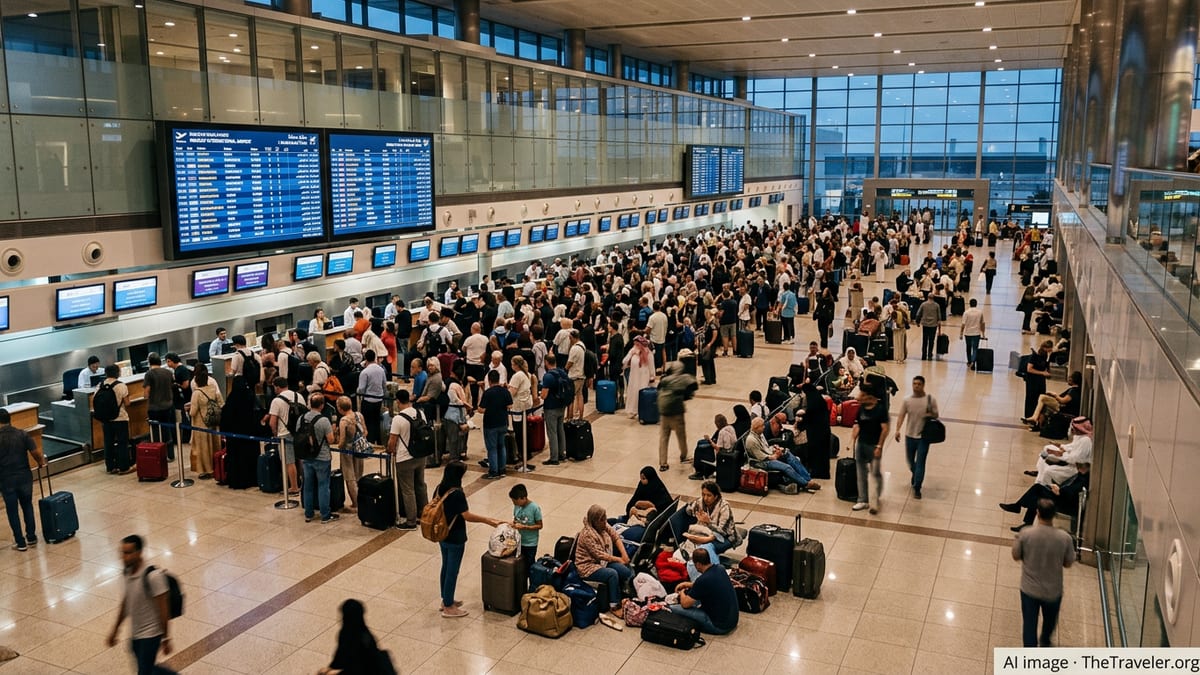
Muscat International itself has been transformed. Ordinarily a calm, modern facility handling a growing mix of business and leisure traffic, the airport is now crowded with families clutching hastily packed bags, tour groups sleeping on the floor and business travellers hunched over laptops as they work the phones for any available seat.
Airport authorities have responded by tightening access, at times limiting terminal entry to ticketed passengers and deploying additional security screening. Airlines and slot coordinators say Muscat has now capped most new commercial arrivals, prioritising embassy-backed repatriation flights and pre-approved extra sections aimed at clearing the backlog of stranded tourists and expatriate workers.
Despite the crush, Muscat retains what many other regional hubs currently lack: a relatively stable operating environment. Runways and taxiways are fully functional, ground handling teams are in place and, while some international regulators have flagged theoretical spillover risks from the wider conflict, there have been no direct attacks on Omani aviation infrastructure.
This combination of operational continuity and perceived safety has led some observers to describe the airport as the Gulf’s “last safe haven” for commercial travellers. Airlines from Europe and Asia have quietly added Muscat tags or temporary rotations, turning the airport into an improvised bridge between otherwise disconnected parts of their global networks.
Global Airlines Pivot Through Oman
The ripple effects of Muscat’s new status are being felt far beyond the Arabian Sea. Carriers that once relied on Dubai, Doha or Abu Dhabi as their primary Middle East hubs are now using Oman as an alternate transit point or emergency collection hub for displaced passengers.
Qatar Airways, forced to curtail normal connecting flows through Doha, has set up temporary operations in Oman to help move travellers onward to Europe and Asia. European airlines have filed special Muscat services, including short-notice relief flights aimed at bringing home citizens who were caught mid-journey when the conflict flared and their original connections vanished.
One northern European carrier has launched a series of dedicated Muscat to Helsinki rotations designed to repatriate more than a thousand passengers. The first flight is prioritising vulnerable travellers, including families with young children and those requiring medical assistance, with additional sorties planned as airspace assessments permit.
For airlines and aviation regulators, the situation presents a delicate balancing act. While Oman offers one of the few viable corridors around the central conflict zone, European authorities have issued conflict-zone bulletins reminding carriers that missile and air defence activity in the wider region still poses a theoretical risk. Flight plans are being continuously adjusted to thread narrow, approved routes while maintaining safe distances from active combat areas.
Stranded Travellers Navigate a Patchwork of Escape Routes
For individual travellers, the upheaval has turned routine itineraries into complex odysseys. Accounts emerging from Muscat describe journeys involving multiple cancellations, sleepless nights in closed Gulf airports and hurried drives across borders to reach what is, for now, one of the few functioning gateways out of the region.
Many of those arriving at Muscat have already endured days of uncertainty in cities like Dubai, Abu Dhabi and Doha, where local authorities have prioritised evacuation and charter operations over regular commercial services. Others have come from further afield, including South and Southeast Asia, where airlines have cut dozens of flights to Middle Eastern destinations in response to the conflict and related airspace restrictions.
At Muscat, passengers are finding some relief but little predictability. Departure boards change by the hour as airlines secure new overflight permissions or stand down services in response to updated security assessments. Long queues form at airline desks as travellers seek to rebook onto scarce seats. Hotels in and around the airport are heavily booked, leaving some families to camp in public areas while they wait for new connections.
Travel advisers are urging those yet to depart to treat Muscat as a last-resort transit point rather than a guaranteed escape. Travellers are being told to verify that flights are confirmed and operating before setting out, to carry printed documentation of tickets and visas, and to prepare for extended layovers in the event of further airspace closures.
What Comes Next for Oman’s Sudden Aviation Hub
The sustainability of Muscat’s role as an emergency hub remains uncertain. Omani officials have signalled that the airport cannot absorb unlimited diversion traffic without compromising safety and service standards, hence the recent move to restrict new commercial slots and prioritise government-coordinated repatriation operations.
Aviation analysts note that while Omani airspace is currently one of the most reliable corridors around the central conflict zone, it is still subject to the same geopolitical forces that have upended the wider region. Any significant escalation, or a change in risk tolerance by major regulators or insurers, could quickly force a further reshaping of routes and available capacity.
For now, however, Muscat International Airport and Oman Air occupy a pivotal position in the global air network. As long as the conflict keeps other Gulf hubs constrained, the airport is likely to remain a vital pressure valve, quietly shuttling thousands of travellers out of a war-shadowed region and back onto the world’s fragmented flight map.