

More news on this day
Passengers transiting through Muscat’s Seeb International Airport are facing fresh uncertainty after Oman Air cancelled six key flights, stranding travellers and disrupting already fragile connections to Bahrain International Airport and Dubai International Airport.
Get the latest news straight to your inbox!
Targeted Cancellations Hit Bahrain and Dubai Connections
Publicly available flight information and regional aviation advisories indicate that Oman Air has withdrawn a cluster of services linking Muscat with key Gulf hubs, including routes that normally feed traffic to Bahrain International and Dubai International. The latest round of cancellations involves six Oman Air flights in a single operational window, intensifying the pressure on Seeb International Airport, which has been acting as a diversion and relief hub during the wider Gulf airspace disruption.
Travel data for late March 2026 shows repeated schedule changes, with certain Muscat services to Bahrain and Dubai removed or re-timed at short notice. While some Oman Air operations continue, particularly longer-haul flights connecting Asia and Europe via Muscat, the selective cancellation of these regional links is creating acute difficulties for passengers who had relied on Muscat as a safe alternative to airports directly affected by recent missile and drone activity.
Advisories from logistics and aviation firms describe the broader pattern as one of constrained but open airspace over Oman, combined with route suspensions driven by operational risk assessments, congestion and network reprioritisation. In this context, Oman Air’s decision to cut multiple departures on the same day has translated into ground-level disruption for travellers already coping with limited options out of the Gulf.
Reports from passengers suggest that the cancellations were communicated unevenly, with some travellers receiving notifications only after arriving at the airport or during transit. This has reinforced perceptions of unpredictability around short-haul Gulf flights, even as long-haul corridors through Muscat remain comparatively more stable.
Stranded Travellers Face Long Waits and Tight Capacity
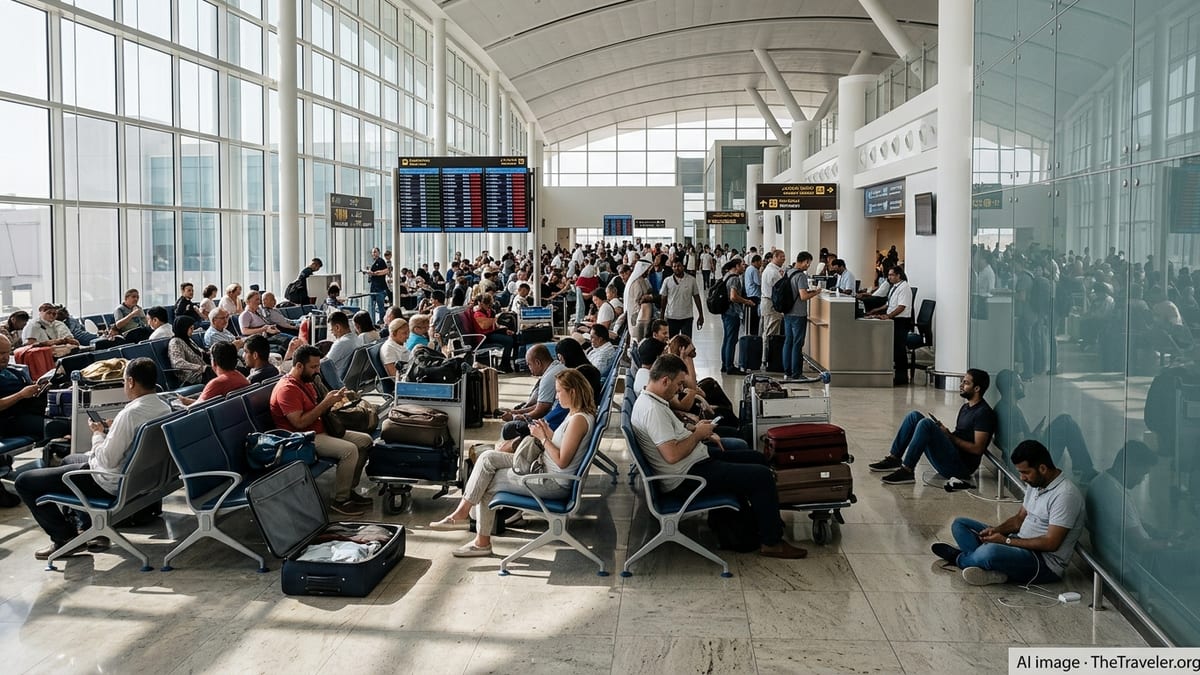
Accounts shared on social platforms and in regional media describe scenes of crowded departure halls and long queues at Muscat as passengers attempt to rebook onto scarce remaining services. With Bahrain’s airspace still heavily restricted and Dubai’s operations described in industry briefings as fragile and intermittent, Oman Air’s cancelled flights have removed what many saw as a critical bridge between disrupted Gulf gateways.
Travelers bound for Bahrain International have been particularly affected, as Bahrain’s closure to most civilian traffic has shifted demand onto any remaining indirect options via Oman or Saudi Arabia. When Oman Air pulled six services out of its schedule, that demand was forced into an even smaller pool of flights operated by other carriers or into lengthy overland detours.
For passengers hoping to reach Dubai International, Muscat has functioned as a staging point during the crisis, with some travellers arriving in Oman by air or via the UAE–Oman land border and then connecting onward. The loss of multiple Oman Air services in a short span has left some of these itineraries broken, requiring last-minute hotel stays, extended layovers, or complete rerouting through more distant hubs such as Riyadh, Jeddah or New Delhi.
Industry advisories highlight that while Omani airspace remains open, available capacity out of Muscat is “oversubscribed,” with additional diversion traffic and evacuation-style services vying for slots. Under these conditions, a cluster of cancellations can tip already stretched schedules into visible disruption for the travelling public.
Regional Security Crisis Shapes Airline Decisions
The cancellations at Seeb International Airport are unfolding against the backdrop of an evolving Gulf security crisis linked to the 2026 Iran war and subsequent strikes across the region. Publicly accessible summaries of the situation describe a patchwork of airspace closures and restrictions stretching from Bahrain and Qatar to parts of the United Arab Emirates, alongside heightened risk levels in key shipping lanes.
Advisories from shipping and aviation consultancies note that Oman’s airspace is technically open, but many international airlines have nevertheless altered routings, suspended selected flights, or diverted traffic into Muscat in order to avoid higher-risk zones. Dubai International, one of the world’s busiest hubs, has reported intermittent suspensions and phased resumptions of service following strikes near aviation infrastructure, adding to the volatility.
Bahrain’s airspace, by contrast, remains under a prolonged closure notice, cutting off routine passenger and cargo movements and forcing airlines either to suspend Bahrain-bound flights altogether or to rely on complex transit itineraries. In this environment, Oman Air’s Muscat–Bahrain services represented one of the more direct links between an operational hub and a heavily restricted destination; their cancellation amplifies the sense of isolation for travellers with essential reasons to reach Bahrain.
Risk assessments used by airlines typically weigh the security threat level, air traffic control constraints, and the viability of alternate routings. Observers of the current situation suggest that shifting operational priorities, pressure on crew schedules, and the need to free capacity for longer-haul and emergency-oriented flights are all likely factors behind the decision to cut several short-haul Gulf services in quick succession.
Knock-On Effects Across the Gulf Travel Network
The immediate impact of Oman Air’s six flight cancellations is being felt in Muscat, but the knock-on effects extend across the Gulf and beyond. With Muscat acting as a relief hub for travellers diverted from closed or compromised airports, any loss of scheduled connectivity can ripple outward into airline networks in Europe, Asia and Africa.
Travel advisories circulated to corporate clients highlight that Muscat has become a key pivot point for rerouting passengers originally booked through Dubai, Abu Dhabi, Doha or Manama. Bus transfers from the UAE into Oman have been used to bridge broken air links, but these road corridors themselves are under strain, with border crossings reporting heavy traffic and extended processing times.
When Oman Air trims its schedule, the burden shifts to other carriers operating from Muscat, some of which are already running at or near capacity. As a result, rebooking options may involve longer journeys, overnight layovers, or flights via secondary hubs that were not part of travellers’ original plans. This adds complexity for travel managers working to keep staff movements compliant with corporate risk policies while also controlling costs.
Beyond individual itineraries, the cancellations underline how interconnected Gulf aviation has become. The removal of a handful of short-haul services at one airport can now affect seat availability and pricing on far-flung routes, particularly at a time when airspace closures have already squeezed regional capacity.
What Travellers Need to Know Before Flying via Muscat
For passengers considering itineraries through Muscat in the coming days, recent developments around Oman Air’s cancellations underscore the importance of flexibility and contingency planning. Reports from regional travel forums indicate that same-day tight connections, especially those involving onward travel to Bahrain or Dubai, carry an elevated risk of misconnection or last-minute cancellation.
Travel specialists recommend building generous buffers into itineraries routed through Seeb International Airport, including the possibility of overnight stays in Muscat where practical. Passengers connecting from the UAE by road are being advised in public notices to allow substantial extra time at land borders, reflecting heavy traffic volumes and slower processing tied to the wider regional situation.
With schedules subject to change, travellers are also encouraged to monitor their bookings frequently and to pay close attention to airline and airport advisories regarding check-in deadlines, minimum connection times and any temporary changes to terminal operations. Those connecting onward to destinations with their own airspace restrictions may face cascading disruptions if upstream flights are delayed or cancelled.
While Omani airspace remains open and Muscat continues to serve as a critical conduit in the Gulf, the cancellation of six Oman Air flights illustrates how quickly conditions can shift. Travellers using the hub in the current environment may benefit from flexible tickets, robust travel insurance and a willingness to adjust plans as the regional aviation picture evolves.