

More news on this day
Oman Air has expanded its list of suspended routes to include Dubai alongside Doha, Kuwait City, Amman, Dammam, Baghdad, Manama and several other destinations, as the widening Middle East conflict continues to snarl airspace and disrupt travel across the region.
Get the latest news straight to your inbox!
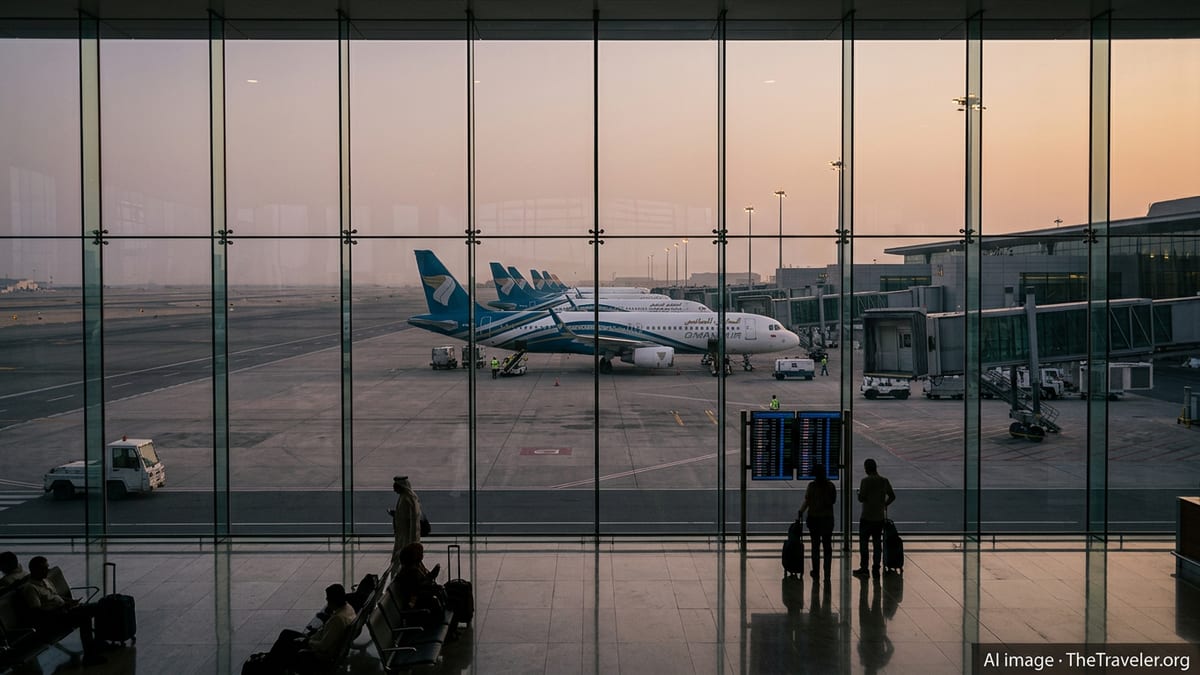
Dubai Added to Growing List of Suspended Oman Air Routes
Dubai has now joined a roster of key Gulf and Levant cities temporarily cut from Oman Air’s network as the carrier reacts to rapidly changing security conditions and airspace closures. In recent days, the airline has confirmed that flights to and from Dubai, Doha, Kuwait City, Amman, Dammam, Baghdad and Manama are among services either cancelled outright or suspended for multiple days in March 2026.
Operational data published by regional aviation trackers and flight coordination bodies indicates that Oman Air’s cancellations initially focused on departures scheduled for 6, 7 and 8 March, affecting services to Amman, Dubai, Bahrain, Doha, Dammam, Kuwait, Copenhagen, Baghdad and Khasab. As the conflict escalated and more airspace restrictions were imposed, those selective cancellations evolved into broader suspensions on several city pairs.
Separate travel advisories compiled by consumer and compensation platforms confirm that Oman Air’s disrupted network now stretches from nearby hubs like Dubai and Doha to longer-haul links such as Copenhagen. These notices highlight that the airline’s suspensions run at least through the first half of March, with some destinations facing longer-term uncertainty as governments and aviation regulators reassess risk levels.
While Dubai International Airport has begun a phased resumption of operations after temporary shutdowns, airlines serving the emirate remain cautious. Oman Air’s decision to keep Dubai off its schedule through at least mid-March reflects that caution, even as other carriers tentatively restore limited frequencies into the airport’s constrained airspace.
Timeline of Cancellations and Extent of the Disruption
The latest wave of Oman Air flight cancellations began in the final days of February and accelerated in early March, coinciding with missile and drone attacks across multiple Gulf states and retaliatory strikes involving Iran, the United States and Israel. Industry summaries show that from 6 to 8 March, Oman Air cancelled a cluster of departures to Amman, Dubai, Bahrain, Doha, Dammam, Kuwait, Copenhagen, Baghdad and Khasab as corridors across the northern Gulf and Levant were deemed unsafe or restricted.
Subsequent advisories from travel management firms and regional airport operators describe a patchwork of closures and partial reopenings that left airlines revising schedules on an almost daily basis. In this environment, Oman Air extended suspensions on some regional routes beyond the initial three-day window, with media in the Gulf reporting that services to Dubai, Doha and at least seven other destinations would not resume before mid-March.
At the same time, Omani authorities have stressed that the country’s own airspace remains open, even as traffic patterns change. Analyses from aviation consultants note that Muscat’s airports were fully operational, but that some airlines chose to cancel or reroute flights as a precaution. Oman Air’s decisions reflect both external constraints, such as closed neighboring airspace, and internal judgments about acceptable overflight risks for crews and passengers.
The timeline is further complicated by intermittent ground disruptions. Reports from regional security firms describe episodes of smoke and debris near Dubai International Airport, along with temporary suspensions at major hubs in the United Arab Emirates and Qatar. These events contributed to knock-on cancellations throughout airline networks, including Oman Air’s, as aircraft and crews were left out of position or unable to transit usual routes.
What Destinations Are Most Affected for Oman Air Travelers
For passengers booked on Oman Air, the most visible impact is on short- and medium-haul routes connecting Muscat with neighboring Gulf and Levant cities. Flights to Dubai, Doha, Kuwait City, Dammam, Manama and Baghdad have been among the most consistently disrupted, reflecting both their proximity to flashpoint areas and their reliance on airspace that has at times been closed or heavily restricted.
Travel advisories compiled in recent days indicate that services involving Iraq, Lebanon and Iran are facing the longest suspensions across multiple carriers, including Oman Air. Regional aviation briefings suggest that routes touching these countries may remain on hold through late March, in line with international risk assessments that classify their skies as high-threat zones for civil aviation.
By contrast, some Gulf corridors that do not require traversing those hotspots have seen more limited disruption. Muscat’s role as a southern gateway has allowed Oman Air to preserve operations on several routes to South Asia, East Africa and selected European cities, even as near-neighbor markets such as Dubai and Doha experience prolonged reductions. The airline has also worked around suspensions by increasing frequencies to certain long-haul destinations, using them as alternative gateways for transit passengers.
Nevertheless, travelers whose itineraries include Dubai or other affected hubs should be prepared for complex re-routing. With many regional competitors also cutting service, spare capacity is tight. Travel agents report that seats on alternative flights out of Muscat, particularly to Europe and major South Asian gateways, have been in high demand as passengers scramble to adjust their plans.
Oman Air’s Rebooking Policies and Strategic Response
In response to the unfolding crisis, Oman Air has introduced flexible options for affected passengers, including voluntary rebooking and refund pathways. Consumer-facing advisories summarize that travelers holding tickets for journeys in early to mid-March can typically change their travel dates without additional charges or, in some cases, request refunds if their flights have been cancelled. The precise terms vary by ticket type and route, but the overarching message is that customers should not travel to the airport without first confirming their flight status and options.
The airline has complemented its cancellations with selective capacity increases on routes deemed safe and strategically important. Industry monitoring shows that Oman Air has recently scheduled extra services to hubs such as London, Istanbul, Bangkok and other long-haul markets, seeking both to accommodate stranded passengers and to capitalize on Muscat’s position as an alternative transit point while other Gulf hubs face constraints.
Aviation analysts describe this as a balancing act between risk management and opportunity. On one hand, Oman Air must demonstrate prudence by suspending operations into zones where flight paths might intersect with military activity. On the other, it aims to maintain connectivity for Oman and support regional mobility by reinforcing corridors that remain viable under current safety assessments.
These strategic moves come at a time when airlines across Europe and the Middle East are reevaluating their exposure to the region. Several European groups have extended suspensions into Dammam, Dubai, Amman, Beirut and Tehran, adding to the competition for safe routing options. Oman Air’s emphasis on Muscat as a stable, southern transit node is designed to position the carrier as a resilient player amid volatile conditions.
Advice for Travelers Caught Up in the Middle East Flight Turmoil
With flight schedules changing frequently, travel experts are urging Oman Air passengers to adopt a proactive approach. The most consistent guidance is to check flight status and any updated travel advisories repeatedly in the 24 hours before departure, and again on the day of travel. Where services to Dubai, Doha, Kuwait City, Amman, Dammam, Baghdad or Manama remain suspended, travelers are encouraged to explore rebooking on alternative Oman Air routes or to adjust their itineraries to connect via cities where operations are stable.
Travel management companies also recommend that business and leisure travelers consider postponing nonessential trips to the most affected states and cities, particularly where local airports have faced direct security incidents or extended closures. For those who must travel, purchasing flexible tickets, maintaining comprehensive travel insurance and allowing larger buffers between connecting flights can help mitigate the risk of missed onward connections.
Experts note that as long as airspace closures and security alerts persist, the situation will remain fluid. Oman Air’s route map for March is likely to look different from week to week, with suspensions lifted or extended depending on diplomatic developments and security assessments. Travelers planning journeys through Muscat or on connecting flights across the Gulf are advised to remain adaptable, monitor official airline communications closely and stay in touch with travel agents who can help navigate sudden changes.
For now, Dubai’s addition to the list of affected Oman Air destinations underscores how deeply the conflict has penetrated the heart of regional aviation. What was once one of the world’s most predictable and highly connected air corridors has become a patchwork of temporary closures, diversions and cancellations, leaving carriers like Oman Air to constantly recalibrate their operations and leaving passengers to grapple with an unusually uncertain travel landscape.