

More news on this day
Oman Air has extended cancellations on nine key regional and European routes until March 15, 2026, as the United Arab Emirates joins Qatar, Oman, Saudi Arabia, Denmark and other nations in tightening airspace controls in response to an escalating security crisis across the Middle East.
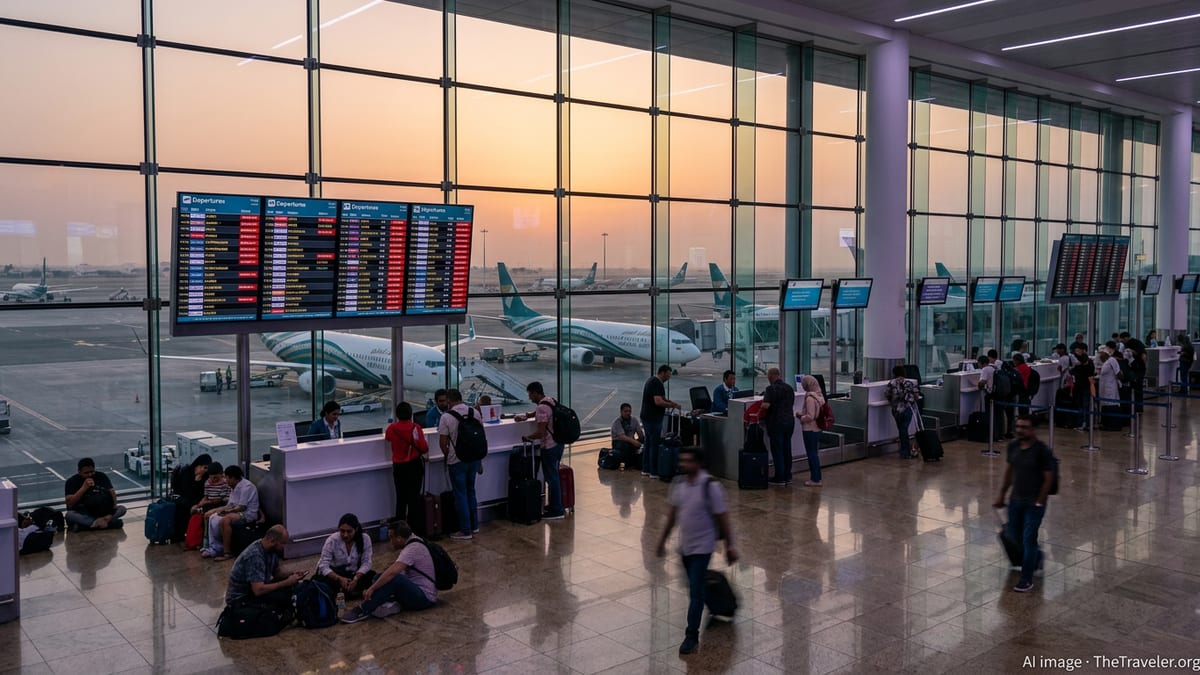
Expanded Cancellations Hit Gulf and European Gateways
Oman Air confirmed that all flights to and from Amman, Dubai, Bahrain, Doha, Dammam, Kuwait, Copenhagen, Baghdad and Khasab are cancelled for services scheduled between March 9 and March 15, 2026. The airline said the decision follows continued regional airspace closures and evolving risk assessments along key Gulf and Levant corridors.
The suspended destinations form the backbone of Oman Air’s short and medium haul network, linking Muscat with major Gulf hubs, political capitals and a strategic Northern Europe gateway in Copenhagen. The extension through March 15 follows an earlier wave of cancellations in the first week of March, underlining that what began as a short-term shock is now a protracted disruption.
Oman Air explained that the affected routes are those most exposed to restricted or contested airspace and to potential missile or drone activity, as authorities and airlines respond to military escalation involving Iran, Israel, the United States and regional states. Services on other routes remain under review, with schedules subject to late changes as the situation develops.
The carrier has urged passengers not to travel to the airport unless they hold a confirmed booking on an operating flight and to monitor official channels for rebooking options, waivers and limited alternative services via still-open corridors.
UAE Joins Regional Clampdown on Airspace
The United Arab Emirates has moved from initial emergency closures to a more structured regime of partial restrictions and controlled operations at its major hubs, including Dubai and Abu Dhabi. Authorities have framed these measures as necessary to protect civil aviation from the risk posed by missiles, drones and air defence activity across several overlapping conflict zones.
The UAE’s stance aligns it with Qatar, Oman, Saudi Arabia, Denmark and a growing list of states that have tightened overflight permissions or curtailed operations in response to the crisis. While policies differ by country, the overall effect is a patchwork of closures and routing constraints that complicate both regional and long haul planning for airlines.
For carriers like Oman Air, the UAE’s restrictions are particularly consequential. Dubai and Abu Dhabi function not only as destination markets but also as critical transfer points for passengers heading onward to Europe, Asia and Africa. With the Emirati hubs operating under tight controls and neighbouring airspace partially closed, Muscat’s role has shifted from a convenient connection point to a pressured lifeline.
Aviation analysts say the coordinated, though uneven, actions by Gulf and European regulators reflect both heightened security concerns and a desire to limit exposure near active conflict zones. The result is an unprecedented reshaping of flight paths over a region that normally serves as one of the world’s busiest air bridges.
Knock-on Effects for Travelers Across the Middle East and Europe
The extension of Oman Air’s cancellations through mid March adds to the strain facing travelers already hit by earlier suspensions by major Gulf and international airlines. Passengers booked to or through the nine affected destinations are finding that alternative options are limited and often significantly more expensive, as remaining carriers and routes absorb displaced demand.
In Muscat, airport authorities have kept terminals open and operational, but report heavy congestion at airline counters as travelers seek rerouting, refunds or accommodation. Similar scenes have played out in Dubai, Doha and other hubs where connecting flows have been severed or drastically reduced by airspace bans and last minute schedule changes.
European travelers are also feeling the impact, particularly those using Copenhagen and other northern gateways that connected into Oman Air’s network. With the Gulf region serving as a critical bridge between Europe and destinations across Asia and Africa, the loss of even a single carrier’s capacity on key sectors can ripple quickly across multiple markets.
Travel advisors in both the Middle East and Europe are urging passengers to build in significant flexibility, avoid non essential journeys through affected hubs, and review insurance coverage and airline waiver policies carefully, as standard compensation rules frequently do not apply to security related disruptions.
Airlines Reroute and Consolidate as Airspace Map Redraws
Behind the immediate cancellations lies a complex operational puzzle. With parts of the airspace over Iran, Iraq and portions of the Gulf effectively off limits, airlines are racing to redesign routings around a narrower set of safe corridors, often adding hours to flight times and sharply increasing fuel and crew costs.
Oman, Saudi Arabia and a handful of neighbouring states have emerged as pivotal waypoints in this new geography of the skies. Even as Oman Air cancels high risk regional sectors, Muscat’s airspace remains one of the few relatively stable options for long haul overflights, intensifying pressure on air traffic management, ground handling and infrastructure.
Carriers based in the UAE, Qatar and Saudi Arabia have responded with a mix of temporary suspensions, long detours over Central Asia or the Red Sea, and consolidation of services onto fewer, larger aircraft. European airlines, meanwhile, are weighing whether to maintain reduced frequencies into the Gulf, switch to alternative hubs, or pause some routes altogether until the security picture improves.
Industry experts note that Denmark’s heightened scrutiny of overflights and operations to and from affected regions is part of a broader move by European regulators to reassess risk tolerances following the sudden escalation. That reassessment is driving more conservative routing decisions, further limiting the flexibility of airlines already operating on thin margins.
What Passengers on Oman Air Should Do Now
For Oman Air customers scheduled to travel on the nine suspended routes up to and including March 15, the airline is offering a mix of date changes, rebooking on alternative routes where available, and refunds in certain cases. The exact options vary by ticket type, point of purchase and itinerary, and may change as the disruption continues.
Travelers are being advised to rely only on official airline communications and to check flight status repeatedly in the 24 hours before departure, as operational decisions are being updated in near real time. Those with complex itineraries involving multiple carriers or codeshares may need to coordinate across airlines to secure through rebooking or to restructure their journeys entirely.
Given the heightened security environment and evolving airspace rules, airports in Oman, the UAE, Qatar and Saudi Arabia are encouraging passengers to arrive earlier than usual and to prepare for additional screening and potential delays, even on flights that are operating normally.
With no clear timeline for a full reopening of closed or restricted airspace, Oman Air’s extension of cancellations to March 15 is widely seen as a benchmark for other regional carriers. Travelers planning trips through the Gulf and wider Middle East in the weeks ahead are being urged to monitor conditions closely and to plan for continued schedule volatility.