

More news on this day
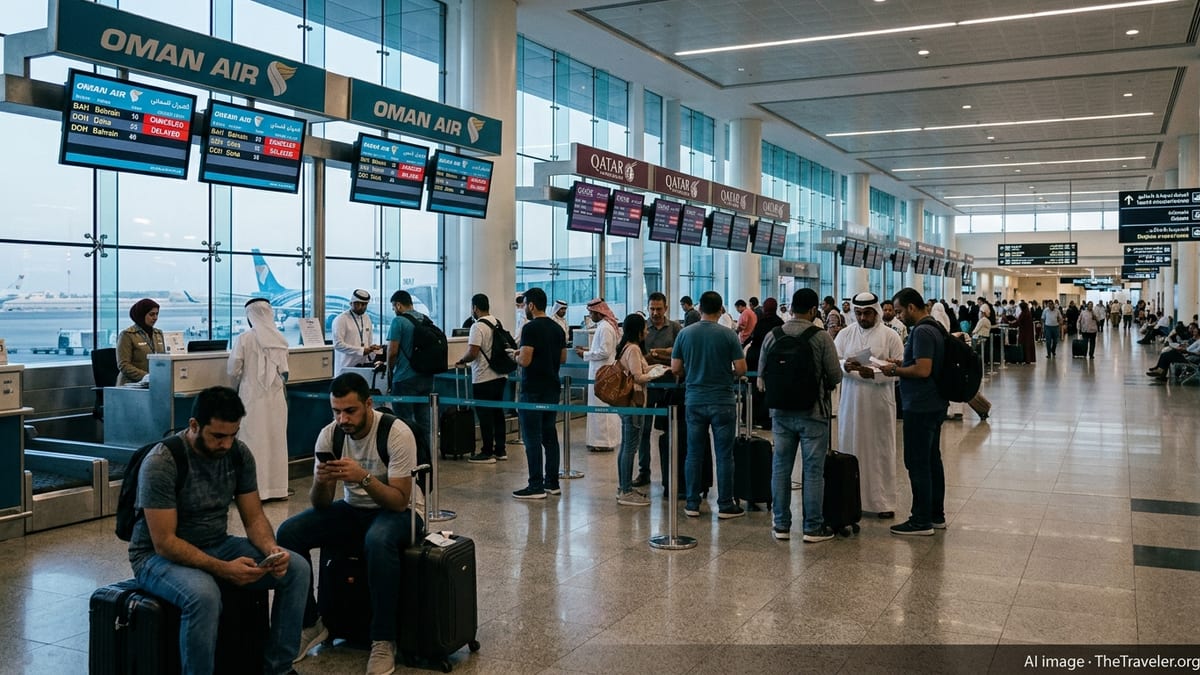
Passengers traveling through Oman faced renewed disruption this week as Oman Air and Qatar Airways canceled additional services from Muscat’s Seeb International Airport to Bahrain and Doha, compounding weeks of instability in regional air travel.
Get the latest news straight to your inbox!
New Cancellations Intensify Ongoing Disruptions
Reports from flight-tracking boards and passenger accounts indicate that three more departures linking Muscat with Bahrain and Doha were withdrawn at short notice, affecting travelers booked on both Oman Air and Qatar Airways itineraries. The latest cancellations add to a rolling series of schedule changes that have already forced many passengers to rebook or reroute journeys through alternative hubs.
Publicly available information shows that services between Muscat and Bahrain, as well as Muscat and Doha, have been especially vulnerable as regional air corridors are periodically adjusted. Some travelers reported seeing their Muscat departures listed as "canceled" for Bahrain and Doha sectors shortly before planned check in, leaving limited time to make alternative arrangements.
The disruption comes at a time when Gulf carriers are still working to stabilize their networks after earlier waves of shutdowns and re-routings linked to broader Middle East security tensions. While many long-haul flights continue to operate using revised routings, short regional hops such as Muscat to Bahrain and Muscat to Doha remain among the most frequently altered.
Regional Airspace Instability Behind Schedule Volatility
Analysts note that airlines serving Oman, Bahrain, and Qatar have been contending with a highly fluid operating environment since late February 2026, when airspace restrictions and intermittent closures across parts of the Middle East triggered widespread cancellations. Published assessments of the situation describe thousands of flights scrubbed or diverted as carriers adjusted routes around temporary no-fly zones and constrained corridors.
In this context, the additional cancellations from Seeb International Airport appear to reflect a mix of operational caution and limited capacity on safe, approved routings. Short-haul sectors between Gulf capitals are particularly sensitive to sudden airspace changes because they often rely on narrow corridors and tight scheduling, leaving little margin to absorb further restrictions or delays.
According to regional aviation coverage, authorities in several neighboring states, including Bahrain and Qatar, have at various points restricted or partially reopened their airspace under controlled conditions. Even when navigation is technically possible, airlines may proactively cancel or consolidate flights if available routings add significant time, fuel burn, or complexity that undermines the economics or reliability of a short sector.
Impact on Passengers: Missed Connections and Last-Minute Changes
For passengers, the practical effect of the latest cancellations from Muscat is a cascade of missed connections and reshuffled itineraries. Travelers booked from Seeb International Airport to major global destinations via Bahrain or Doha have reported losing their onward segments once the initial Muscat leg was removed from the schedule, forcing them to seek new routes or extended layovers.
Posts on public travel forums describe situations in which Qatar Airways customers were rebooked via Oman Air or other partners, only to see later segments altered again as airline systems caught up with rapidly changing conditions. Some passengers flying from Asia and India to Europe noted being rerouted through Muscat when Doha options were limited, illustrating how Oman has simultaneously functioned as both a transit alternative and a point of disruption.
Travelers connecting through Bahrain have faced similar uncertainty. With Bahrain’s own airspace and airport operations subject to heightened caution, short regional feeders from Muscat can be among the first to be thinned or canceled when capacity has to be prioritized for long-haul or repatriation services. This dynamic leaves point-to-point Muscat passengers, as well as those using Bahrain and Doha as hubs, exposed to repeated itinerary changes.
Airlines Balance Safety, Capacity and Network Recovery
Oman Air, as the home carrier at Muscat’s Seeb International Airport, has been at the center of these adjustments. Public documentation on the airline’s broader strategy highlights an ongoing effort to streamline its network and manage capacity more tightly, making unplanned cancellations and consolidations particularly disruptive when demand spikes around limited safe corridors.
Qatar Airways, meanwhile, has been operating under constraints linked to Qatar’s periodic airspace closures and partial reopenings. Travel advisories and independent analyses note that the airline has prioritized certain long-haul and repatriation flights while suspending or reducing frequencies on some regional routes, including those touching Muscat. This approach can leave short sectors vulnerable if crew, aircraft and routing approvals are needed elsewhere across the global network.
Aviation observers say that in such an environment, carriers often opt to cancel a cluster of short flights outright rather than risk rolling delays that could ripple across long-haul operations. As a result, passengers on routes such as Muscat to Bahrain and Muscat to Doha may see what appear to be sudden cancellations, even though those decisions stem from broader network-planning tradeoffs under tight regulatory and safety constraints.
What Travelers Through Muscat Should Expect Now
For those planning to travel via Seeb International Airport in the coming days, industry guidance suggests preparing for a higher-than-usual risk of last-minute change when itineraries rely on Bahrain or Doha connections. Travel specialists recommend monitoring bookings frequently and being ready to accept alternative routings, longer layovers, or departures on different dates if capacity tightens further.
Publicly available advice from airlines and aviation agencies consistently stresses the importance of checking real-time flight status through official channels before departing for the airport. Given the pattern of cancellations on short Gulf sectors, passengers with non-essential travel have in some cases opted to postpone their journeys or choose routings that avoid multiple regional hops.
While there are tentative signs of gradual normalization in parts of the region, the latest cancellations from Muscat to Bahrain and Doha under Oman Air and Qatar Airways schedules underline how fragile that recovery remains. Until airspace restrictions stabilize and carriers can rebuild predictable patterns across their networks, travelers using Muscat as a gateway to the wider Gulf should anticipate possible disruption and factor extra flexibility into their plans.