

More news on this day
Passengers traveling from Oman faced fresh uncertainty this week as three more Oman Air and Qatar Airways services from Muscat’s Seeb International Airport to Bahrain and Doha were cancelled, compounding ongoing regional airspace disruptions and leaving many travelers scrambling to rebook or reroute their journeys.
Get the latest news straight to your inbox!
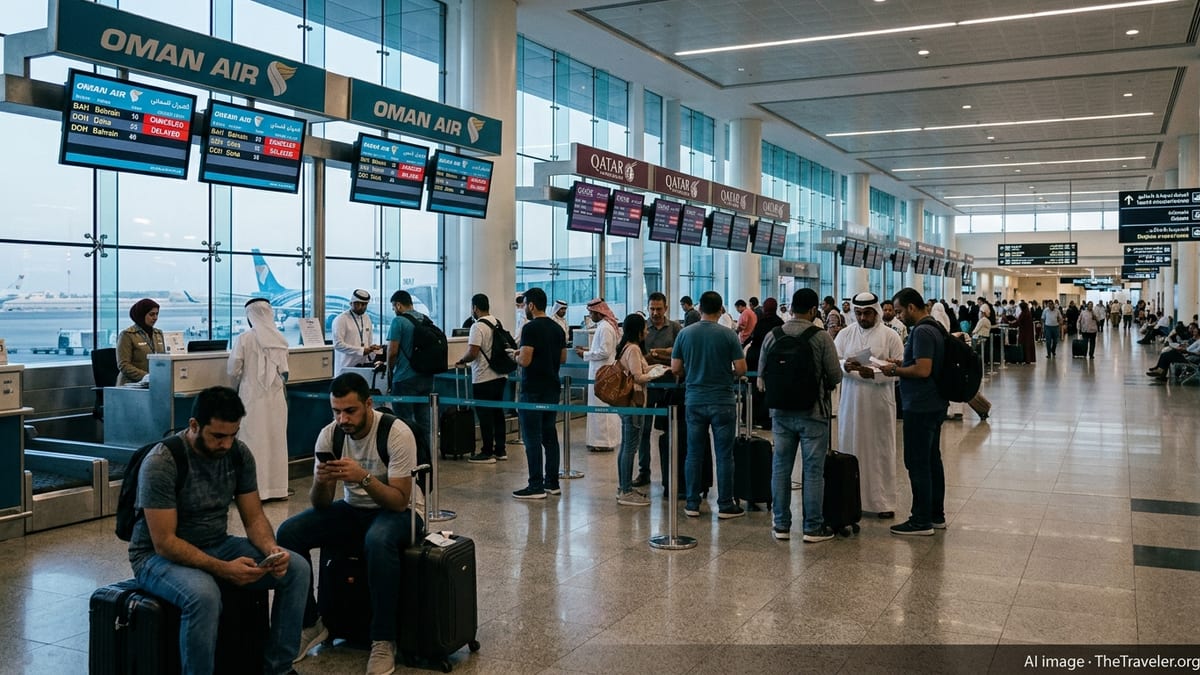
Fresh Cancellations Hit Seeb International Airport
Recent operational updates indicate that three additional departures from Seeb International Airport in Muscat to Bahrain and Doha were withdrawn from schedules, affecting flights operated by Oman Air and codeshare services linked to Qatar Airways. The cancellations come on top of earlier cuts across Middle East networks, as airlines continue to adjust to a volatile security and airspace environment.
Publicly available flight-tracking data and airport information show that services on key short-haul routes to Bahrain International Airport and Doha’s Hamad International Airport have seen repeated last-minute changes since late February 2026. The latest round of cancellations has added to queues at airline service desks in Muscat, with passengers reporting unplanned overnight stays and missed onward connections.
While individual flight numbers and timings have varied by day, the impact has been most visible on peak business and transit waves, when Muscat typically feeds regional hubs in Bahrain and Doha. These routes are widely used by travelers connecting onward to Europe, Asia, and North America, magnifying the disruption beyond point-to-point traffic between the Gulf states.
Airline statements and travel advisories reviewed by TheTraveler.org emphasize that affected customers are being offered rebooking options where seats are available, though capacity constraints and rerouting around affected airspace have limited flexibility on some days.
Regional Airspace Turmoil Drives Operational Strain
The latest cancellations from Muscat are unfolding against a broader backdrop of airspace restrictions and heightened security concerns across parts of the Middle East. Analysis of regional reports shows that since late February 2026, several Gulf and neighboring countries have faced intermittent closures or tight controls on overflight, leading to widespread rerouting and schedule reductions on international services.
Coverage of recent Iranian missile and drone activity across multiple Arab states indicates that civil aviation authorities have repeatedly adjusted flight corridors to protect commercial traffic. Some airports, including Doha’s Hamad International Airport and hubs in Bahrain, have operated with limited capacity or temporary suspensions for certain arrivals and departures during peak alert periods.
These constraints have forced carriers such as Oman Air and Qatar Airways to reassess the viability of short regional legs that rely on stable airspace access and predictable turnaround times. Industry analysis suggests that even brief closures or route changes can quickly cascade into missed rotations, crew timing conflicts, and aircraft positioning challenges, particularly on tightly scheduled narrow-body fleets.
Travel-sector briefings from consultancies and logistics firms further highlight how knock-on effects extend beyond the Gulf, with long-haul flights being retimed, consolidated, or rerouted to avoid sensitive areas. For Muscat-origin passengers, this environment has translated into a higher risk of late-notice cancellations or substantial delays, especially on routes feeding into Bahrain and Doha.
Impact on Passengers in Oman and Beyond
The immediate consequence for passengers departing from Oman has been increased uncertainty around departure times and connection reliability. Travelers with itineraries linking Muscat to Bahrain or Doha before continuing to Europe, Asia, or the Americas have been particularly exposed to disruption, as a cancelled regional leg can invalidate entire through-tickets.
Reports shared by affected passengers through public forums describe long waits at Seeb International Airport, with some travelers receiving cancellation notices only after completing check-in formalities. Others have noted that rebooking options often involve extended layovers in alternative hubs or overnight stays in Muscat as airlines work within revised operating windows and reduced capacity.
Travel agents active in the Gulf market indicate that corporate customers are beginning to adjust their planning by building in longer connection buffers or favoring routings that avoid multiple short intra-Gulf segments. Some leisure travelers, meanwhile, appear to be postponing non-essential trips or opting for point-to-point services that bypass Bahrain and Doha altogether when feasible.
For residents and expatriates in Oman who regularly commute to Bahrain or Qatar for work, the reduced reliability on these short-haul links has added complexity to weekly travel patterns. According to publicly available booking and schedule data, some have shifted to less convenient departure times or alternative carriers in search of more stable operations.
Oman Air and Qatar Airways Adjust Networks
The cancellations at Seeb International Airport also intersect with broader network and fleet adjustments underway at Oman Air and Qatar Airways. Oman Air has been pursuing a restructuring program that includes capacity optimization and route rationalization, measures that can make short regional sectors particularly sensitive to any external operational shock.
Industry coverage of Oman Air’s recent strategy points to a focus on improving financial performance and aligning capacity with demand, including earlier decisions to retire widebody aircraft and trim underperforming routes. In a climate of regional security uncertainty, such a leaner network may have less slack available to absorb prolonged airspace disruptions or airport capacity constraints.
Qatar Airways, for its part, has been managing a complex environment centered on restrictions affecting Doha and the surrounding region. Published analyses from aviation observers indicate that the carrier has at times suspended or limited services on certain routes while maintaining a reduced schedule on others, depending on evolving guidance from aviation regulators and air navigation authorities.
Codeshare and interline arrangements between Oman Air and Qatar Airways mean that operational decisions by one carrier can directly affect passengers ticketed on the other, especially on Muscat–Doha and Muscat–Bahrain itineraries. As a result, travelers may encounter cancellations or rebookings issued under one airline’s code even when the operating aircraft belongs to a partner.
Guidance for Affected Travelers
Travel industry advisories consistently recommend that passengers flying from Muscat to Bahrain or Doha monitor their bookings closely in the days and hours before departure. In the current environment, schedules published far in advance are more likely than usual to be adjusted as airlines respond to evolving airspace and security developments.
Public guidance from airlines and airport operators stresses the importance of checking real-time flight status through official channels and enabling notifications where available. Travelers are also encouraged to verify the status of onward connections, since a change to the initial Muscat departure can cascade across an entire multi-leg itinerary.
Experts in consumer travel rights note that eligibility for refunds, rebooking at no extra cost, or accommodation support varies based on the ticket type, operating carrier, and applicable regulations. Passengers whose journeys originate or terminate in jurisdictions with strong air passenger protection frameworks may have additional remedies, while those traveling entirely within the region are more dependent on individual airline policies.
With regional airspace conditions still fluid as of late March 2026, publicly available assessments suggest that occasional last-minute cancellations on intra-Gulf routes remain possible. Travelers using Seeb International Airport are therefore advised to allow extra time, maintain flexible plans where they can, and stay alert to updates affecting services to Bahrain, Doha, and other nearby hubs.